


This article was automatically translated from the original Turkish version.
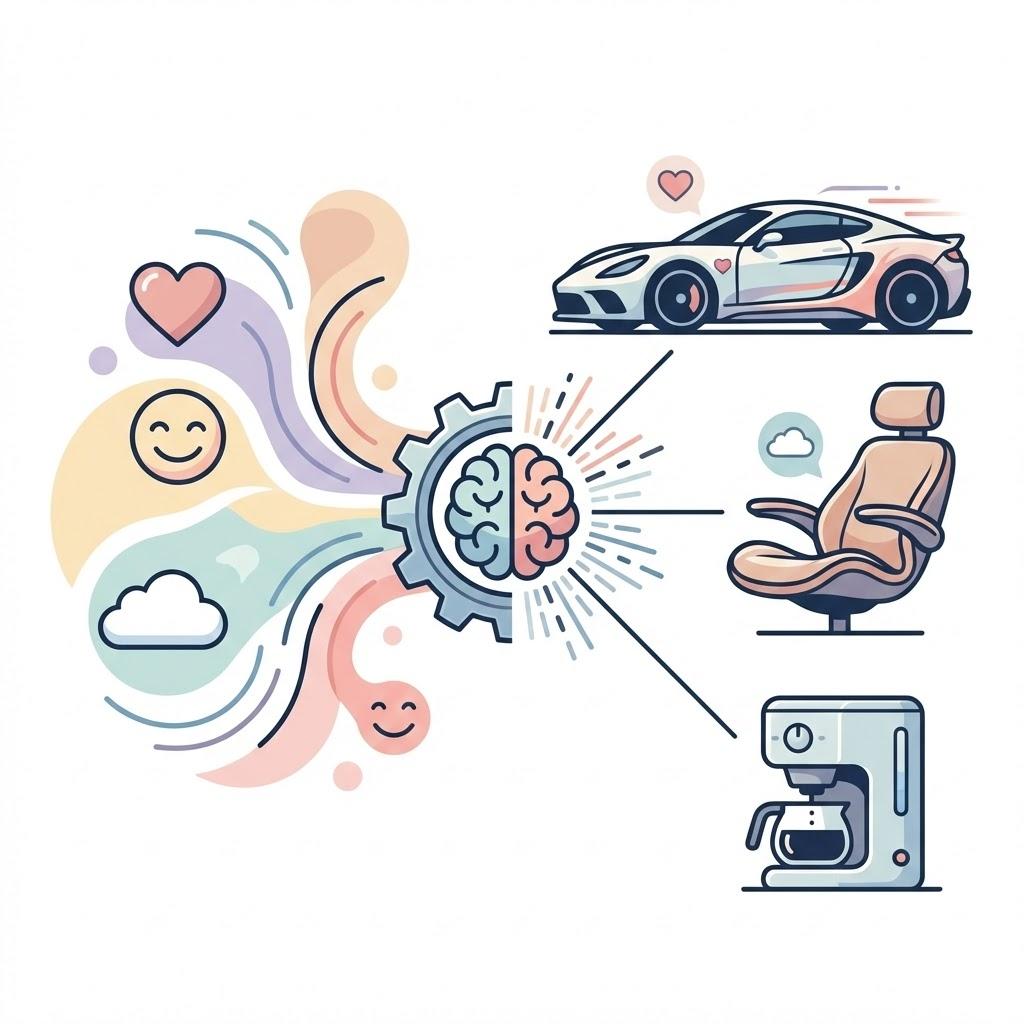
(Generated by Artificial Intelligence.)
Kansei Engineering
Founder(s) | Mitsuo Nagamachi | ||||||||
|---|---|---|---|---|---|---|---|---|---|
Application Area(s) | Architecture Web White Goods Automotive | ||||||||
Example | Mazda Miata (MX-5) | ||||||||
Related Model | Kano Model | ||||||||
Kansei Engineering is a consumer-centered product development technology that transforms consumers’ emotional feelings, perceptions, and impressions (Kansei) into quantitative data and links this data to product design parameters. While traditional engineering approaches typically focus on a product’s functionality, durability, and cost, Kansei Engineering places the user’s psychological and emotional expectations at the center of the design process. This method translates the abstract concept of “emotion” into concrete design elements—such as color, shape, and texture—to create products that evoke desired feelings in users.
Kansei Engineering was developed in the 1970s at Hiroshima University in Japan by Professor Dr. Mitsuo Nagamachi with the aim of making Japanese products more competitive and emotionally resonant in the global market. The term “Kansei” is of Japanese origin and refers to the psychological emotion, imagery, and aesthetic perception evoked by an object. In Japanese culture, Kansei is defined as the initial impression and intuitive response generated in the mind by stimuli from the five senses. The philosophical roots of this concept extend back to the 18th century and the work “Aesthetica” (1750) by German philosopher Alexander Gottlieb Baumgarten, who studied aesthetic perception.
Initially called “Emotional Technology” or “Emotional Ergonomics,” the approach gained global recognition primarily through Mazda’s application of it in automobile design. Particularly, the “Jinba Ittai” philosophy—meaning “horse and rider as one”—applied during the design of the Mazda MX-5 Miata became a concrete example of Kansei Engineering; hardware choices that maximized the driver’s emotional connection to the vehicle played a significant role in its sales figures and market share. Following this success, the method was adopted by researchers and industrial organizations in Europe and America from the 1990s onward, becoming a global design methodology.
The Kansei Engineering process follows a systematic workflow that transforms abstract user emotions into concrete product attributes. The process begins with area selection, defining the product category and target audience. Next, Kansei words—such as “sporty,” “elegant,” or “reliable”—that describe the product are collected through magazines, expert opinions, and literature reviews. These words are then filtered using statistical methods such as factor analysis to identify the adjectives that best represent the product. Simultaneously, physical parameters such as dimensions, color, material, and form that constitute the design are defined. In the synthesis and analysis phase, advanced statistical and mathematical methods—including Quantification Theory Type I, regression analysis, genetic algorithms, and artificial neural networks—are used to establish relationships between Kansei words and design features. The developed concept is validated by testing prototypes or simulations to confirm whether they generate the intended emotional response.

Design Concept (Generated by Artificial Intelligence)
It is important to note that emotional design is only one phase of the product development process. A decision based solely on user feelings and sensory design cannot directly lead to production. In most cases, sensory design is applied during concept definition or final refinement stages. After an ideal emotional profile is established, manufacturing feasibility, material constraints, engineering tolerances, and cost calculations come into play. The final design emerges as an optimal synthesis of the user’s emotional expectations and the industry’s economic and technical realities.
Depending on the application method, tools used, and complexity of the problem, Kansei Engineering is divided into distinct systems. The first type, Category Classification (Type I), is based on the principle of hierarchically breaking down a product concept into subcategories and mapping them to design features. In this method, a hierarchy is followed from a general concept down to the finest physical details of the product.
The most widely used system, Computer-Aided System (Type II), operates by having users input desired feelings such as “modern” or “classic.” The system then retrieves corresponding design features from databases and suggests them to the designer. Depending on the nature of the product and system setup, the Kansei database may consist of one or more of the following: Appearance Database, Information Database, or Design Database. The third type, Mathematical Modeling (Type III), analyzes the relationships between product features and emotional responses using more complex mathematical formulas. Although logically similar to the computer-aided system, it requires significantly more advanced statistical inference. Finally, Hybrid Kansei Engineering combines bidirectional systems: when a user selects a design detail, the software predicts the emotion it evokes; conversely, when a user inputs an emotion, the system recommends a suitable physical design feature.
When reviewing academic and industrial research on Kansei Engineering in Türkiye, it is evident that the method is applied across a broad spectrum. For instance, in the automotive sector, comprehensive ergonomic studies on driver seat design have analyzed configurations that best convey feelings of “safety,” “comfort,” and “aesthetics.” These studies found that leather material, cream-colored finishes, and adjustable headrests positively influenced Turkish users’ perceptions.

Design Concept (Generated by Artificial Intelligence)
One study applying the method to culturally specific Turkish objects focused on the industrial design of the slender-waisted tea glass. These studies revealed mathematical relationships between geometric parameters such as waist thickness, base width, and volume, and the emotions of “tradition,” “warmth,” and “aesthetics” evoked in users. In the field of information technology and web design, the relationship between e-commerce websites’ color palettes and interface layouts and the feelings of “professionalism” and “trust” they generate has been examined using methods such as Cause-Effect Chain Analysis.
Architecture and interior fittings have also been studied, including bathroom furniture, kitchen faucets, and ceramic claddings. In these designs, forms that trigger users’ perceptions of “spaciousness,” “hygiene,” or “luxury” have been optimized. Furthermore, within the context of inclusive design, accessibility features have been addressed using this method; portable ramp designs for people with disabilities integrate not only mandatory physical standards but also psychological expectations that convey a sense of safety and confidence to users.
Kansei Engineering is frequently integrated with the Kano Model in product development processes. The Kano Model classifies customer needs into three quality categories: “basic” (must-be), “performance” (linear), and “excitement” (attractive). Kansei Engineering is particularly effective in uncovering “excitement” qualities—features that users cannot explicitly articulate but respond to with high satisfaction upon encountering them. While traditional research methods and the Kano Model focus on the question of “what” (which features should be included in the product), Kansei Engineering answers the question of “how” (what emotion should these features evoke and how should they be designed?) to refine the design process.
Arslan Gürdal, Halime. "Kansei Mühendisliği ve Bir Uygulama." ResearchGate. Accessed February 9, 2026. https://www.researchgate.net/publication/364361770_Kansei_Muhendisligi_ve_Bir_Uygulama
Baz, Fatih Çağatay, and Oğuzhan Cinkara. "Kansei Mühendisliği ve Kano Modeli ile Türkiye'de Yapılan Çalışmaların Çeşitli Değişkenler Açısından Değerlendirilmesi." *Çukurova II. Uluslararası Multidisipliner Çalışmalar Kongresi*, 2019. Accessed February 9, 2026. Accessed Adresi
Erol, Ayşe, and Leblebici Başar, Deniz. "İnce Belli Çay Bardağının Kansei Mühendisliği Yöntemi ile Duygusal Tasarım Analizi." *UTAK Ulusal Tasarım Araştırmaları Konferansı*, 2022. Accessed February 9, 2026. https://open.metu.edu.tr/handle/11511/98723
Fığlalı, Nilgün, Alpaslan Fığlalı, and Elçin Uzundurugan. "Kansei Mühendisliği ve Uygulamaları." *Doğuş Üniversitesi Dergisi* 3, no. 1 (2002): 85–96. Accessed February 9, 2026. https://dergipark.org.tr/tr/pub/doujournal/article/1042811
Fığlalı, Nilgün; Fığlalı, Alpaslan; Uzundurugan, Elçin. “Kansei Mühendisliği ve Uygulamaları.” *Doğuş Üniversitesi Dergisi*, no. 5 (2002): 85–96. Accessed February 9, 2026. https://polen.itu.edu.tr/entities/publication/a5490e76-644c-462f-8d9f-f7b81d10156e
Gündüz, Berkay. "E-Commerce Web Application in Fashion Industry: Kansei Engineering Approach With Means-End Chain Analysis." Master's thesis, İzmirYüksek Lisans Enstitüsü, 2025. Accessed February 9, 2026. https://gcris.iyte.edu.tr/entities/publication/c09deaa6-518c-4150-a2fc-c18f6b2fbff9
Öztürk, Mustafa Umut. "Kansei Mühendislik Modeli ile Otomobil Sürücü Koltuğunun Tasarımı." PhD thesis, Bursa Uludağ Üniversitesi, 2022. Accessed February 9, 2026. https://acikerisim.uludag.edu.tr/entities/publication/b506e2e2-ea9e-46dd-82f8-4b17f76ac56f

(Generated by Artificial Intelligence.)
Kansei Engineering
Founder(s) | Mitsuo Nagamachi | ||||||||
|---|---|---|---|---|---|---|---|---|---|
Application Area(s) | Architecture Web White Goods Automotive | ||||||||
Example | Mazda Miata (MX-5) | ||||||||
Related Model | Kano Model | ||||||||
Historical Development and Origins
Method and Implementation Process
Types of Kansei Engineering
Research and Industrial Applications in Türkiye
Integration with the Kano Model