

This article was automatically translated from the original Turkish version.
+2 More
Type(s) | Ancient sea port | ||||||||
|---|---|---|---|---|---|---|---|---|---|
Period(s) | Ancient Period (associated with the coastal settlements of the Bithynia region) | ||||||||
Location | on the southern coast of the Sea of Marmara Bursa province Mudanya district | ||||||||
Main Structures | Western and eastern breakwaters, mooring stone, stone pile pier system | ||||||||
Basic Feature | A sheltered port structure located within a natural bay and constructed with breakwaters | ||||||||
Kapanca Ancient Harbour is an ancient harbour site located on the southern coast of the Sea of Marmara in northwestern Türkiye, within the boundaries of the Mudanya district of Bursa Province. Situated along the coastal strip between the settlement of Trilye (Zeytinbağı) and Mudanya, the harbour was constructed within a natural bay and served as a significant maritime node in antiquity for sea transport and coastal settlements. The artificial breakwater-formed harbour basin, when considered alongside the regional coastal morphology, provides archaeological evidence of the ancient seafaring infrastructure along the southern coast of the Sea of Marmara.

Kapanca Ancient Harbour (Mudanya Municipality)
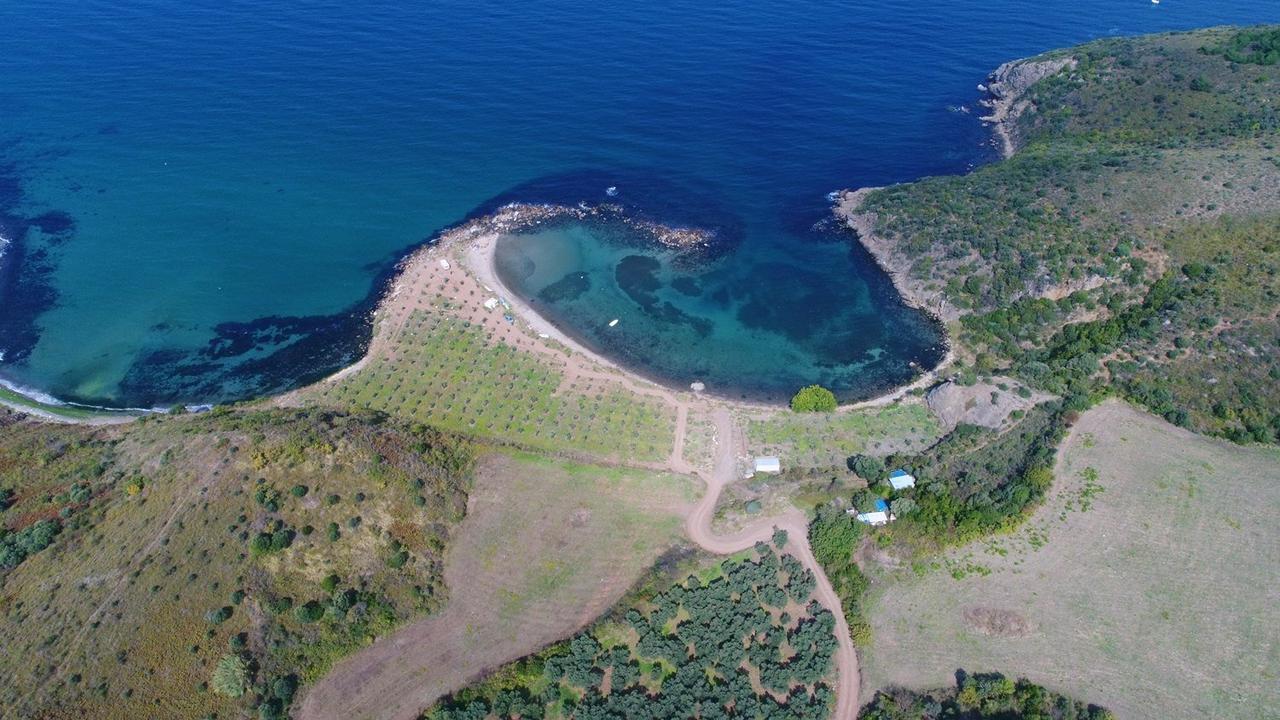
Kapanca Ancient Harbour is situated on the coastal section between the Mudanya district of Bursa Province and the settlement of Trilye on the southern coast of the Sea of Marmara. The harbour is located within a bay附属 to Trilye and is built on a natural indentation surrounded by high hills. This topographical configuration created a natural shelter that effectively protected the harbour from prevailing winds. The surrounding hills reduced wind and wave action, creating a favourable environment for the safe anchorage of small and medium-sized vessels.
The bay in which the harbour is located is enclosed on three sides by elevated terrain, transforming it into a natural refuge against the wind and wave movements of the Sea of Marmara. This natural protection was a decisive factor in the selection of the site during antiquity.
The coastal section where Kapanca Harbour is located exhibits a morphology characteristic of the southern shores of the Sea of Marmara, defined by natural bays. This morphology provided an ideal setting for the formation of small harbours and maritime access points in antiquity. The surrounding elevations and the bay’s shape contributed to shielding the harbour from winds coming from the west and north.

Kapanca Ancient Harbour (Mudanya Municipality)
Kapanca Ancient Harbour is an ancient harbour structure located on the southern coast of the Sea of Marmara, featuring a harbour basin shaped by artificial breakwaters. Built within a natural bay, the harbour was rendered a secure maritime facility through the combination of natural coastal protection and human-engineered breakwater systems.
The most prominent architectural elements of Kapanca Harbour are its breakwaters. The harbour basin was formed by two breakwaters, one on the western side and the other on the eastern side. The artificial breakwater system located at the centre of the bay divides it into two sections, with the eastern portion designated as the harbour area. This arrangement effectively shielded the harbour basin from wave action.
The western breakwater is the longest structural element of the harbour and exhibits a concave form. It extends approximately 240 metres into the sea. Although the full width of the structure cannot be measured today due to erosion, the measurable portion is estimated to be about 10 metres wide. The western breakwater functions as the primary protective structure of the harbour.
The eastern breakwater is positioned directly opposite the seaward end of the western breakwater. Measuring approximately 15 metres in length and 10 metres in width, it serves as the second breakwater defining the entrance to the harbour. When considered together, the two breakwaters create an entrance opening approximately 35 metres wide. This configuration provided protection against waves and wind while enabling safe access and egress for vessels.
When viewed from above, the overall plan of Kapanca Harbour resembles the shape of the Greek letter omega (Ω). This layout indicates a semi-enclosed harbour basin formed by the positioning of the breakwaters. This design reduced the impact of incoming waves and winds, creating a calmer water surface within the harbour.
Thanks to this planned configuration, the harbour basin is protected from winds originating from the west, northwest, north and northeast directions.
The construction technique used at Kapanca Harbour is based on the irregular stacking of large, unshaped and unworked stones. This method was commonly employed in antiquity for the building of breakwaters and quays. The irregular layering of stones helped dissipate wave energy and contributed to the protection of the harbour basin.
A mooring stone has been identified at the seaward end of the western breakwater. This rectangular stone measures approximately 235 × 120 × 63 cm and is made of marble. The stone is no longer in its original position.

Kapanca Ancient Harbour (Mudanya District Governorship)
Kapanca Ancient Harbour is assessed as part of the coastal and maritime network of ancient settlements along the southern coast of the Sea of Marmara. This coastal section, located within the region of Bithynia, held significant importance for maritime transport and trade throughout antiquity. As one of the smaller harbour structures along this shoreline, Kapanca Harbour formed a functional connection with nearby settlements.
Archaeological investigations conducted at Kapanca Harbour and its surroundings have contributed to a better understanding of its structural characteristics and coastal usage. Surface surveys have identified breakwaters, stone alignments and architectural remains. These findings demonstrate that the harbour was deliberately planned and constructed using advanced engineering knowledge in antiquity.
Today, the bay where the harbour is located retains its natural features, but changes along the coastline have led to partial destruction of some structural elements. Nevertheless, the remains of the breakwaters and other architectural traces continue to provide valuable information about the harbour’s layout and operation.
Gündüz, Serkan. "Bursa’nın Antik Deniz Limanları." *U.U. International Journal of Social Inquiry / U.Ü. Sosyal Bilimler Enstitüsü Dergisi* 8, no. 1 (2015): 105–146. Accessed March 14, 2026. https://www.academia.edu/34957823/BURSANIN_ANT%C4%B0K_DEN%C4%B0Z_L%C4%B0MANLARI
Mudanya Belediyesi. "Kapanca Antik Limanı Foto Galeri." Accessed March 14, 2026. https://mudanya.bel.tr/en/foto-galeri/kapanca-antik-limani
Mudanya Belediyesi. “Kapanca Antik Limanı.” Accessed March 14, 2026. https://mudanya.bel.tr/yerler/tarihi-yapilar/kapanca-antik-limani
Mudanya Belediyesi. “Mudanya’nın Huzur Limanı Kapanca.” Accessed March 14, 2026. https://mudanya.bel.tr/arsiv/mudanya-nin-huzur-limani-kapanca
Mudanya Kaymakamlığı. “Kapanca Limanı.” Accessed March 14, 2026. https://www.mudanya.gov.tr/kapanca-limani
Şahin, Mustafa, Yasemin Polat, and Thomas Zimmermann. “Der Hafen von Kapanca: Ein Neuer Vorschlag zur Lokalisation der Stadt Caesarea Germanica.” Olba 19 (2011). Mersin: Mersin Üniversitesi Kilikia Arkeolojisini Araştırma Merkezi. https://dergipark.org.tr/en/download/article-file/765871


Type(s) | Ancient sea port | ||||||||
|---|---|---|---|---|---|---|---|---|---|
Period(s) | Ancient Period (associated with the coastal settlements of the Bithynia region) | ||||||||
Location | on the southern coast of the Sea of Marmara Bursa province Mudanya district | ||||||||
Main Structures | Western and eastern breakwaters, mooring stone, stone pile pier system | ||||||||
Basic Feature | A sheltered port structure located within a natural bay and constructed with breakwaters | ||||||||
No Discussion Added Yet
Start discussion for "Kapanca Ancient Harbor" article
Location and Geographical Features
Architectural and Structural Features of the Harbour
Breakwaters
Harbour Plan
Construction Technique and Harbour Elements
Historical Background and Relationship with Ancient Cities
Archaeological Research and the Present State of Kapanca Harbour