


This article was automatically translated from the original Turkish version.
+1 More
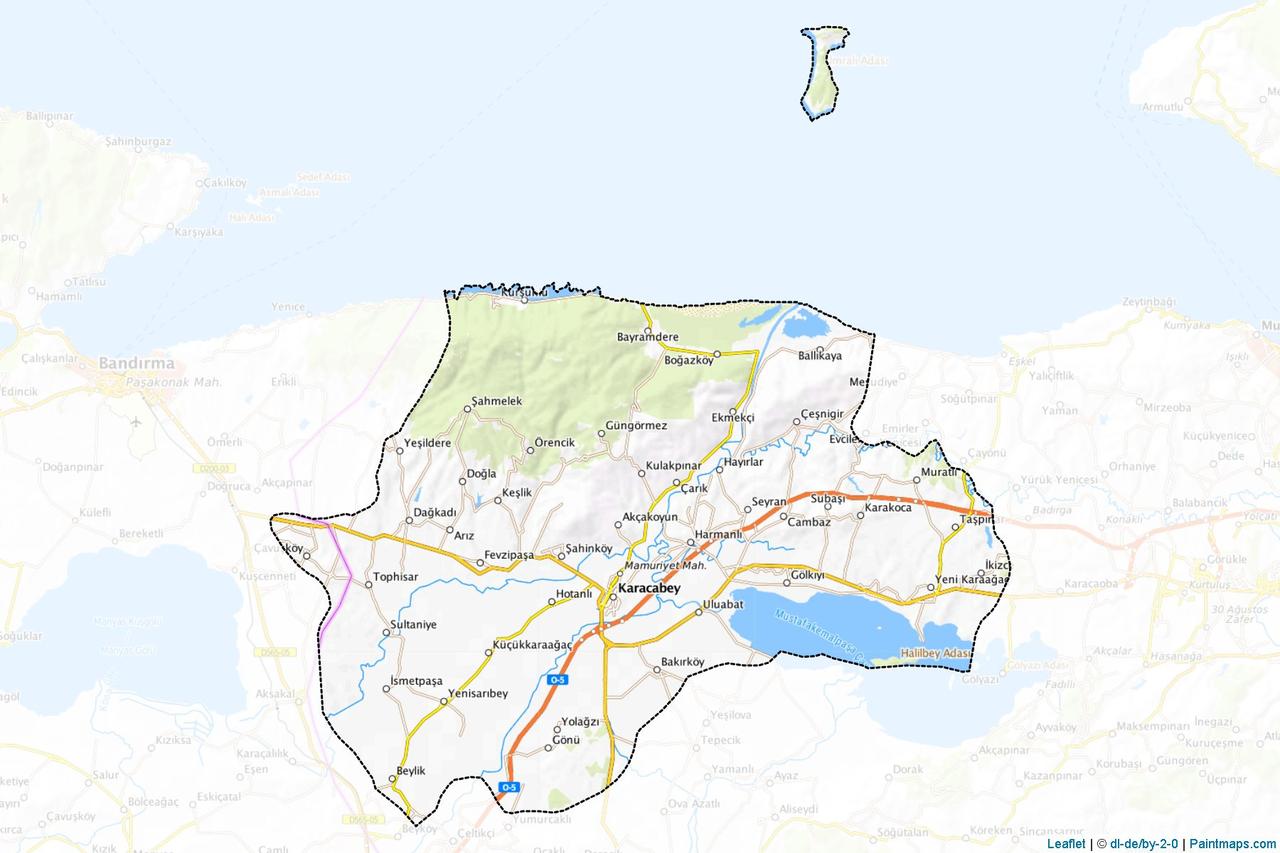
Karacabey (District)
Karacabey (District)
Location | Bursa Türkiye | ||||||||
|---|---|---|---|---|---|---|---|---|---|
Coordinate(s) | 40th parallel north (25 km north) 28th meridian east (20 km east) | ||||||||
Area(s) | 1 247 km² | ||||||||
Neighbors | Mudanya, Bursa (east), Mustafakemalpaşa, Susurluk (south), Manyas (southwest), Bandırma (west), Sea of Marmara (north) | ||||||||
District Governor | Hakan Kafkas | ||||||||
Mayor(s) | Ali Özkan | ||||||||
Population | 85,968 | ||||||||
Karacabey, is a district of Bursa Province in Türkiye. It is located 25 kilometers north of the 40th parallel north and 20 kilometers east of the 28th meridian east. The district covers an area of 1,247 km². It is bordered by Mudanya and Bursa to the east, Mustafakemalpaşa and Susurluk to the south, Manyas to the southwest, the district of Bandırma in Balıkesir to the west, and the Sea of Marmara to the north. Its position at the intersection of the Bursa-Çanakkale, Bursa-Balıkesir, and İzmir highways enhances its strategic and economic significance.
The history of Karacabey dates back to the 12th century BCE, when the Mysians migrated to the region. During this period, a city named Miletopolis existed within the boundaries of present-day Karacabey. It is known that the Ethnics, believed to have originated from Central Asia approximately 4,000 years ago, settled in the area. Following them, the Mysians, Phrygians, Lydians, Persians, Alexander the Great, the Kingdom of Pergamon, and the Romans successively established dominance in the region. During these periods, Karacabey was known as Mihaliç.
In 560 BCE, the Lydians gained control of the region, followed by the Persian king Cyrus II. The Kingdom of Bithynia reached its peak during the reign of King Prusias I. During the Roman Empire, the territories of Bithynia were annexed to Rome through the will of Nicomedes IV, and Karacabey came under Roman rule.
During the Ottoman period, Karacabey joined the Ottoman Beylik in 1336 after the local lords of Kirmasti and Mihaliç pledged allegiance to Orhan Gazi, and it enjoyed approximately six centuries of peace. However, following World War I, it was occupied by Greek forces on July 2–3, 1920, during which extensive destruction and atrocities occurred. On September 6–7, 1922, as Greek troops began to withdraw, retaliatory units burned the district center and numerous villages. Among the Bursa districts, Karacabey suffered the greatest damage: 7,158 houses, 14 mosques, and 8 caravanserais were reduced to ashes. Karacabey was liberated from occupation on September 14, 1922, when the Turkish army entered the district.
After the fires, reconstruction began in Karacabey; fire victims were relocated to Kirmasti, and the damaged Uluabat and Canbalı bridges were repaired. In 1929, an aircraft purchased through public donations by the people of Karacabey and named “Karacabey” was delivered to the Turkish military.
Karacabey lies in the southern part of the Marmara Region on a sedimentary deposit with an average elevation of 24 meters. The Karacabey Plain was formed by subsidence during the fourth geological era. To the east lie Lake Uluabat and to the west Lake Manyas (Bird Lake), both situated within this subsidence zone. The district is separated from the Bursa Plain by the Görükle Ridge and from the Mustafakemalpaşa Plain by the Hara Ridge, and it connects to the Susurluk and Manyas plains in the west.
Mount Karadağ, the highest point in the district, reaches 764 meters at Sarnıç Hill and is separated from the Mudanya hills by a narrow gorge carved by the Susurluk River. The coastal strip of Karadağ features prominent cliffs; between Malkara and Kurşunlu, small crescent-shaped bays are found. East of Yeniköy lies a deltaic plain formed by the Kocadere River, along with the Arap Çiftliği and Dalyan Lagoon Lakes.
Major rivers include the Susurluk River (Kocadere), 321 km long; the Nilüfer Stream; the Karadere, 160 km long; and the Kemalpaşa Creek and Orhaneli Stream, which flow into Lake Uluabat. Lake Uluabat (Apolyont), with a surface area of 134 km², is the most important lake in the district, but fish and crayfish populations have declined due to overfishing and pollution. Reservoirs such as Keşlik, Dağkadı, Bayramdere, and İnkaya have been constructed for agricultural irrigation.
Underground water resources are limited. Marble known as “Karacabey Siyahı” is quarried in Seyran Village, while talc is extracted in Şahmelek and Kurşunlu.
Karacabey’s climate exhibits transitional characteristics between Mediterranean and Black Sea climates. Summers are less dry and hot than in the Mediterranean, while winters are mild and rainy. The annual average temperature is 14°C, with a recorded maximum of 38.5°C (August) and a minimum of -9.7°C (February). Annual precipitation totals 562 mm, with 77 rainy days and 3.3 snowy days per year. Prevailing winds blow from the northeast (poyraz) and the southwest (lodos).
The vegetation reflects the general characteristics of the Marmara Region. Near the northern coastal areas, Mediterranean flora and moisture-loving oak forests are found; land suitable for olive and citrus cultivation is available. On the higher elevations of Karadağ, hardy stands of linden and hornbeam trees thrive. Mediterranean species such as davulga, laurel, broom, cornel, and stone oak are widespread. In rural “Pistikoz slopes,” only the karaca tree is found.
As of 2021, Karacabey has a population of 84,241, with 50% female and 50% male. Analysis of the population pyramid shows the highest concentrations in the 40–44 age group (7.43%), followed by the 35–39 age group (6.98%) and the 5–9 age group (6.89%), indicating a significant proportion of young and working-age population.
In terms of education, the number of students and schools in preschool, primary, and secondary education remains stable. In 2020, the student-to-classroom ratio was 15.27 in primary education and 22.23 in secondary education. The literacy rate stands at 96.8%, above the provincial average. At the Karacabey Vocational School of Uludağ University, 1,187 students are enrolled across 12 departments.
Health services are provided by the Karacabey State Hospital, with a capacity of 158 beds. This equates to 1.87 beds and 0.17 intensive care beds per 1,000 people. Residents often seek healthcare in Bursa, Mustafakemalpaşa, or Istanbul.
According to the Ministry of Industry and Technology’s Socioeconomic Development Ranking, Karacabey ranks 208th nationally and 8th within Bursa, with a score of 0.56, placing it in the second tier.
Karacabey’s economy is based on agriculture, industry, trade, transportation, and services, with agriculture and livestock farming dominating. In the Karacabey Plain, maize, tomato for paste, potatoes, and onions are the main crops; vegetable and fruit cultivation have also developed. Livestock farming includes cattle, sheep, and horse breeding. Türkiye’s finest racehorses are raised at the Karacabey Stud Farm. The district is famous for Mihaliç cheese, and economic activity is supported by brands such as Sütaş and factories producing tomato paste and flour.
In 2020, 75% of insured workers were under the 4A (SGK) scheme, 18% under the 4B (BAĞ-KUR) scheme, and 7% under the 4C (Public Sector) scheme. Among 4A workers, food manufacturing (19%) and metal product manufacturing (11%) were most prominent; among 4B workers, mixed farming (27%) and field agriculture (11%) stood out. Completion of the Istanbul-Izmir motorway has enhanced the district’s transportation advantages, reducing travel time to Istanbul to 2.5 hours.
Karacabey is rich in natural, coastal, and rural tourism. Major attractions include the Karacabey Strait, Issız Han, Ulubatlı Hasan Türbesi, Dayı Karacabey Dede Türbesi, Yeniköy, Kurşunlu Beach, Longoz Forests, Eskikaraağaç Village, Karacabey Camii, Karacabey Harası, Kuş Cenneti (Bird Paradise), and the Ova Korusu Bear Sanctuary.
Intangible cultural heritage elements include weaving, Hıdırellez, rain prayers, and the culture of olive and olive oil production.
As of 2021, there were no licensed tourism accommodation facilities, but six municipally licensed facilities existed. The average occupancy rate was 61.66%, with an average stay duration of 1.69 days.
Karacabey’s population in 2025 is projected to be 85,968, with equal gender distribution. The concentration of young and working-age population supports the district’s economic potential. Of its 83 neighborhoods, the oldest settlements are Mamuriyet, Selimiye, Hamidiye, Garipçe, and Hüdavendihar, established by Balkan migrants in the 19th century.
Karacabey’s main historical monuments include the Ulu Camii built by Sultan I. Murat, the Karacabey Camii (İmaret Camii) constructed by Karaca Bey in 1457, the Kümbetle Camii, and Issız Han on the shore of Lake Uluabat. These structures, built during the Ottoman period, reflect the district’s cultural heritage.
Bursa Valiliği. “Karacabey.” Accessed April 20, 2025. http://www.bursa.gov.tr/karacabey.
Kalkınma Kütüphanesi. "Karacabey İlçe Raporu." Accessed April 20, 2025.
Karacabey Belediyesi. "Karacabey’s Geographic Information." Karacabey Municipality. Accessed April 20, 2025. https://karacabey.bel.tr/sayfalar/karacabeyin-cografi-bilgileri.
Karacabey Belediyesi. "Karacabey’s Name and History." Karacabey Municipality. Accessed April 20, 2025. https://karacabey.bel.tr/sayfalar/karacabeyin-adi-ve-tarihcesi.
Karacabey (District)
Karacabey (District)
Location | Bursa Türkiye | ||||||||
|---|---|---|---|---|---|---|---|---|---|
Coordinate(s) | 40th parallel north (25 km north) 28th meridian east (20 km east) | ||||||||
Area(s) | 1 247 km² | ||||||||
Neighbors | Mudanya, Bursa (east), Mustafakemalpaşa, Susurluk (south), Manyas (southwest), Bandırma (west), Sea of Marmara (north) | ||||||||
District Governor | Hakan Kafkas | ||||||||
Mayor(s) | Ali Özkan | ||||||||
Population | 85,968 | ||||||||
No Discussion Added Yet
Start discussion for "Karacabey (District)" article
History
Geographical Structure
Climate and Vegetation
Social Structure
Economic Structure
Tourism Potential
Demographic Structure
Important Historical Sites