


This article was automatically translated from the original Turkish version.
+2 More
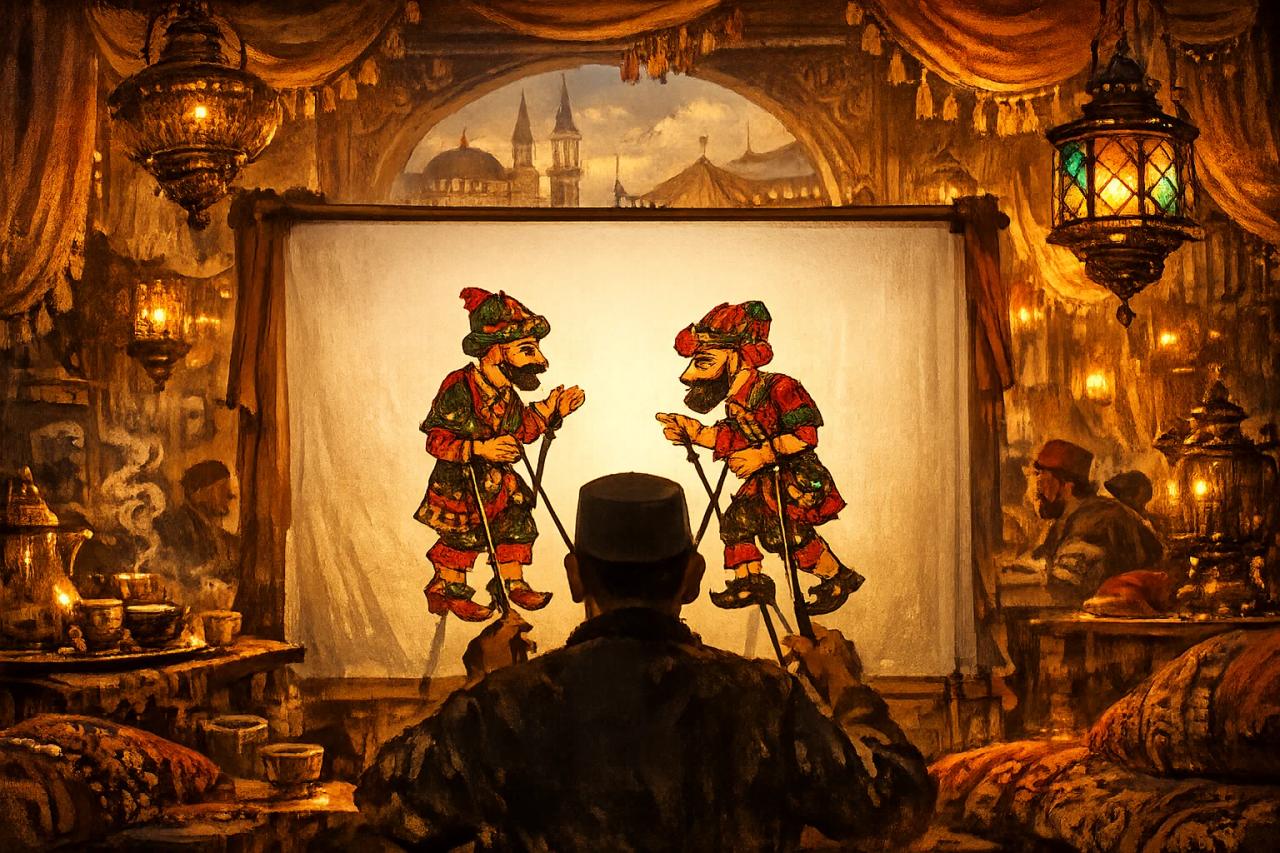
Karagöz and Hacivat (Generated by Artificial Intelligence.)
Structure(s) | Mukaddime – Muhavere – Fasıl – Bitiş | ||||||||
|---|---|---|---|---|---|---|---|---|---|
Type(s) | Shadow Play | ||||||||
Performance Spaces (Historical) | Palace Festivals, Coffeehouses | ||||||||
Text Type (Beginning) | Perde Gazeli | ||||||||
Performer | Hayalî (Dreamer) | ||||||||
Central Types | Karagöz, Hacivat | ||||||||
Basic Elements | Screen, Painting (Leather), Light | ||||||||
Art Discipline | Traditional Turkish Theatre | ||||||||
Karagöz and Hacivat are the two central figures in Turkish shadow play, a performance based on projecting translucent leather figures onto a screen using backlighting. The structure of the play, composed of four parts—introduction, dialogue, main act, and conclusion—along with its oral dialogue system, screen poems, and Sufi conceptual repertoire, represents a continuous tradition of representation from the Ottoman period to the present.
Karagöz and Hacivat (TRT Archive)
The historical origins of Karagöz and Hacivat are established through the name the shadow play adopted within Ottoman cultural contexts, its structural development, performance venues, and early textual traces. In this framework, the term “hayal oyunu” served as the general designation in the early period; from the seventeenth century onward, the term “Karagöz oyunu” gained widespread usage, and the name of the play began to be used interchangeably with the name of its central character. This shift in nomenclature coincided with the emergence of a character-centered mode of representation.

Karagöz and Hacivat (Generated by Artificial Intelligence)
In the early period, hayal oyunu appeared as a stage practice performed during holidays and large-scale entertainment gatherings. Streets and major ceremonies were the primary venues for these performances. Large-scale events such as the circumcision festivities of princes formed part of the performance contexts for hayal oyunu. This early form of performance is associated with a comedic structure based on “crude speech and gestures”; the relationship between the performance and the audience developed through direct oral delivery.
Court festivities represent another dimension of early visibility. Hayal oyunu performances are documented during celebrations held in 1539 for the sons of Kanuni Sultan Süleyman and during the circumcision ceremony of Prince Mehmed, son of Murad III in 1582.【1】 These two dates serve as early evidence that shadow play was not confined to everyday entertainment spaces but also featured in major ceremonial programs centered on the palace.
Among early testimonies, travelogues clearly reveal the technical and performative aspects of the performance. Pietro della Valle describes seeing shadows projected onto a screen from behind, illuminated by light, in Istanbul coffeehouses during Ramadan.【2】 The oral nature of the performance and the performer’s ability to alter his voice to imitate different languages and dialects are prominent features of this testimony. This framework demonstrates that by the early period, the technique of backlighting the screen and the multivoiced performance—including vocal and dialect imitation—had become an established performance practice.
The coffeehouse environment functioned as a public space where performances regularly circulated. Specific time periods such as Ramadan nights marked periods of sustained audience engagement. This continuity enhanced the recognition of the characters and strengthened the play’s reliance on misunderstandings, wordplay, and imitation.

Karagöz and Hacivat During Ramadan (Generated by Artificial Intelligence)
Early written references to the name Karagöz become prominent in Evliya Çelebi’s Seyahatnâme. In the text, the expression “hayâl-i zıll-ı Karagöz” is used as a metaphorical reference to certain artisans and laborers in Istanbul.【3】 This usage indicates that by the seventeenth century, “Karagöz” had transcended its identity as merely the name of a play or character to become a well-established cultural reference with metaphorical power.
Seyahatnâme also includes narratives centered on Karagöz and Hacivat under the title “Hikâye-i Münâsib”.【4】 These narratives reveal an early dimension in which Karagöz and Hacivat were recounted within a “mythic” framework. Thus, the early period is characterized by both observational descriptions of performances and collections of mythic stories.
Evliya Çelebi also includes two examples of screen poems. One is attributed to Muzaffer Çelebi, and another two-line example is recorded. This demonstrates that screen poems were not merely oral texts performed during shows but had also become a documented genre circulating in written culture during the early period.【5】

Karagöz and Hacivat in the Ottoman Era (Generated by Artificial Intelligence)
The arrival of shadow play in Anatolia is not explained through a single narrative line. The question of origins appears along two distinct lines: one posits that the play was brought to Anatolia during migrations; the other traces its transmission to Ottoman territories via Egypt. This multiplicity requires that the issue of origins be addressed not as a single-centered explanation but as a framework encompassing multiple possibilities of transmission and transfer.
Until the end of the sixteenth century, the term “hayal oyunu” served as the general designation for performances. In the seventeenth century, the term “Karagöz oyunu” became widespread, and the name of the play became synonymous with the name of its central character. This process coincided with the expansion of the play’s structure and repertoire.
From the seventeenth century onward, the performance adopted a four-part structure: mukaddime–muhavere–fasıl–bitiş. The number of themed plays increased; new characters and new performance formats emerged. As the variety of characters expanded, the repertoire of figures multiplied and acquired a caricatured appearance. This visual style is associated with a lineage connected to miniature painting and artistic traditions. Thus, the early period is marked not only by a change in nomenclature but also by a clear evolution in dramatic structure (segmentation), narrative framework (increase in themed plays), and visual repertoire (diversification of figures).
Behind the Screen: Karagöz (Generated by Artificial Intelligence)
The Karagöz play consists of four main sections that became prominent during the Ottoman period and gradually solidified into a fixed structure: mukaddime, muhavere, fasıl and bitiş. This segmentation continues to serve as the fundamental framework in both traditional and contemporary performances. The structure forms a system that determines both the dramatic flow and the relational dynamics between the characters.
The mukaddime is the opening section of the play. In this part, the screen is raised and the interpretive framework of the performance is established. Hacivat’s entrance onto the stage and his recitation of the screen poem are defining elements of the mukaddime. The screen poem consists of couplets composed in aruz meter, following the classical gazel form, and carries the tone and conceptual scope of the performance.
In the mukaddime, the screen is not merely a technical surface but is conceptually associated with the notion of a “mirror.”【6】 Concepts such as “hakikat perdesi, hayâl, zıll, tecelli, nûr, zâhir, bâtın” found in the screen poems construct the symbolic foundation of this section. Thus, before the play begins, the audience is presented with both an aesthetic and intellectual framework.
The mukaddime also functions as a threshold that establishes the balance between seriousness and humor. Once this section is completed, the performance transitions into the dialogue-centered muhavere phase.
The muhavere is the section of dialogue between Karagöz and Hacivat. This is the primary arena where the play’s dialogue system is established and the contrast between the characters becomes evident. Hacivat initiates, organizes, and opens the space for response, while Karagöz responds with his characteristic “word-play” style, forming the core dynamic of the muhavere.
The muhavere includes misunderstandings, wordplay, repetition of phrases, and mutual interruptions. This dialogue structure creates the foundation for the play’s comedic framework. The contrast between Karagöz’s impatient and direct manner and Hacivat’s more orderly and rule-bound speech becomes apparent in the flow of conversation.
The muhavere generally serves as a preparatory section that reinforces the presence of the characters on stage and establishes a connection with the audience, prior to the introduction of the main plot.

Karagöz and Hacivat (Generated by Artificial Intelligence)
The fasıl is the section where the main story unfolds. Within a specific thematic framework, the plot develops and additional characters enter the scene. In this section, scenes from daily life, occupational groups, neighborhood relationships, and various social elements are represented through the characters.
Extraordinary beings may also appear in this section. Figures such as Şahmeran, Simurg, Burak, sea maidens, sorcerers, cazus (witches), jinn, zebani, dragons, and monsters are noted to play functional roles in some plays.【7】 These beings sometimes advance the plot and sometimes serve as elements that enhance the visual variety of the stage.
The fasıl reveals the diversification of themed plays, the introduction of new characters, and the expansion of the figure repertoire. This structure allows Karagöz plays to be reimagined around different themes rather than being bound to a single fixed text.
The bitiş is the concluding section of the play. Here, the performance is completed, typically ending with Karagöz’s apology or closing remarks. The bitiş marks the resolution of the onstage conflict and the completion of the play’s framework.
The bitiş establishes a structural balance with the mukaddime at the beginning. The performance, initiated with a symbolic and poetic introduction, concludes with a verbal closure. Thus, the play exhibits a cohesive flow within its four-part structure.
Shadow Play (Generated by Artificial Intelligence)
In Karagöz plays, the concept of “character” refers to stage figures who represent specific behavioral patterns and social positions. At the center of this system are Karagöz and Hacivat. The conflict and dialogue axis of the play’s structure is built upon the contrast between these two characters. Characters emerge on stage as representative patterns defined by prominent and recurring traits rather than individual psychological depth.
Karagöz is the central and namesake character of the play. He is associated with a dynamic, impatient, easily angered, and rule-defying nature. His direct expression of emotions and unfiltered articulation of thoughts constitute his defining feature on stage.
In the muhavere, Karagöz’s method of generating speech is described as “laf yetiştirme”—a form of improvisational retort. In contrast to Hacivat’s orderly and measured speech, Karagöz responds with direct, often disruptive and satirical replies. These responses create the groundwork for misunderstandings, wordplay, and verbal conflict.
Karagöz’s position on stage is shaped by a stance of distance from conventional language and behavioral norms. In this sense, he functions as a character who reflexively challenges social rules and established patterns. However, these traits are not presented as a one-dimensional negativity; Karagöz is the primary element carrying the play’s comedic structure and the central figure determining its flow.
Hacivat is the character positioned as Karagöz’s opposite. He is associated with a conforming, rule-bound, and value-oriented nature. His speech is orderly, measured, and linguistically more systematic. His recitation of the screen poem in the mukaddime reinforces his role as the order-establishing figure within the performance.
In the muhavere, Hacivat is the one who initiates and sustains the conversation. He opens the topic, organizes the discourse, and leaves space for Karagöz to respond. In this way, he assumes a regulatory function within the dialogue flow. Hacivat’s use of language appears as a more conventional and rule-bound mode of expression, contrasting with Karagöz’s direct and sometimes sharp tone.
Hacivat’s presence on stage enables the prominence of Karagöz’s verbal and behavioral reactions. Therefore, the two characters are evaluated as complementary opposites.
The relationship between Karagöz and Hacivat is analyzed within the framework of neuro-cultural character behavior patterns as one of contrast. Karagöz’s rule-free and direct manner contrasts with Hacivat’s conforming and rule-bound demeanor, generating the play’s conflict dynamics. This contrast is not merely a personal difference but is regarded as a structural element that determines the dialogue system, humor production, and plot development.
The relationship between the two characters is not established as a unidirectional superiority or one-dimensional critique. Karagöz’s verbal responses to Hacivat and Hacivat’s order-establishing demeanor develop through mutual interaction. This interaction nourishes the play’s comedic structure and sustains the core dynamic of the muhavere section.
Shadow Play Characters (Generated by Artificial Intelligence)
The structure centered on Karagöz and Hacivat expands in the fasıl through the introduction of other characters. Characters representing occupational groups, neighborhood residents, and various social elements are positioned around the two central figures. These characters appear on stage with distinctive behavioral patterns and speech styles; however, the defining axis of the play’s flow remains the relationship between Karagöz and Hacivat.
The character system is defined not by individual psychological analysis but by recurring behavioral patterns and stage functions. This structure creates a flexible representational space that allows Karagöz plays to be reimagined around different themes.

Karagöz and Hacivat (Generated by Artificial Intelligence)
In Karagöz plays, language is not merely a tool of communication; it is the fundamental ground upon which humor, conflict, and character contrast are produced. The dialogue system between Karagöz and Hacivat is based on an oral cultural tradition. This structure constructs a comedic framework through speech patterns, word choice, misunderstandings, and mutual interruptions.
Karagöz plays rely on oral performance. The performer (hayalî) alters his voice to give distinct speech patterns to each character; each figure emerges with a unique rhythm and mode of expression. This oral structure becomes most evident in the muhavere. Hacivat’s orderly and measured speech contrasts with Karagöz’s direct and occasionally sharp responses, forming the core of the dialogue.
In the dialogue structure, repetition, phonetic similarity, word association, and misunderstandings play a significant role. These features enable the performance to be delivered without reliance on a fixed written text and allow the performer to incorporate improvisational elements.
In Karagöz plays, humor arises from the characters’ attitudes and speech. The comedic effect is defined as revealing the amusing side of reality without offending behavior. The humorous element is often constructed through the characters’ deviation from expected behavioral norms or through mutual misunderstandings.
Karagöz’s misinterpretation of Hacivat’s words, his recontextualization of terms, or his immediate reactions are primary methods of humor production. Hacivat’s more measured and rule-bound language highlights these deviations and accentuates the contrast. Thus, humor is shaped through the linguistic difference between the two characters.
In Karagöz plays, irony is established by making visible the discrepancy between what is and what is expected. Social roles, professions, and everyday relationships are represented through the characters, revealing their contradictory aspects.
Irony is present not only at the verbal level but also in the situational structure. In the fasıl, the behavior of characters introduced on stage generates comedic tension through the mismatch between expectation and outcome. This tension enables the audience to follow the plot both as entertainment and as a form of awareness.
Shadow Play Characters (Generated by Artificial Intelligence)
The screen poem recited in the mukaddime represents the symbolic and conceptual dimension of language. Concepts such as “hakikat, hayâl, zıll, tecelli, nûr, zâhir, bâtın” appear in this section. Thus, the play’s language simultaneously generates humor through everyday speech and constructs a symbolic and poetic narrative space.
These two linguistic levels—everyday and symbolic—coexist within the play. The mukaddime employs a more poetic and conceptual language, while the muhavere and fasıl sections are dominated by direct and colloquial speech. This structure gives Karagöz plays a multilayered narrative framework.
In Karagöz plays, the speech patterns of characters serve as indicators of social position and occupational differences. Different characters appear on stage with distinctive modes of expression. The performer’s voice imitation and tonal variations make this diversity visible.
Within this framework, language not only produces humor but also becomes a medium for representing social diversity and differences. Thus, the dialogue between Karagöz and Hacivat functions as the fundamental basis for both the comedic structure and the representational system.
Shadow Play (Generated by Artificial Intelligence)
The performance of Karagöz plays is built around three technical elements: the screen, the figures, and light. This triad forms the fundamental framework determining both the visual and auditory organization of the play. Traditional tools and materials directly influence the form of performance; however, with technological advancements in modern times, some elements have changed while others have retained their traditional form.
The screen is the surface onto which shadows are projected. The figures are illuminated from behind and cast their shadows onto this surface. The screen is not merely a technical instrument; it is also regarded as a conceptual space. Associated with the concept of a “mirror” in screen poems, this surface carries symbolic meanings as the site of reflection.
The screen defines the stage area throughout the performance. The performer stands behind the screen and manipulates the figures using rods. This arrangement ensures that the audience sees only the shadows.
The figures represent the characters used in Karagöz plays. These figures, shaped as humans, animals, or objects, are made from translucent leather (calfskin). They are manipulated with rods and projected onto the screen through backlighting.
During the Ottoman period, the figure repertoire expanded in parallel with the emergence of new characters. It is noted that figures gradually acquired a caricatured appearance and that their production reflected an aesthetic linked to miniature painting and artistic traditions.
Figures are crafted according to the play’s character system. The figures of the central characters, Karagöz and Hacivat, possess distinguishing features that set them apart from others. The figures introduced in the fasıl representing different professions and social groups demonstrate the breadth of the figure repertoire.
The fundamental technical principle of Karagöz plays is the projection of shadows onto the screen. This projection is achieved by illuminating the figures from behind. In traditional practice, the light source remains fixed in position; the figures are placed between the light and the screen to create shadows.
Modern practices have introduced technological variations in lighting, but the principle of projection remains unchanged. The position and intensity of the light directly affect the visibility and clarity of the figures on the screen.

Karagöz and Hacivat (Generated by Artificial Intelligence)
The person who performs the Karagöz play is called the “hayalî” or “hayalbaz.” In traditional practice, the hayalî may be assisted by helpers known as “çırak” and “sandıkkâr.” A “yardak,” who recites songs and folk tunes, may also participate in the performance.
Today, maintaining a permanent apprentice has become difficult, and most performances are now structured for a single performer. When an apprentice is present, they assume responsibilities such as handling musical instruments and preparing the figures for entry. This situation affects both the technical and organizational dimensions of the performance.
The fact that the performer simultaneously constructs the script, voices the characters, manipulates the figures, and controls the lighting transforms Karagöz play into a multifunctional performance practice. This structure allows all elements of the representation to be centralized in one person.
The traditional methods of crafting figures and using the screen have been largely preserved. However, lighting and sound equipment have evolved in accordance with technological advances. Nevertheless, the fundamental principle—the projection of figures onto the screen via light—remains unchanged.
This technical structure forms the material and organizational foundation for the visibility of Karagöz and Hacivat on stage. Thus, the character system, language framework, and dramatic structure of the play are shaped upon the triad of screen, figure, and light.

Karagöz and Hacivat (Generated by Artificial Intelligence)
The screen poem is the poetic text recited in the mukaddime section of Karagöz plays, establishing the interpretive framework of the performance. Recited by Hacivat, this poem creates an aesthetic and intellectual connection between the stage and the audience at the beginning of the play. It is not a conventional poem but a specialized genre that directly defines the meaning domain of the Karagöz representation.
Screen poems are composed in classical gazel form, written in aruz meter and consisting of couplets. Examples follow the rhyme structure of classical gazels. Ottoman-era “old screen poems” were composed in Ottoman Turkish and aruz meter.
Screen poems composed after the founding of the Republic reflect the linguistic features of their time. Nevertheless, the continued use of the term “screen poem” reflects a commitment to preserving the tradition. Thus, although formal transformations have occurred, the genre’s name has been maintained.
The conceptual repertoire of screen poems forms a symbolic framework. Terms such as “hakikat perdesi, hayâl, zıll, hayme, ibret, vahdet, kesret, zâhir, bâtın, tecelli, nûr” construct the semantic structure of the poems.
These concepts elevate the screen from a mere technical surface to a metaphorical space. Associated with the concept of the “mirror,” the screen is understood as the site of reflection; the term “tecelli” denotes the emergence of this reflection. Thus, shadow play becomes a representational field interpreted through the relationship between existence and appearance.
Sufi elements are prominent in screen poems. Themes such as the transience of the world, the concept of ibret (moral lesson), and the relationship between appearance and truth are explored. The screen is associated with the cosmos; the shadow symbolizes the transient and reflective nature of existence.
Some screen poems contain vocabulary and symbols linked to Bektaşism.【8】 The presence of figures associated with Bektaşî circles among the authors of screen poems indicates the influence of this spiritual tradition on the texts. Furthermore, references to Şeyh Küşterî demonstrate the connection between these poems and the traditional founding figure.【9】
Evliya Çelebi’s Seyahatnâme includes two examples of screen poems. One is attributed to Muzaffer Çelebi, and another two-line example is also recorded. These records demonstrate that screen poems were part of written culture in the seventeenth century.
These examples reveal that screen poems were not merely oral texts delivered during performances but were also recorded and circulated within written culture.
The screen poem establishes the interpretive framework of the play at its beginning and serves as a transition into the performance. This section contains both symbolic and aesthetic intensity. Once the poem concludes, the play transitions into the muhavere section and enters the realm of everyday language.
This transition reveals the play’s two-layered linguistic structure: a poetic and symbolic language in the mukaddime, and a colloquial and humor-centered language in the muhavere and fasıl sections. Thus, the screen poem functions as both an aesthetic and intellectual starting point in Karagöz plays.

Karagöz and Hacivat (Generated by Artificial Intelligence)
Sufi elements in Karagöz plays become especially evident through screen poems, but they also permeate the conceptual framework and founding narratives of the play. These elements allow the representation to be understood not merely as a form of entertainment but as a structure imbued with symbolic meaning layers.
Terms such as “hakikat perdesi, zıll (shadow), hayâl, tecelli, nûr, zâhir, bâtın” found in screen poems form a vocabulary associated with Sufi thought. These concepts elevate the technical structure of shadow play to a symbolic dimension.
The screen is not merely the surface onto which figures are projected; it is understood as a space associated with the “mirror.” The concept of the mirror evokes the idea of reflection; tecelli denotes the emergence of this reflection. Thus, the screen is placed within a symbolic framework where it can be interpreted as a surface of cosmic reflection. This symbolic structure creates a meaning network that evokes the relationship between appearance and truth.
The transience of the world and the concept of ibret hold significant places in screen poems. These themes are introduced at the beginning of the performance to define its meaning domain. The conceptual repertoire of the poem constructs a framework that connects the audience not only with the visible surface of the representation but also with its underlying layers of meaning.
In this way, Sufi language creates a symbolic intensity at the beginning of the play. Subsequently, the performance transitions into the colloquial and humor-centered language of the muhavere and fasıl sections. Thus, two distinct levels of narration coexist within the representation.
Within the Karagöz tradition, the name Şeyh Küşterî is associated with a founding figure. According to the narrative, Şeyh Mehmet Küşterî came from the regions of Khorasan, settled in Bursa, established a zaviye in the Kara Şeyh neighborhood, and is remembered as a follower of the Ahmet Yesevi order.【10】 This narrative constructs a framework linking the emergence of Karagöz plays with Sufi circles.
References to Şeyh Küşterî in screen poems serve as symbolic references to the tradition’s origins. These references form part of a narrative line that interprets Karagöz plays not merely as a technical stage art but as a continuation of a spiritual tradition.
Among the authors of screen poems are figures associated with Bektaşî circles. The names Raşid (Raşid Baba), known by the neighborhood name “Kemterî,” and the Bektaşî şeyhi Mehmet Ali Hilmi Dede (Hilmî) are mentioned in this context.【11】 Additionally, Birrî is noted to have lived within a Mevlevi tradition.【12】
These examples indicate that screen poems were composed in contact with Sufi circles. The vocabulary and symbols in the poems are said to carry specific meanings within these traditions.

Karagöz and Hacivat (Generated by Artificial Intelligence)
Sufi elements are concentrated especially in the mukaddime section. In the fasıl, these elements are occasionally used to generate comedic effects. Thus, Sufi language functions both as a symbolic introductory framework and as a functional element within the play.
Within this framework, Karagöz and Hacivat are positioned within a meaning domain that transcends the technical structure of the play, through the Sufi conceptual repertoire and the Şeyh Küşterî narrative. Sufi elements constitute fundamental components of the play’s symbolic and conceptual dimensions.
Extraordinary beings and mythic elements in Karagöz plays appear as part of the narrative expansion, particularly in the fasıl section. The play incorporates not only scenes of daily life and social characters but also mythological and fantastical elements, demonstrating that shadow play is not limited to realistic staging but presents a flexible and multilayered narrative structure.

Extraordinary Characters in Shadow Play (Generated by Artificial Intelligence)
Extraordinary beings in Karagöz plays are categorized into two groups according to their stage functions:
Spectacle elements are typically figures that appear briefly on stage and provide visual variety. They may not directly determine the plot but expand the visual and representational scope of the play.
Extraordinary beings appearing in the fasıl may assume a decisive role in advancing the narrative. These figures contribute to the progression of the story and function as elements that intensify onstage conflict.
The Karagöz repertoire includes mythic beings such as Şahmeran, Simurg, Burak, sea maidens, dragons, and monsters.【13】 These figures are elements found in both oral cultural traditions and broader mythological narratives.
In some plays, these beings are central to the stage action; in others, they serve as elements that enhance visual richness. The expanded repertoire of figures enables the inclusion of these mythic beings on stage.
The jinn and witch (cazu) types hold a special place among extraordinary beings in Karagöz plays. The witch figure is a character found in oral narratives as a “woman who performs magic” or a “reanimated corpse.” The jinn is associated with invisibility, frightening, striking, or sudden appearances.
These characters enter the stage as figures conveying fear; however, within the comedic structure of the play, this fear is often transformed into humor. Thus, the extraordinary element generates tension while remaining consistent with the overall comedic framework of the play.
Extraordinary beings in Karagöz plays fulfill three primary functions:
These elements, combined with the technical possibilities of shadow play, create a fantastical representational space on the screen. The technique of shadow and light enhances the visual impact of these extraordinary figures.
The presence of mythic beings in Karagöz plays strengthens the connection between oral cultural traditions and shadow play. Figures from folk narratives and mythological repertoires are transferred to the stage and transformed into visual and dramatic forms.
This demonstrates that Karagöz is not merely a representation of social characters but also a medium capable of embodying the mythic layers of narrative tradition. Thus, the play unites everyday life and the realm of extraordinary narratives within a single stage framework.
Karagöz and Hacivat Performance, 1980 (TRT Archive)
The imagery of Karagöz and shadow play elements has been employed in classical Turkish poetry as metaphor, simile, and symbolic reference. Particularly from the sixteenth century onward, the use of terms such as “screen, hayâl, hayâlbâz, zıll” in divan poetry reflects engagement with the aesthetic and conceptual associations of shadow play. This demonstrates that Karagöz is not merely a stage art but also a cultural element with resonance in written literature.
In classical poetry, the terms “screen” and “hayâl” carry multilayered meanings. In the context of shadow play, the screen is understood as the surface where appearances are reflected; hayâl evokes the notion of transient and mutable existence. This imagery constructs a symbolic framework associated with Sufi thought.
The use of the term “hayâl-bâz” in poems is interpreted as a reference to the shadow play performer.【14】 This term is associated with the person manipulating figures behind the screen and acquires metaphorical layers of meaning.
Poets in classical Turkish poetry who employed imagery from shadow play include Hayâlî, Bâkî, and Lâmiî from the sixteenth century.【15】 In their couplets, terms such as screen, hayâl, and hayâl-bâz are used in contexts evoking shadow play. These usages demonstrate that shadow play imagery found a place in poetic language as metaphor and simile.
In a couplet by the eighteenth-century poet Kânî, a reference to Şeyh Küşterî reveals the connection established between the founding figure of shadow play and poetic language.【16】 Similarly, Adanalı Sürûrî’s use of the term “hayâl-bâz” in a historical poem constitutes a direct reference to the shadow play performer.【17】
These examples demonstrate that shadow play established a reference field in classical poetry either through direct naming or indirectly through concepts such as hayâl, screen, and hayâl-bâz.

Karagöz and Hacivat (Generated by Artificial Intelligence)
The use of screen and hayâl concepts in classical poetry alongside Sufi meanings enables a connection between shadow play and symbolic thought. The opposition of “zâhir–bâtın,” the relationship between appearance and truth, and the notion of reflection form a shared vocabulary in both screen poems and classical poetry.
This shared conceptual field facilitated the integration of the Karagöz image into poetic language. Thus, shadow play transcended its status as a mere stage art and acquired a function within literary texts as an aesthetic and conceptual reference.
The presence of the Karagöz image in classical Turkish poetry is interpreted as evidence of interaction between oral culture and written literature. Shadow play, transformed into metaphor and simile in poetry, expanded the realm of cultural circulation.
Within this framework, Karagöz and shadow play elements became both aesthetic images and symbolic conceptual fields in classical poetry. Thus, the representation on stage was transferred into the metaphorical world of written literature, establishing a link between two distinct cultural domains.
Akkaya, Sunay. “Nöro-Kültürel Tip Davranış Kalıbı: Hacivat ve Karagöz Örneği.” *Milli Folklor* 17, no. 131 (2021): 97–112. Accessed February 15, 2026. https://dergipark.org.tr/en/pub/millifolklor/article/712004
Anameriç, Hakan. “Bilginin Toplumsallaşmasında Bir Bilgi Kaynağı Olarak Gölge Tiyatrosu: Karagöz ve Hacivat.” *Uluslararası Kültürel Mirasın ve Kültürel Bellek Kurumlarının Yönetimi Kongresi* (2014). Accessed February 15, 2026. https://www.researchgate.net/profile/Hakan-Anameric/publication/334989783_Bilginin_Toplumsallasmasinda_Bir_Bilgi_Kaynagi_Olarak_Golge_Tiyatrosu_Karagoz_ve_Hacivat/links/5d496aca92851cd046a5d3b2/Bilginin-Toplumsallasmasinda-Bir-Bilgi-Kaynagi-Olarak-Goelge-Tiyatrosu-Karagoez-ve-Hacivat.pdf
Coşar, Asiye Mevhibe, and Çiğdem Usta. “Geleneksel Türk Gölge Oyununda Ana Tipler ve Dil Yergisi.” *bilig* 51 (Fall 2009): 13–32. Accessed February 15, 2026. https://www.ajindex.com/dosyalar/makale/acarindex-1423873167.pdf
Eliuz, Ülkü. “Toplumsal İroni Bağlamında Karagöz.” Turkish Studies 3, no. 2 (2008): 294–305. Accessed February 15, 2026. https://www.proquest.com/openview/b277d29f8f59b13dcfda57fe63f8c45c/1
Ersan, Işınsu. “Karagöz Perdesinde Osmanlı Tasviri.” *Sanat Dergisi* 26 (2016): 73–90. Accessed February 15, 2026. https://dergipark.org.tr/en/pub/ataunigsfd/article/563077
Gümüş, İbrahim. “Gölgedeki Mit: Karagöz’de Olağanüstü Varlıklar.” *Çeşm-i Cihan: Tarih Kültür ve Sanat Araştırmaları Dergisi* 8, no. 2 (2021): 82–89. Accessed February 15, 2026. https://dergipark.org.tr/tr/pub/cesmicihan/article/1032977
Kılıç, Çiğdem. “Karagöz Oyunlarında Tasavvuf İzleri.” *Journal of Strategic and Social Researches* 2, no. 2 (July 2018). Accessed February 15, 2026. https://dergipark.org.tr/en/download/article-file/520892
Sağlam, Ömer. “Geleneksel ve Günümüz Karagöz Oyunlarında Teknik Araç ve Gereçlerin Kullanımı.” *Sanat Yazıları* 47 (2022): 501–518. Accessed February 15, 2026. https://izlik.org/JA94JM52WN
TRT Arşiv. "Karagöz ve Hacivat." YouTube video. Accessed February 16, 2026. https://www.youtube.com/watch?v=EvHSQdFhV4U
TRT Arşiv. "Karagöz’ü Sevenlere Karagöz Perdesi (1980)." YouTube video. Accessed February 16, 2026. https://www.youtube.com/watch?v=Q-M9HI4MG3E
Taş, Hülya. “Günümüz Bursa’sında Karagöz.” *Uludağ Üniversitesi Fen-Edebiyat Fakültesi Sosyal Bilimler Dergisi* 8, no. 12 (2007): 133–146. Accessed February 15, 2026. https://izlik.org/JA33YE48TB
Uysal, Duygu. “Bütünüyle Karagöz Perde Gazelleri.” *Uluslararası Sosyal Bilimler Akademi Dergisi* 4 (2020): 874–887. Accessed February 15, 2026. https://dergipark.org.tr/en/pub/usbad/article/781656
Yenen Avcı, Yıldız. “İletişimsizliğin Gülen Yüzleri: Karagöz ile Hacivat.” *IBAD Sosyal Bilimler Dergisi* 8 (2020): 295–307. Accessed February 15, 2026. https://dergipark.org.tr/en/pub/ibad/article/741657
Öncü, Aydın. “Karagözle İlgili Araştırmalarda Bir Kaynak Olarak Evliya Çelebi Seyahatnâmesi.” *A.Ü. Türkiyat Araştırmaları Enstitüsü Dergisi (TAED)* 46 (2011): 111–126. Accessed February 15, 2026. https://d1wqtxts1xzle7.cloudfront.net/66469361/Karagozle_Ilgili_Arastirmalarda_Bir_Kayn_1_-libre.pdf
Özhan, Mevlüt. “Karagöz ve Mizah.” *Türk Folklor Araştırmaları Derneği Dergisi* 372 (2026): 215–230. Accessed February 15, 2026. https://dergipark.org.tr/tr/pub/tfa/article/1854868
Özhan, Mevlüt. “Karagöz ve Ortaoyunu.” *Büyük İstanbul Tarihi: Gösteri Sanatları.* Accessed February 15, 2026. https://istanbultarihi.ist/assets/uploads/pdf/284.pdf
Öznülüer, Hüseyin, and Mikail Karabulut. “Osmanlı Dönemi Gölge Oyununun Günümüz Karagöz Hacivat Tasvirlerine Yansımaları.” *Erzincan Üniversitesi Sosyal Bilimler Enstitüsü Dergisi* 18, no. 1 (2025): 130–143. Accessed February 15, 2026. https://dergipark.org.tr/tr/pub/erzisosbil/article/1648675
Şenödeyici, Özer. “Klâsik Şiire Akseden Karagöz.” *Gazi Türkiyat* 1, no. 13 (2013): 111–120. Accessed February 15, 2026. https://izlik.org/JA59YG58XY
[1]
Mevlüt Özhan. “Karagöz ve Ortaoyunu.” Büyük İstanbul Tarihi: Gösteri Sanatları. Accessed 15 February 2026. https://istanbultarihi.ist/assets/uploads/pdf/284.pdf
[2]
Mevlüt Özhan. “Karagöz ve Ortaoyunu.” Büyük İstanbul Tarihi: Gösteri Sanatları. Accessed 15 February 2026. https://istanbultarihi.ist/assets/uploads/pdf/284.pdf
[3]
Aydın Öncü. “Karagözle İlgili Araştırmalarda Bir Kaynak Olarak Evliya Çelebi Seyahatnâmesi.” A.Ü. Türkiyat Araştırmaları Enstitüsü Dergisi (TAED) 46 (2011): 111–126. Accessed 15 February 2026. https://d1wqtxts1xzle7.cloudfront.net/66469361/Karagozle_Ilgili_Arastirmalarda_Bir_Kayn_1_-libre.pdf
[4]
Aydın Öncü. “Karagözle İlgili Araştırmalarda Bir Kaynak Olarak Evliya Çelebi Seyahatnâmesi.” A.Ü. Türkiyat Araştırmaları Enstitüsü Dergisi (TAED) 46 (2011): 111–126. Accessed 15 February 2026. https://d1wqtxts1xzle7.cloudfront.net/66469361/Karagozle_Ilgili_Arastirmalarda_Bir_Kayn_1_-libre.pdf
[5]
Aydın Öncü. “Karagözle İlgili Araştırmalarda Bir Kaynak Olarak Evliya Çelebi Seyahatnâmesi.” A.Ü. Türkiyat Araştırmaları Enstitüsü Dergisi (TAED) 46 (2011): 111–126. Accessed 15 February 2026. https://d1wqtxts1xzle7.cloudfront.net/66469361/Karagozle_Ilgili_Arastirmalarda_Bir_Kayn_1_-libre.pdf
[6]
Duygu Uysal. “Bütünüyle Karagöz Perde Gazelleri.” Uluslararası Sosyal Bilimler Akademi Dergisi 4 (2020): 874–887. Accessed 15 February 2026. https://dergipark.org.tr/en/pub/usbad/article/781656
[7]
İbrahim Gümüş. “Gölgedeki Mit: Karagöz’de Olağanüstü Varlıklar.” Çeşm-i Cihan: Tarih Kültür ve Sanat Araştırmaları Dergisi 8, no. 2 (2021): 82–89. Accessed 15 February 2026. https://dergipark.org.tr/tr/pub/cesmicihan/article/1032977
[8]
Duygu Uysal. “Bütünüyle Karagöz Perde Gazelleri.” Uluslararası Sosyal Bilimler Akademi Dergisi 4 (2020): 874–887. Accessed 15 February 2026. https://dergipark.org.tr/en/pub/usbad/article/781656
[9]
Duygu Uysal. “Bütünüyle Karagöz Perde Gazelleri.” Uluslararası Sosyal Bilimler Akademi Dergisi 4 (2020): 874–887. Accessed 15 February 2026. https://dergipark.org.tr/en/pub/usbad/article/781656
[10]
Çiğdem Kılıç. “Karagöz Oyunlarında Tasavvuf İzleri.” Journal of Strategic and Social Researches 2, no. 2 (July 2018). Accessed 15 February 2026. https://dergipark.org.tr/en/download/article-file/520892
[11]
Çiğdem Kılıç. “Karagöz Oyunlarında Tasavvuf İzleri.” Journal of Strategic and Social Researches 2, no. 2 (July 2018). Accessed 15 February 2026. https://dergipark.org.tr/en/download/article-file/520892
[12]
Çiğdem Kılıç. “Karagöz Oyunlarında Tasavvuf İzleri.” Journal of Strategic and Social Researches 2, no. 2 (July 2018). Accessed 15 February 2026. https://dergipark.org.tr/en/download/article-file/520892
[13]
İbrahim Gümüş. “Gölgedeki Mit: Karagöz’de Olağanüstü Varlıklar.” Çeşm-i Cihan: Tarih Kültür ve Sanat Araştırmaları Dergisi 8, no. 2 (2021): 82–89. Accessed 15 February 2026. https://dergipark.org.tr/tr/pub/cesmicihan/article/1032977
[14]
Özer Şenödeyici. “Klâsik Şiire Akseden Karagöz.” Gazi Türkiyat 1, no. 13 (2013): 111–120. Accessed 15 February 2026. https://izlik.org/JA59YG58XY
[15]
Özer Şenödeyici. “Klâsik Şiire Akseden Karagöz.” Gazi Türkiyat 1, no. 13 (2013): 111–120. Accessed 15 February 2026. https://izlik.org/JA59YG58XY
[16]
Özer Şenödeyici. “Klâsik Şiire Akseden Karagöz.” Gazi Türkiyat 1, no. 13 (2013): 111–120. Accessed 15 February 2026. https://izlik.org/JA59YG58XY
[17]
Özer Şenödeyici. “Klâsik Şiire Akseden Karagöz.” Gazi Türkiyat 1, no. 13 (2013): 111–120. Accessed 15 February 2026. https://izlik.org/JA59YG58XY


Karagöz and Hacivat (Generated by Artificial Intelligence.)
Structure(s) | Mukaddime – Muhavere – Fasıl – Bitiş | ||||||||
|---|---|---|---|---|---|---|---|---|---|
Type(s) | Shadow Play | ||||||||
Performance Spaces (Historical) | Palace Festivals, Coffeehouses | ||||||||
Text Type (Beginning) | Perde Gazeli | ||||||||
Performer | Hayalî (Dreamer) | ||||||||
Central Types | Karagöz, Hacivat | ||||||||
Basic Elements | Screen, Painting (Leather), Light | ||||||||
Art Discipline | Traditional Turkish Theatre | ||||||||
No Discussion Added Yet
Start discussion for "Karagöz and Hacivat" article
Historical Origins and Early Traces
Early Performance Spaces and Visibility
Early Testimonies in Travel Accounts
Karagöz Name and Mythic Framework in Evliya Çelebi
Multiplicity of Origin Narratives
Establishment of Nomenclature and Structural Development
Structure and Sections of the Play
Mukaddime
Muhavere
Fasıl
Bitiş
Character System: The Nature of Karagöz and Hacivat
Karagöz’s Character Structure
Hacivat’s Character Structure
Principle of Contrast and Complementarity
Expansion of the Character System
Language, Humor, and Irony System
Oral Culture and Dialogue Structure
Construction of Humor
Irony and Contrast
Conceptual and Symbolic Language
Social Language and Representation
Screen, Figures, and Technical Structure
Screen
Figures
Light and Projection System
Performance System and Auxiliary Elements
Continuity Between Traditional and Contemporary Practice
Screen Poems and Symbolic Framework
Formal Features
Content and Concepts
Sufi Framework
Seyahatnâme’s Screen Poems
Function Within the Mukaddime
Sufi Elements and the Şeyh Küşterî Tradition
Screen and Cosmos Relationship
World and Ibret Theme
Şeyh Küşterî Narrative
Relationship with Bektaşî and Mevlevî Circles
Place of Sufi Elements Within the Play
Extraordinary Beings and Mythic Elements
Classification of Extraordinary Beings
Mythic and Fantastical Figures
Jinn and Witch (Cazu) Type
Function of Extraordinary Elements
Relationship of Mythic Elements with Tradition
Karagöz Imagery in Classical Turkish Poetry
Screen and Hayâl Imagery
Shadow Play Elements in Poets
Sufi and Symbolic Connections
Cultural Interaction