

This article was automatically translated from the original Turkish version.
Material(s) | Usually wool yarn natural dyes | ||||||||
|---|---|---|---|---|---|---|---|---|---|
Place of Production | Karatepe, Osmaniye, Türkiye | ||||||||
Production Method | Weaving on a traditional handloom | ||||||||
Distinguishing Features | Regional motifs, vibrant colors, tight weaving | ||||||||
Cultural Significance | An important cultural heritage representing the traditional crafts of Osmaniye | ||||||||
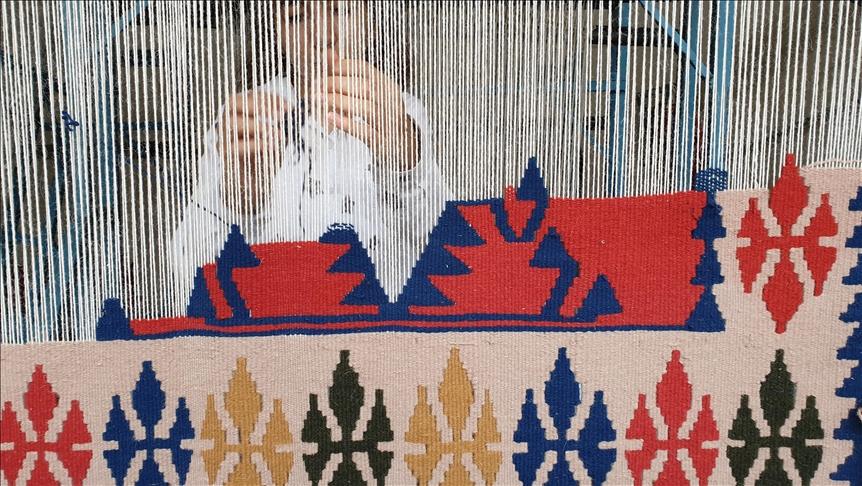
Karatepe kilims are traditional handicraft products produced in the Karatepe region of Osmaniye Province, Türkiye, using conventional weaving techniques. These kilims represent one of the most significant examples of the centuries-old weaving culture in the area.
Karatepe kilims are an important component of Osmaniye’s local handicraft traditions. The weaving tradition in the region has been maintained in homes and workshops from the past to the present. The techniques and motifs used in these kilims have been passed down from generation to generation, forming the region’s collective weaving heritage. Kilims produced by hand on traditional looms are widely manufactured in the villages surrounding Karatepe.

Karatepe Kilims (Osmaniye Municipality)
The production of Karatepe kilims primarily uses wool yarn. Natural dyes derived from plant sources are employed to achieve vibrant colors. The patterns used in kilim weaving incorporate region-specific motifs that carry symbolic meanings and reflect the weavers’ connection to local culture. Production is carried out on traditional looms through the tight interweaving of warp and weft threads.
Karatepe kilims are regarded as part of Osmaniye’s cultural heritage. Weaving has become an essential element of social life in the region, contributing to household economies and showcasing local artisanal skills. In addition, local authorities and civil society organizations support various events, visits, and promotional activities to raise awareness of Karatepe kilims.
Today, the production of Karatepe kilims is encouraged through the preservation of traditional methods. Local initiatives such as the Karatepe Kilim Cooperative support kilim production and ensure the transmission of this craft to new generations. As an important cultural asset for promoting Osmaniye, Karatepe kilims attract the interest of both domestic and international visitors.
Anadolu Ajansı. “Karatepe Kilimlerinde Asırlık Motifler.” Accessed June 26, 2025. https://www.aa.com.tr/tr/yasam/karatepe-kilimlerinde-asirlik-motifler/572227.
Culture Portal. "Karatepe Kilimi." Accessed June 26, 2025. https://www.kulturportali.gov.tr/portal/karatepe-kilimi.
Osmaniye Belediyesi. "Başkan İbrahim Çenet’ten Karatepe Kilim Kooperatifine Ziyaret." Accessed June 26, 2025. https://osmaniye-bld.gov.tr/baskan-ibrahim-cenetten-karatepe-kilim-kooperatifine-ziyaret.html.
Osmaniye Belediyesi. "Karatepe Kilimi Kooperatifi’ne Ziyaret." Accessed June 26, 2025. https://osmaniye-bld.gov.tr/osmaniye-karatepe-kilimleri.html.
Osmaniye Ticaret ve Sanayi Odası. "Karatepe Kilimi." Accessed June 26, 2025. https://www.osmaniyetso.org.tr/karatepe-kilimi/.
Osmaniye Valiliği. "Karatepe Kilimleri." Accessed June 26, 2025. http://www.kadirli.gov.tr/karatepe-kilimleri.
Osmaniye İl Kültür ve Turizm Müdürlüğü. "Geleneksel Osmaniye El Sanatları." Accessed November 26, 2025.

Material(s) | Usually wool yarn natural dyes | ||||||||
|---|---|---|---|---|---|---|---|---|---|
Place of Production | Karatepe, Osmaniye, Türkiye | ||||||||
Production Method | Weaving on a traditional handloom | ||||||||
Distinguishing Features | Regional motifs, vibrant colors, tight weaving | ||||||||
Cultural Significance | An important cultural heritage representing the traditional crafts of Osmaniye | ||||||||
Historical Background
Production Process and Materials
Cultural Significance
Current Status