


This article was automatically translated from the original Turkish version.
+2 More
Turkish Textile Culture is a culture that developed over historical processes across a vast geographical area extending from Southern Siberia and Central Asia to the Caucasus, Anatolia and the Balkans. This culture emerged in response to the needs of a nomadic lifestyle and gradually transformed into artistic production forms associated with settled life. Turkish textile art encompasses works produced through various techniques such as felt, flat weaving (kilim, cicim, zili, sumak) and pile weaving (carpet), which possess both functional and symbolic qualities. The historical development process began with the earliest examples in Southern Siberia and Central Asia, became institutionalized during the Seljuk and Ottoman periods, and took shape during the Republican era around industrialization and cultural preservation policies.
The foundations of Turkish textile culture lie in the steppe culture and the equestrian nomadic lifestyle of Southern Siberia and Central Asia. In this way of life, animal husbandry was the primary economic activity, and animal fibers such as wool and hair formed the main raw materials for producing shelter and utilitarian objects. The tents known as "yurt" (round house/white house), which were the most important shelter element of nomadic communities, were constructed using felt and woven materials. The tent culture enabled weaving to evolve not merely as an object but also as an architectural element.
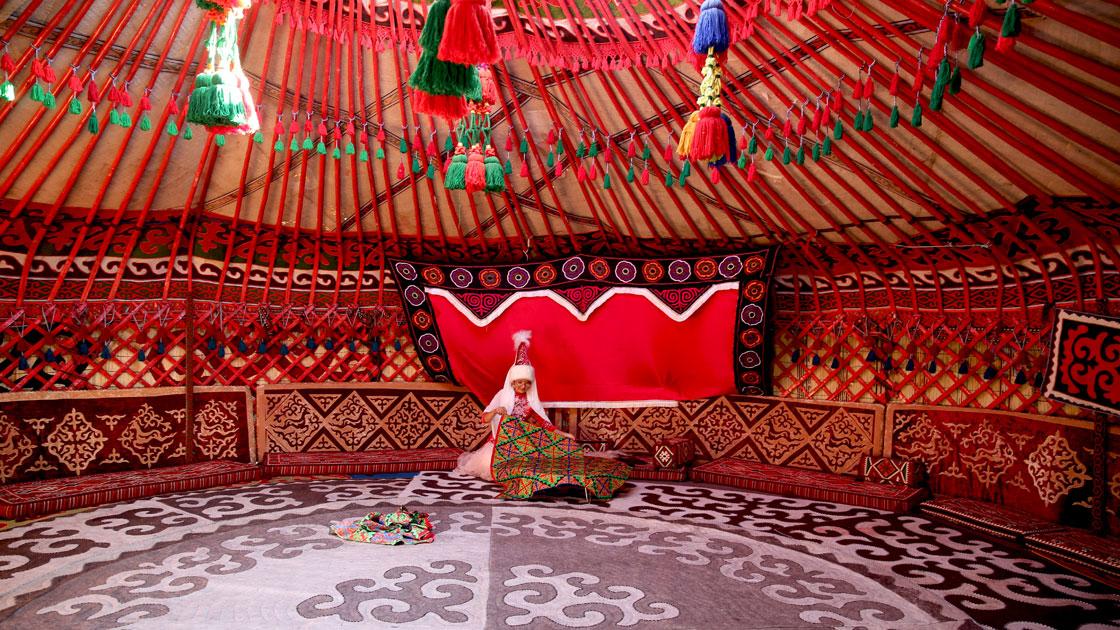
Traditional Kyrgyz Yurt (Tent) (AA)
The mobility required by nomadic life necessitated that objects be lightweight, portable and durable. In this context, felts used for interior decoration and insulation of tents, floor coverings, storage sacks and animal harnesses constituted the earliest functional examples of textile art. Among Central Asian Turkish communities, felt is the oldest textile surface used prior to weaving.【1】 From the Huns onward, tent coverings, floor coverings and garments found widespread use.
Turkish textile culture consists of major types that vary according to purpose and material structure, spanning from the practical needs of nomadic life to the aesthetic demands of settled existence. These types are fundamental material culture elements reflecting social status, economic structure and daily life practices.
Considered one of the most important contributions of the Turks to world art history, the carpet served as a floor covering in both nomadic tents and palaces due to its thick structure providing thermal insulation and its aesthetic value. Historically described as "the luxury of the East"【2】, the carpet was regarded as a symbol of wealth and status, used not only as a floor covering in mosques, palaces and homes but also hung on walls or employed as furniture coverings. Commercially, carpets have been among Anatolia’s most important export items for centuries and are categorized by use into prayer rugs, floor carpets, cushion covers and saddle covers.
Flat weave floor coverings, lighter, thinner and easier to fold and transport than carpets, constitute the textile group most suited to the mobility needs of nomadic life. In addition to being used as floor coverings, these textiles were produced in a wide variety of functional forms such as sacks (alaçuval, flour sack), bags, load covers (çul) and cradle covers for transporting and storing belongings during migration. In Anatolia, this group is generally known as "yaygı"; it is subdivided into kilim, cicim, zili (sili) and sumak according to the appearance of the woven surface and its purpose; coarser weaves such as "palas" are also included in this group.
Fine weaves produced to meet clothing and household textile needs represent one aspect of Turkish textile art in terms of aesthetics and technique. These fabrics, typically woven from cotton, silk or linen threads, were used in making headscarves, undergarments, shirts and bed sheets. One important living example of this type is the fine weave known as "dastar," unique to the village of Yeşil Üzümlü in Fethiye, Muğla, adorned with original motifs.【3】 These weaves, historically produced from a silk and cotton blend and now predominantly cotton-based, form part of the cultural identity of the local population.
Felt, which does not involve a warp-weft system but is one of the oldest and most traditional products of Turkish textile art, is the fundamental building material of the "tent" (yurt/round house) tradition brought from Central Asia to Anatolia. Due to its thermal and moisture insulation properties, felt met the shelter needs of nomads and was also used to make symbolic and functional garments such as the "kepenek" worn by shepherds, saddle covers for horses and the "sikke" worn by Mevlevi dervishes. Although its use narrowed with the transition to settled life, felt continues to exist as a tourist and artistic object.
These weaves, produced as long narrow strips, serve as complementary elements of daily life through their carrying and fastening functions. Known as "çarpana" and "kolan," these strips are used in animal harnesses, securing loads (örken), carrying babies on the back, cradle bindings and as belts or sashes in traditional clothing. Particularly among Yörük and Turkmen communities, ornate and motif-decorated narrow weaves carry symbolic meanings in rituals such as weddings and funerals.
In Turkish textile culture, carpets and flat weaves were used not only as floor coverings but also on vertical surfaces for thermal insulation and aesthetic decoration. In early examples from Central Asia, carpets were used not only on the ground but also as wooden panel, saddle and wall coverings. In Anatolian village life, due to the weight of pile carpets, lighter flat weaves such as kilims and other flat weave types were preferred for vertical uses such as wall decorations, heavy curtains and door coverings. In the late Ottoman period, this tradition gained new dimensions in palace decoration; wall carpets with special dimensions and patterns were produced at the Hereke Factory for the decoration of Dolmabahçe and Yıldız Palaces, becoming integral to interior design. Exported Turkish carpets acquired prestige status in Western palaces and churches, where they were used not as floor coverings but as tablecloths and wall carpets.
The oldest and most advanced known example of knotted carpet technique is the "Pazırık Carpet," discovered in the 1940s in the Pazırık Kurgan (3rd–5th century BCE) in the Altai Mountains (Southern Siberia). This artifact, approximately 2,300–2,500 years old, exhibits a structure similar to the double knot (symmetric/Turkish) technique used in modern hand-knotted carpets.【4】 The equestrian figures, deer motifs and compositional arrangement on the Pazırık carpet reflect the iconographic characteristics of Central Asian steppe art. This find is a concrete archaeological indication that knotted carpet technique had reached a high level of technical proficiency during the Asiatic Hun period.
The World’s First Known Carpet: The Pazırık Carpet (TRT Avaz)
The mass migration of Turks into Anatolia from the 11th century onward facilitated the transfer of textile techniques and motif languages originating in Central Asia and Southern Siberia to the west. After the 1071 Battle of Manzikert, the Turkmen tribes who settled in Anatolia continued their weaving looms and production practices in this region. During the Anatolian Seljuk period (13th century), centers such as Konya, Aksaray and Sivas emerged as major carpet production cities.
The traveler Marco Polo noted in his travelogue that the most beautiful carpets in the world were woven in Konya during the 13th century. Similarly, travelers such as Ibn Said and Ibn Battuta wrote about the quality of Turkmen carpets and their export to countries such as Egypt, Syria, Iraq and India.【5】 Anatolian Seljuk carpets are generally characterized by geometric ground patterns, Kufic borders and large motifs.
During the Ottoman Empire, textile art developed along two main lines: court-sponsored workshops and rural production. The 15th and 16th centuries are regarded as the classical period of Turkish carpet art. Carpets produced in centers such as Uşak, Bergama and Konya during this period began to be exported to European markets and were depicted in Western painting.【6】
From the 19th century onward, under the influence of the Industrial Revolution and demands from Western merchants, workshops producing carpets for export with specified patterns and colors were established in Western Anatolia (particularly Uşak, Gördes, Kula) under the supervision of British and other European companies (e.g., Şark Halı Kumpanyası). This process led to partial changes in traditional motifs and natural dyeing techniques but significantly increased production volume. Additionally, to meet court needs and develop silk weaving, the Hereke Factory (Hereke Weaving Factory) was established in 1843, where the carpets produced gained a universally privileged status.
Hereke Carpet Factory (TBMM - Grand National Assembly of Türkiye)
With the proclamation of the Republic of Türkiye, the preservation and development of traditional arts became state policy. Institutions such as Sümerbank supported carpet production in centers like Isparta and Hereke, providing local producers with yarn and pattern support. From the 1960s onward, industrialization and the spread of machine-made carpets affected hand-weaving; however, traditional production continued in rural areas and within cultural projects (e.g., the DOBAG Project)【7】. Today, Turkish textile culture persists both as a historical heritage preserved in museum collections and as a living tradition with tourist and commercial value.
In Turkish textile culture, production is fundamentally based on animal husbandry, a natural consequence of the nomadic lifestyle. The most important factor determining the technical structure, durability and aesthetic quality of textiles is the type and processing method of the raw material. In traditional production, natural fibers such as wool, hair, silk and cotton are spun into yarn using regional methods and then dyed with natural dyes to prepare them for weaving.
The most commonly used raw material in Anatolian weaving is sheep’s wool. Wool became the primary material for carpets, kilims and flat weaves due to its porous structure, thermal insulation properties, dye absorption capacity and flexibility. The quality of wool varies according to the season of shearing. Wool sheared in spring is called "yapağı," while wool sheared in autumn is called "güz yünü." Because animals graze and clean themselves naturally during summer, autumn wool has a brighter, cleaner and softer structure compared to spring wool. Therefore, autumn wool is preferred especially in the weft of fine kilims.
Goat hair is a fiber of high strength and was used in durable textiles such as tents (kara çadır/yurt), sacks and bags due to its moisture retention and pest-repelling properties. Artisans who spin yarn from goat hair are called "mazman," and those who weave with this yarn are called "mutaf."【8】
Silk is a costly and labor-intensive material used primarily in palace carpets and specialized production centers such as Hereke. The fineness of silk fibers allows for an increased number of knots per square centimeter and enables intricate patterns to be woven. Cotton is generally used as the warp thread, especially in fine weaves such as Antep kilims or to provide structural strength in the base of Hereke carpets.
The textile preparation process begins with the shearing of animals. The raw wool or hair is washed in rivers to remove dirt and grease. After washing, the fibers are dried and then carded to align them parallel.
Spinning the fibers into yarn is traditionally performed using simple hand tools called "kirman" (needle) or "çıkrık." The twist direction and tightness of the yarn are adjusted according to its intended use (weft, warp or pile). Warp threads, which must withstand tension, are prepared with high twist and usually double-ply, while weft and pattern threads are left with looser twists to cover the surface. From the late 19th century onward, the establishment of yarn factories with industrialization initiated the transition from hand-spun to factory-made yarn.【9】
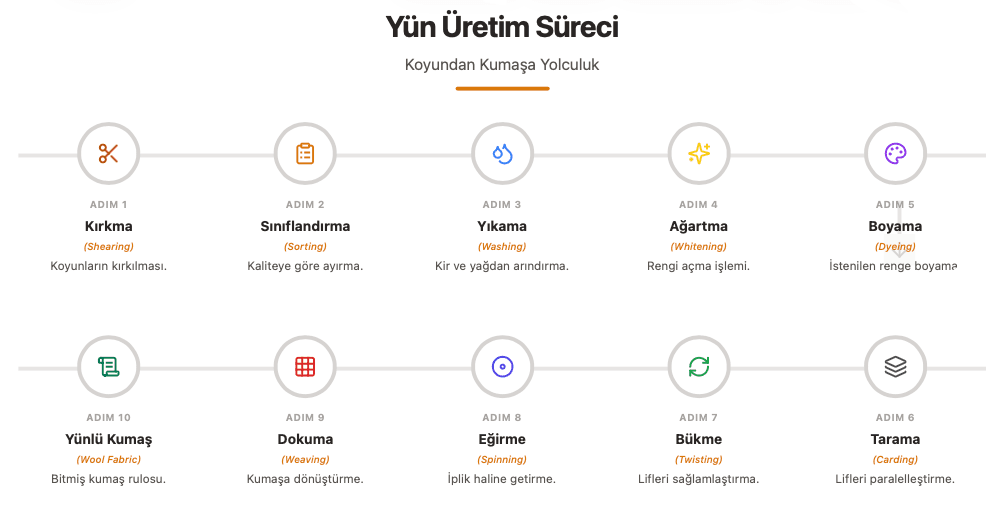
Commonly Used Natural Dyes (Generated by Artificial Intelligence)
In Turkish textile art, colors were derived from natural dyes obtained from plant, animal and mineral sources. Until the end of the 19th century, natural dyeing was the sole method of coloring, and it is the key factor enabling textiles to survive to the present day without fading.
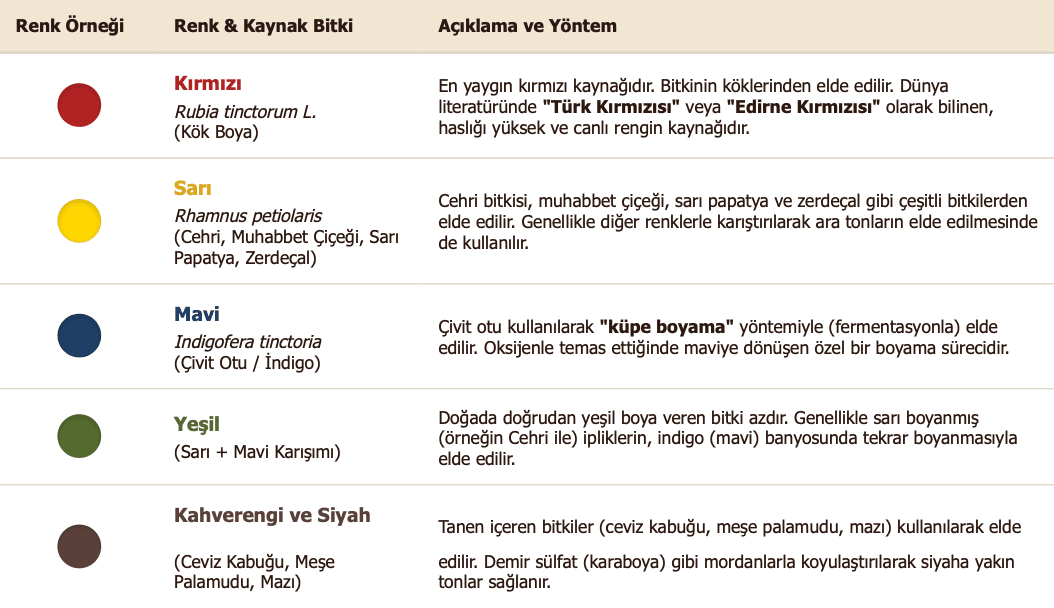
Commonly Used Natural Dyes (Generated by Artificial Intelligence)
Mordanting: Metal salts known as "mordants" are used to chemically bind natural dyes to fibers and enhance resistance to washing and light. The most commonly used mordants in traditional Turkish dyeing are alum (potassium aluminum sulfate), copper sulfate (göztaşı), iron sulfate (karaboya) and cream of tartar (tartaric acid). The mordanting process is typically performed before dyeing by boiling the yarn in mordant solution (pre-mordanting).
From the second half of the 19th century, the introduction of synthetic dyes (aniline and alizarin) into the Ottoman market led to a decline in traditional dyeing techniques and noticeable changes in color quality. However, starting in the 1980s, projects such as DOBAG (Natural Dye Research and Development) have sought to revive traditional dyeing methods.
In Turkish textile culture, the production process is carried out using different technical equipment depending on the type of product (carpet, kilim, fabric), the raw material used and the social environment (settled or nomadic). The looms that provide the tension and shed-opening system for weaving, along with auxiliary tools for knotting, compacting and cutting, form the technical infrastructure of production.
Weaving looms are devices that maintain the tension of warp threads and allow the weft threads to pass through. In the Anatolian and Central Asian weaving tradition, two main types are used: vertical (ıstar) and horizontal (floor loom).【10】
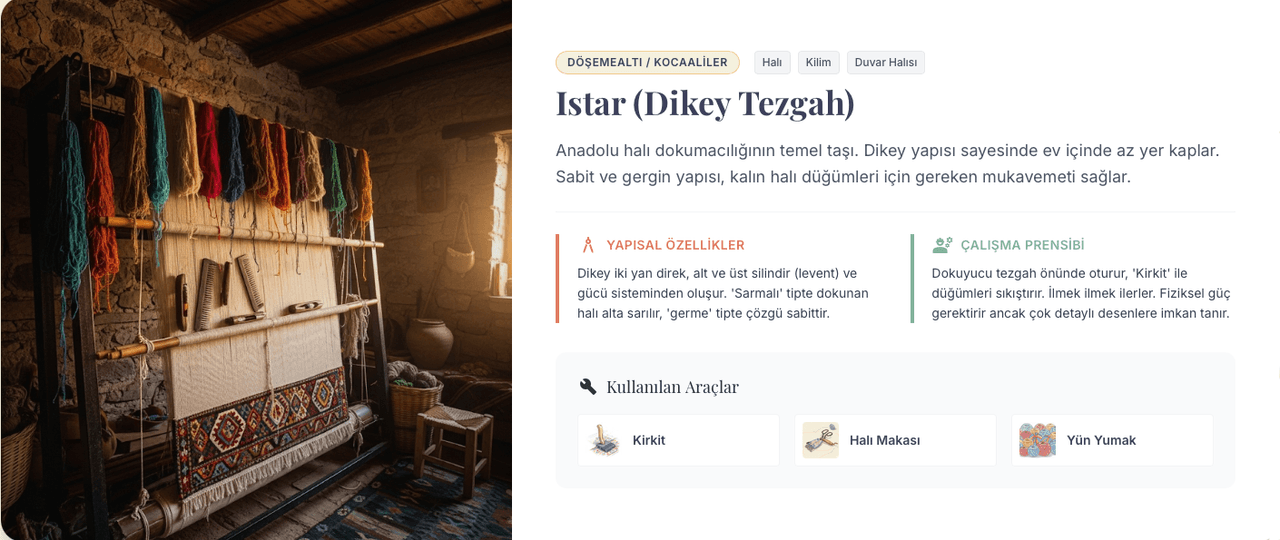
Weaving Looms (Generated by Artificial Intelligence)
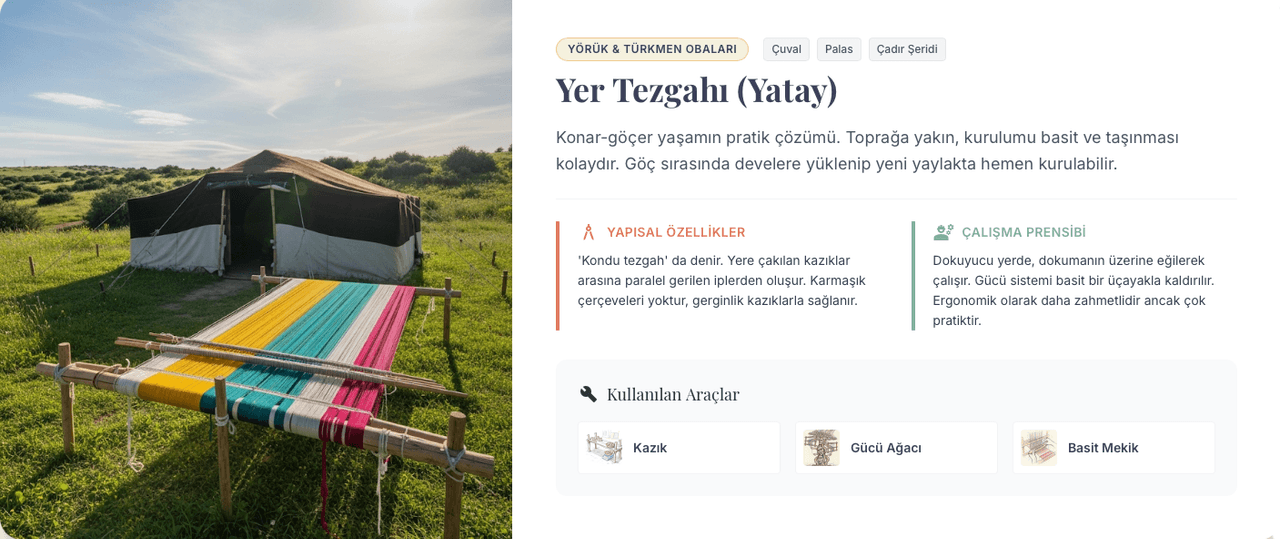
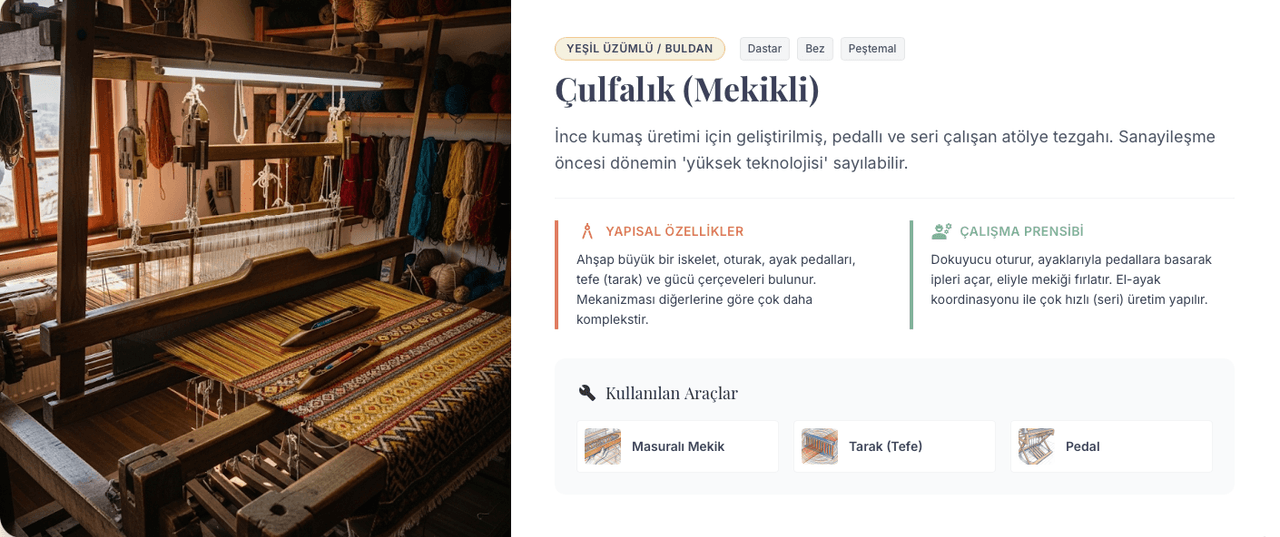
Various hand tools are used during weaving to compact knots, cut threads and smooth the surface.
Turkish textile culture is technically classified according to how threads intersect or interlock. These techniques are examined under three main categories based on whether pile (hav) is created, the number of weft and warp systems, and the mechanism of surface formation:
In addition, specialized narrow weaves (çarpana/kolan) constitute an important part of this technical classification according to their use.
A carpet is a weave created by tying knots onto warp threads to form a pile (pile) surface, with weft threads passed and compacted after each row. The fundamental structural element of the carpet, the knot, is referred to by various names, and academic debates exist regarding these terminologies.
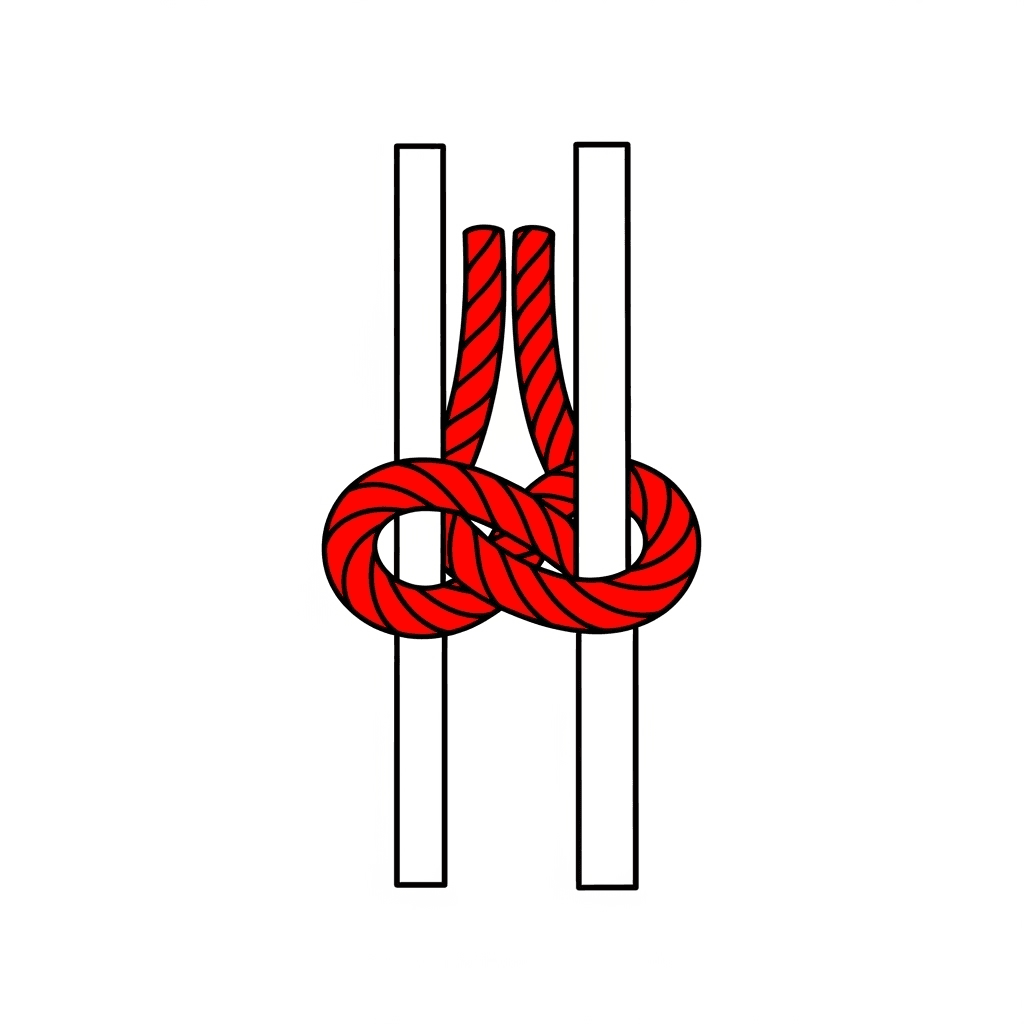
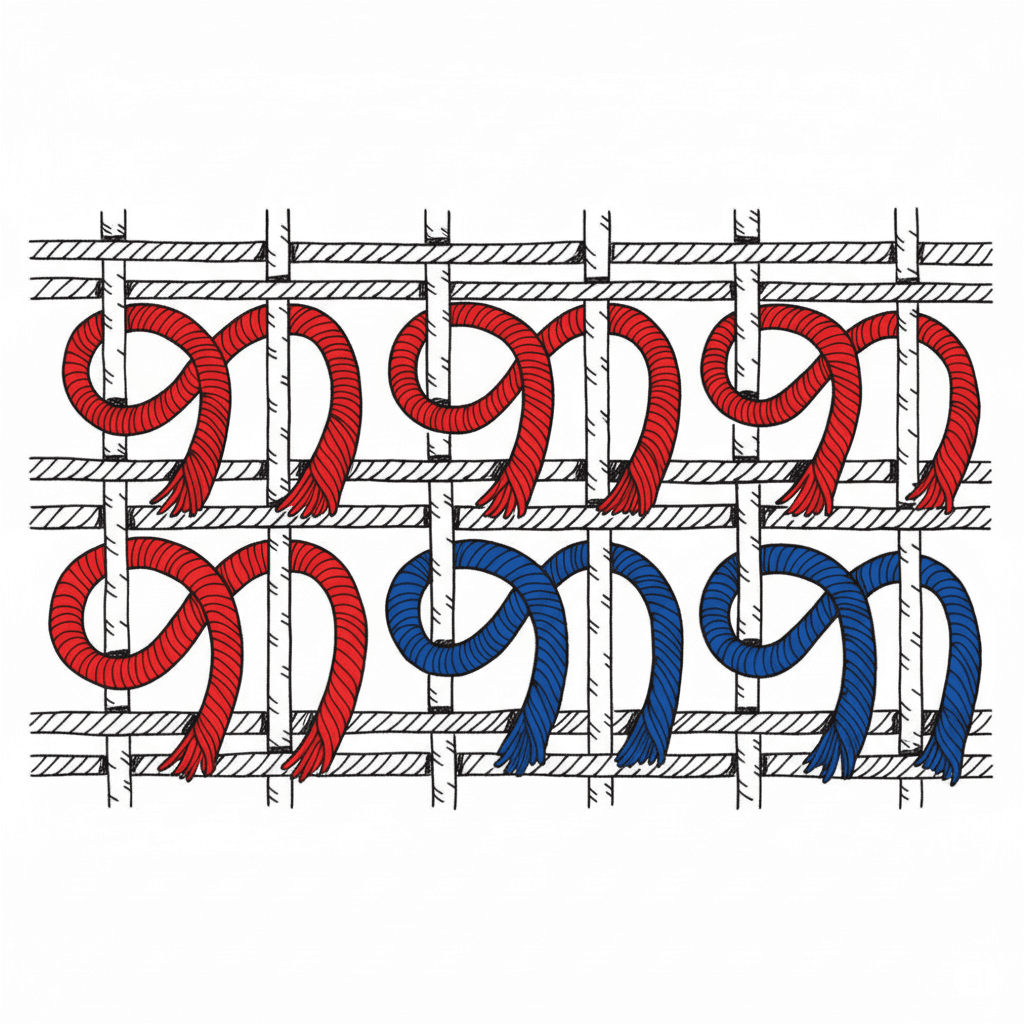
Flat weaves, which create non-pile (hairless) surfaces, are subdivided into subgroups according to the intersection pattern of weft and warp systems and the technique of pattern formation:
Felt is a non-woven surface produced without warp or weft systems, by felting wool fibers together under pressure, moisture and heat (tepme). This technique, based on the principle of the surface scales of wool fibers opening and interlocking, was extensively used by Central Asian nomads for tent coverings (yurt), floor coverings and kepenek production. In Anatolia, this method, known as "tepme keçe," has a very ancient history, as evidenced by examples found in the Pazırık kurgans.
Narrow weaves, typically produced in widths ranging from 0.5 cm to 50 cm, are strip-shaped textiles used for carrying loads, animal harnesses, belts and decoration.
In Turkish textile culture, the surface composition of weaves is structured according to specific geometric and symbolic schemes. These schemes are shaped according to the region of production, the intended use (floor covering, prayer rug, cushion, etc.) and the weaver’s technical preferences. When examining Anatolian examples (e.g., Mut, Silifke, Yahyalı, Döşemealtı), six fundamental surface schemes emerge in terms of surface division and motif placement: hexagonal, central-bulb, baklava, mihrap, box and horizontal-banded schemes.【15】
In this design, the weave surface is divided into equal-sized hexagonal forms. The lines connecting the hexagons are formed as single, double or triple rows of strips depending on the size of the weave. The interiors of the hexagons are filled with motifs from the regional repertoire in different colors and sizes. In Mut and Silifke zili weaves, motifs are typically arranged horizontally at a 45-degree angle, covering the entire surface.
The central-bulb scheme is based on placing one or more primary motifs, called "top" or "göbek," at the center of the weave surface. Variations of this scheme include:
In this scheme, the weave surface is covered by a network formed by the repetition of baklava-shaped (rhombus) forms. The size of the baklava shapes and the thickness of their frames are adjusted according to the size of the weave. The interiors of the shapes are decorated with different colors and motifs following principles of contrast and rhythm. Examples of this scheme are found in Mut and Silifke zili weaves.
This is the fundamental scheme found in textiles used for prayer (seccade/namazlağı). The composition is created by stylizing the architectural element of the mihrab.
This is a characteristic surface division unique to Yahyalı carpets. The surface composition of Yahyalı carpets, from outside to inside, is arranged as: outer border, border, inner border, box, and inner ground (bulb). The box section consists of rectangular panels located between the inner border and the inner ground (bulb). In regional tradition, the use of this scheme is associated with social status; the "box" section is included in carpets woven by married or engaged women but omitted in those woven by unmarried or widowed women.
This scheme divides the ground into horizontal (crosswise) bands. Known regionally as "taktalı," "tahtalı" or "çubuklu," this design allows the bands to be filled with motifs or left as simple color strips. This scheme is one of the most prominent examples of rhythm and repetition principles.
In Turkish textile culture, motifs are not merely decorative elements; they constitute a silent language expressing the weaver’s inner world, beliefs, expectations and social status. This language is integrated with various rituals shaped by life cycle transitions and protective instincts from birth to death.
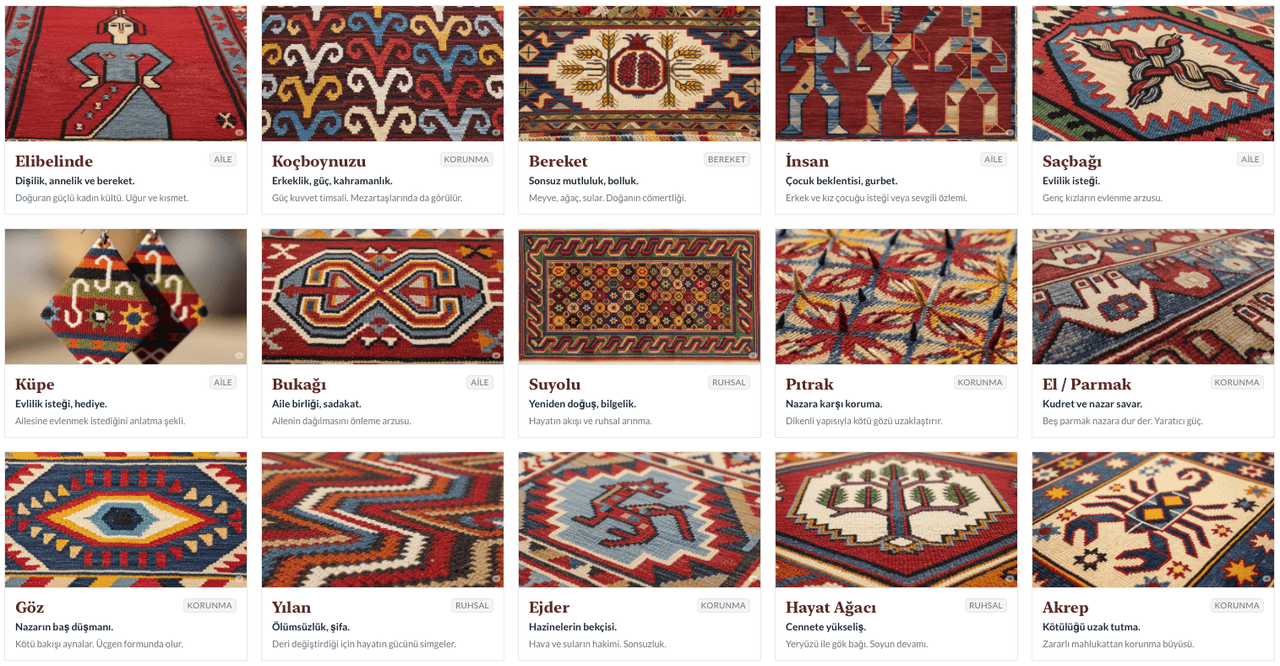
Textile Examples (Generated by Artificial Intelligence)
The production process of carpets and flat weaves is surrounded by specific rituals from beginning to end, beyond being merely a technical act. These rituals aim to ensure prosperity, rapid completion and protection from the evil eye.
Textile products assume functional and symbolic roles during key transitions in an individual’s life.
The act of weaving is also a means of making requests and fulfilling vows. In Bünyan, young girls believe that if a plant called "kader çiçeği" remains alive when hung on their loom, their wishes will be granted. Additionally, "votive carpets" (usually mihrap-patterned prayer rugs) are woven to be donated to mosques for the fulfillment of a wish; it is noted that during weaving, each knot is accompanied by a prayer, and the carpet functions as a rosary.
In Türkiye, textile culture is divided into various regional schools exhibiting distinct characteristics based on geographical conditions, ethnic origins (Yörük, Turkmen tribes), local raw material sources and lifestyles. These schools developed along two main lines in terms of production organization: "court/workshop" and "rural/home" production, differing from each other in technique, material, color palette and motif repertoire.
The most important school representing the "palace carpet" tradition of Turkish carpet art. Established in 1843, the Hereke Weaving Factory began production to meet the needs of Ottoman palaces for floor coverings, curtains and carpets. Hereke carpets hold a privileged position in world literature due to their material quality (silk and wool) and knot density.
The design character consists of compositions designed in palace nakkaşhane workshops, typically floral, medallion-based and with curvilinear branches. From the 19th century onward, Hereke carpets won awards at international fairs (Lyon, Chicago, Munich) and were used as diplomatic gifts in Western palaces (e.g., White House, Peace Palace, Huis Doorn Castle). During the Republican period, Hereke continued production under Sümerbank and became a world brand, especially in silk carpet production from the 1960s onward; its designs were copied in other Anatolian regions (Tokat, Kayseri, etc.) as "Hereke type."
One of the most important commercial production centers of Turkish carpet art during the Republican period. This school developed particularly in the late 19th century under the organization of British companies (Şark Halı Kumpanyası) and was decisive in Türkiye’s carpet exports and domestic consumption from the 1950s to the 1980s.
Isparta carpets are typically woven with wool pile on a cotton warp using the "Gördes" (symmetric) knot technique. The design character consists of botanical ornaments, medallions and angular compositions shaped according to Western buyers’ tastes (Smyrna type). The first standardization and quality control efforts in Turkish carpet weaving were initiated in 1955 with Isparta as the center.
One of the historically significant centers of Western Anatolian carpet weaving, Demirci, along with Gördes and Kula, is a region where the symmetric knot technique known in literature as "Gördes knot" is intensively used. During the 19th century, under the influence of British companies focused on export, the design and color characteristics were shaped according to the European market.
Demirci carpets are recognized as a school specialized in mosque carpet (saf seccade) production. They were featured among Turkish carpet representatives at international platforms such as the 1897 Stockholm Exhibition. During the Republican period, Demirci was one of the first centers to witness the transition from hand-weaving to mechanization.
The Sarıkeçili Yörüks, one of the communities that maintained the nomadic lifestyle the longest, shaped their textile culture around animal husbandry and migration needs. In this school, concentrated in Karaman and its surroundings, a large portion of production consists of sack-type textiles used for transporting and protecting belongings during migration. Sarıkeçili textiles typically use goat hair and sheep wool obtained from their own herds. Hair material is preferred due to its ease of cleaning and thermal insulation properties.
Textiles are generally classified as "ala çuval" (for storing dowry and clothing), "un çuvalı" (for flour) and "kıl çuval" (for grain and household items). Technically, kilim, cicim and sumak techniques are common; ground weaves are typically made of hair, while motifs are made of root-dyed wool yarn. The motif repertoire prominently features geometric forms such as pıtrak, ram’s horn, abundance, hook, waterway and checkerboard.
This school, developed in the Yahyalı district and surrounding areas of Kayseri, is known for its unique surface scheme and color understanding. Yahyalı carpets differ from Bünyan carpets by being produced in smaller sizes (prayer rug type) and featuring geometric designs. The most distinctive feature of these carpets is the surface composition arranged from outside to inside as: outer border, border, inner border, box, and inner ground (bulb). The "box" section is a characteristic element unique to Yahyalı carpets; in regional tradition, it is included in carpets woven by married or engaged women but omitted in those woven by unmarried or widowed women. The color palette is dominated by dark and bright tones; navy blue, burgundy (apple red), dark brown and dark green are frequently used.
This school, developed by the Karakoyunlu Yörüks in the Döşemealtı plateau and surrounding areas (Burdur-Kocaaliler, etc.) of northern Antalya, is known for its distinctive "Döşemealtı" carpets. These carpets are generally prayer rug size and feature a palette dominated by red, blue, burgundy, green and black colors.
Döşemealtı carpets are named according to their ground composition and motifs: halelli, toplu, akrepli, kocasulu and camili. In halelli carpets, the ground is filled with geometric motifs; in toplu carpets, large cross-shaped (top) motifs are arranged on the ground. In the regionally known akrepli carpets, the scorpion motif is rendered as a protective symbol (talisman) against external threats.
The Tahtacı Turkmen living in Güzelköy and surrounding areas of Ayvacık district, Çanakkale, have created a unique school through their distinctive narrow weaving techniques of "çarpana" and "kolan" weaving. In this region, kolan weaves are used for functional purposes such as carrying firewood, animal harnesses and child-carrying.
One of the most remarkable products of the Ayvacık school is the "Meydan Kilimi," used in funeral rites, and the special "Örken" kolan used to secure the corpse. Additionally, "urba yastığı," a lidded textile for storing clean clothing, is unique to the region. Motifs include local names such as "İstanbul street," "waterway" and "dişeme."
In the village of Yeşil Üzümlü, Fethiye, dastar fabrics woven on pedal looms called "düven" or "düzen" are the region’s most important textile product.【17】 Dastar is a fine, transparent fabric woven with warp and weft threads and a third thread (yanış ipi) for creating patterns.
Traditionally woven from a cotton-silk blend, today dastars prefer flexible cotton yarn. Motifs are generally geometric and named after papaya, stick, leech, camel foot and snake.
In the districts of Mut and Silifke in Mersin, flat weaves (kilim, cicim, zili) are common, produced in accordance with the Yörük lifestyle. Various surface schemes, including hexagonal, central-bulb, baklava and horizontal-banded, have been identified in these region’s textiles. The warps typically use hair, while the wefts use wool yarn. Regional motifs include yar yare küstü, ram’s horn, box and curved water.
In Turkish textile culture, the long-term preservation of produced items (carpets, kilims, fabrics, etc.) without deterioration and protection from harmful agents has become a cultural practice as important as the production process itself. These practices encompass both physical protection methods (trunks, bundles) and traditional measures developed against biological pests (moths, insects).
The greatest enemy of textiles made from natural fibers (wool, silk, hair) is moth larvae and other insects. In traditional Turkish homes, non-chemical, natural protectants were used against these pests.
The storage of valuable textiles (dowry items, special garments, embroidered coverings) is integrated into a tradition known as trunk culture. The trunk is not merely a storage tool but a symbolic object preserving the family’s memory and material wealth.
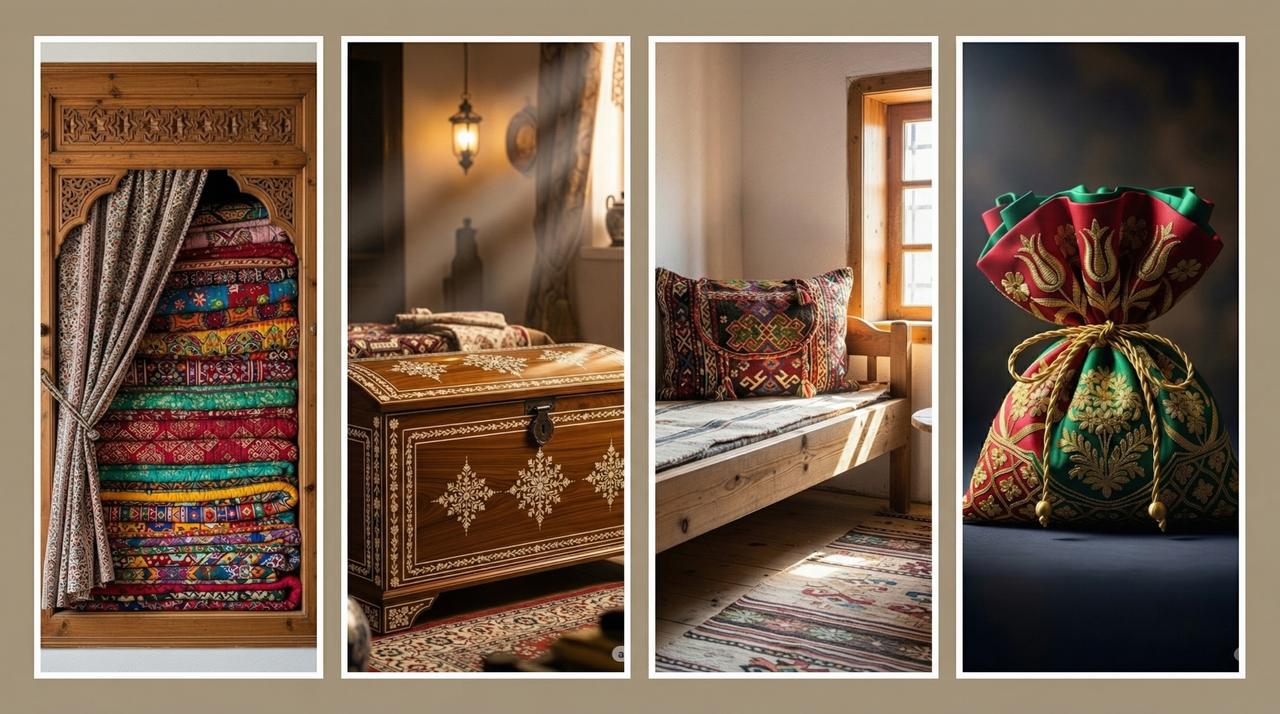
Sequential Order: Storage Rack, Trunk, Urba Pillow, Bundling (Generated by Artificial Intelligence)
Repairing valuable textiles damaged or worn over time is part of the preservation culture. Especially for public-use items such as mosque and foundation carpets and family heirloom carpets, maintenance and repair were attempted using traditional methods. Torn or detached sections were extended or patched using yarn and colors matching the original, thereby prolonging the textile’s life (e.g., patches seen in Sarıkeçili sacks). Additionally, the restoration of Turkish carpets used in the British Royal Palaces (Buckingham Palace) is currently carried out at the Aksaray Sultanhanı, demonstrating the international expertise of Turkish textile repair traditions.【18】
Turkish textile culture, throughout history, has transcended its role as merely a commercial commodity or utilitarian object, functioning as an instrument of diplomatic relations, a symbol of status and a central element of artistic interaction. Particularly in relations with the Western world, carpets and textiles were accepted as tangible manifestations of political and cultural diplomacy.
Turkish carpets began to be frequently depicted in European art from the 14th century onward, and these depictions have become important documents for dating carpets and determining their origins. Renaissance and Baroque painters rendered Turkish carpets in their paintings with detailed realism. These carpets are often named after the painters who depicted them in literature:
Turkish carpets were among the most valuable gifts presented by Ottoman sultans and state officials to Western monarchs and diplomats.
Turkish textile culture exhibits strong ties with Azerbaijan and the Caucasus in terms of technique and terminology. Flat weave techniques such as zili (Sili) and sumak are produced in both regions using the same techniques and similar names (in Azerbaijan: Zili, Sumak or Şedde). Additionally, textile types such as palas and cecim exhibit similar technical and design features in both Anatolia and Azerbaijan (Karabakh school). This demonstrates that textile culture represents a shared Turkish cultural heritage transcending political boundaries.
The World’s First Carpet Museum is in Azerbaijan (TRT Avaz)
My Visual Sources
Accessed November 26, 2025. Accessed November 26, 2025.
Accessed November 26, 2025.
Accessed November 26, 2025.
Accessed November 26, 2025.
Accessed November 26, 2025.
Anadolu Ajansı. “Kapadokya’daki Kırgız Obasında Türk Kültürünü Tanıtıyorlar.” Accessed November 19, 2025.
Aytaç, Ahmet. "OSMANLI DÖNEMİ’NDE BURSA İPEKÇİLİĞİ, DOKUMACILIK ve BAZI ARŞİV BELGELERİ." Tarihin Peşinde Uluslararası Tarih ve Sosyal Araştırmalar Dergisi 13 (2015): 1–12. Accessed November 19, 2025.
Benli, Hüseyin. "Türk halılarında kullanılan kök boya ve cehri ile boyanmış yün ipliklerin haslıklarının iyileştirilmesi." Arış Dergisi 7 (2012): 18–25. Accessed November 19, 2025.
Demirarslan, Deniz. “BATI SARAYLARINDA TÜRK HALISININ KULLANIMI VE ÖNEMİ.” Milli Folklor 17, no. 132 (2021): 208–225. Accessed November 19, 2025.
Doku Araştırmaları II. Editörler: Mustafa Genç, Ayşegül Koyuncu Okca, Gülşen Öztürk. Paradigma Akademi Yayınları, ISBN: 978-625-5850-72-0.Accessed 19 Kasım 2025.
Erman, Deniz Onur and Seda Dilay. “ORTA ASYA GÖÇEBE HAYATI VE SANATA YANSIMALARI.” Sanat ve Tasarım Dergisi 33 (2024): 33–55. Accessed November 19, 2025.
Genç, Mustafa and İsmail Solak. “KAYSERİ BÜNYAN’DA TESPİT EDİLEN HALI DOKUMA İLE İLGİLİ RİTÜELLER VE SÖZLÜ KÜLTÜR.” Arış Dergisi 17 (2020): 80–101. Accessed November 19, 2025.
Gezer, Ülkü. “BAŞLANGICINDAN 16. YÜZYILA KADAR, TÜRK DOKUMA SANATINDAKİ ÜSLUP, DESEN, MOTİF VE SEMBOLLERİN TARİHİNE BAKIŞ.” Hars Akademi Uluslararası Hakemli Kültür Sanat Mimarlık Dergisi 5(Özel Sayı 3) (2022): 455–477. Accessed November 19, 2025.
Gür, Semra. "Anadolu’nun sanat objesine dönüşen kültürel değeri keçe." Batman Üniversitesi Yaşam Bilimleri Dergisi 1.1 (2012): 1173–1181. Accessed November 19, 2025.
Kahraman, Murat. Türk Mitolojisinde Temel İnançlar (Kozmogoni, Astroloji, Renkler). Master's thesis, Ankara Yıldırım Beyazıt Üniversitesi, 2020. Accessed November 19, 2025.
Oyman Büken, N. Rengin. "El Dokumacılığının ve El Dokuma Tezgahının Tarihçesi, El Dokuma Tezgahı Çeşitleri." Sanat Dergisi 8 (2010): 63–84. Accessed November 19, 2025.
Soysaldı, Aysen. "Türk kilimlerinde dokuma teknikleri ve boyama özellikler." Erdem 10.30 (1999): 599–613. Accessed November 19, 2025.
TRT Avaz. “Dünyanın bilinen ilk halısı: Pazırık Halısı.” YouTube video. Accessed November 19, 2025.
TRT Avaz. “Dünyanın İlk Halı Müzesi Azerbaycan'da.” YouTube video. Accessed November 19, 2025.
Tarım ve Orman Bakanlığı. "Türk Motifleriyle, Geçmişten Günümüze..." Accessed November 19, 2025.
Türkiye Büyük Millet Meclisi (TBMM). “Hereke Halı Fabrikası.” YouTube video. Accessed November 19, 2025.
Türkmen, Nalan. "Orta Asya Türkmen Halılarına Genel Bir Bakış." Arış Dergisi 3 (1997): 80–87. Accessed November 19, 2025.
Yılmaz, Esra. "İPEĞİN DOĞUŞU VE İPEK YOLU'NDA İPEĞİN YOLCULUĞUNUN KISA TARİHÇESİ." Asya Araştırmaları Uluslararası Sosyal Bilimler Dergisi 5.1 (2021): 95–104. Accessed November 19, 2025.
Öngen, Ayşe and Kadriye Didem Atış. “ANADOLU SELÇUKLU HALI TASARIMINDA ZEMİN - ŞEKİL İLİŞKİSİ.” Hars Akademi Uluslararası Hakemli Kültür Sanat Mimarlık Dergisi 5(Özel Sayı 3) (2022): 1–16. Accessed November 19, 2025.
Öztürk, Bahadır. "CUMHURİYET TÜRKİYE’Sİ HALICILIĞI-I: 1923–1980 YILLARI ARASI." Arış Dergisi 17 (2020): 44–61. Accessed November 19, 2025.
Öztürk, Bahadır. "Halıda Türk–Gördes Düğümü, İran–Sine Düğümü: Doğru Bilinen Yanlışlar." Yedi 33 (2025): 163–176. Accessed November 19, 2025.
İmer, Zahide. "Türklerin dokuma sanatında boyacılık." Erdem 10.29 (1999): 331–354. Accessed November 19, 2025.
[1]
Semra Gür, “Anadolu’nun Sanat Objesine Dönüşen Kültürel Değeri Keçe,” Batman Üniversitesi Yaşam Bilimleri Dergisi1, no. 1 (2012): 1175.
https://dergipark.org.tr/en/pub/buyasambid/issue/29824/320964
[2]
Deniz Demirarslan, “Batı Saraylarında Türk Halısının Kullanımı ve Önemi,” Milli Folklor 17, no. 132 (2021): 210.
https://dergipark.org.tr/en/pub/millifolklor/issue/66376/705335
[3]
Dilek Tüm Cebeci, “Fethiye Yeşil Üzümlü Beldesinin Kültürel Mirası Dastar Dokumacılığı,” Dokuma Araştırmaları II içinde, 49, 51.
Dokuma Araştırmaları II, ed. Mustafa Genç, Ayşegül Koyuncu Okca, Gülşen Öztürk. Paradigma Akademi Yayınları, ISBN 978-625-5850-72-0. PDF
[4]
Bahadır Öztürk, “Halıda Türk–Gördes Düğümü, İran–Sine Düğümü: Doğru Bilinen Yanlışlar,” Yedi 33 (2025): 172.
[5]
Demirarslan, “Batı Saraylarında Türk Halısının Kullanımı…,” 209-210.
[6]
Demirarslan, “Batı Saraylarında Türk Halısının Kullanımı…,” 211–213.
[7]
Aysen Soysaldı, “Türk Kilimlerinde Dokuma Teknikleri ve Boyama Özellikleri,” Erdem 10, no. 30 (1999): 612. https://dergipark.org.tr/en/download/article-file/687886
[8]
Mustafa Konuk, “Karaman Sarı Evlerde Yaşayan Sarıkeçili Yörüklerinde Tespit Edilen Çuval Dokumalar,” Dokuma Araştırmaları II içinde, 149 PDF
[9]
Bahadır Öztürk, “Cumhuriyet Türkiye’si Halıcılığı-I: 1923–1980 Yılları Arası,” Arış Dergisi 17 (2020): 47.
https://doi.org/10.34242/akmbaris.2020.139
[10]
Soysaldı, “Türk Kilimlerinde Dokuma…,” 599.
[11]
Nalân Türkmen, “Orta Asya Türkmen Halılarına Genel Bir Bakış,” Arış Dergisi 3 (1997): 84.
[12]
Öztürk, “Halıda Türk–Gördes Düğümü…,” 168.
[13]
Öztürk, “Halıda Türk–Gördes Düğümü…,” 169.
[14]
Meral Orhan ve Alim Gadanaz, “Çanakkale İli Ayvacık İlçesi Güzelköy'de Çarpana ve Kolan Dokuma Geleneği,” Dokuma Araştırmaları II içinde, 86 PDF
[15]
Derya Konuk ve Necla Dursun, “Mut ve Silifke İlçelerinde Bulunan Yaygılardaki Yüzey Şemaları,” Dokuma Araştırmaları II içinde, 38. PDF
[16]
Orhan ve Gadanaz, “Çanakkale İli Ayvacık…,” 81–82.
[17]
Tüm Cebeci, “Fethiye Yeşil Üzümlü…,” 69.
[18]
Demirarslan, “Batı Saraylarında Türk Halısının Kullanımı…,” 215.
https://dergipark.org.tr/en/pub/millifolklor/issue/66376/705335
[19]
Demirarslan, “Batı Saraylarında Türk Halısının Kullanımı…,” 211.
[20]
Demirarslan, “Batı Saraylarında Türk Halısının Kullanımı…,” 214.


No Discussion Added Yet
Start discussion for "Turkish Weaving Culture" article
Origins of Turkish Textile Culture
Main Types of Turkish Textiles
Carpet
Flat Weave Floor Coverings (Kilim, Cicim, Zili, Sumak)
Fabric and Cloth Weaves (Dastar and Bürümgük)
Felt
Narrow Weaves (Çarpana and Kolan)
Wall Carpets and Wall Decorations
The Pazırık Carpet and the Origins of Knotted Weaving
Transition to Anatolia and the Seljuk Period
The Ottoman Period and Interaction with the West
The Republican Period and Modernization
Raw Materials and Preparation Process
Fiber Sources: Wool, Hair, Silk and Cotton
Shearing, Cleaning and Spinning
Natural Dyeing and Mordanting
Weaving Tools and Looms
Weaving Looms
Auxiliary Tools and Equipment
Basic Weaving Techniques
Pile Weaves (Carpet) and Knot Technique Discussion
Flat Weaves
Non-Weaved Textiles (Felt/Tepme)
Narrow Weaves (Çarpana and Kolan)
Pattern Design and Surface Schemes
Hexagonal Surface Schemes
Central-Bulb (Toplu) Surface Scheme
Baklava Surface Scheme
Mihrap Surface Scheme (Prayer Rug)
Box (Sandıklı) Surface Scheme
Horizontal-Banded Surface Scheme
Motif Language, Symbolism and Rituals
Rituals in the Weaving Process
Life Cycle Rituals: Birth, Wedding and Death
Requests and Votive Practices
Regional Schools in Türkiye
Hereke Carpets (Kocaeli)
Isparta Carpets
Manisa Demirci Carpets
Sarıkeçili Textiles (Karaman – Mersin Axis)
Yahyalı Carpets (Kayseri)
Döşemealtı Carpets (Antalya – Burdur)
Ayvacık and Güzelköy Textiles (Çanakkale)
Fethiye/Yeşil Üzümlü Dastar (Muğla)
Mut and Silifke Yaygılar (Mersin)
Protection and Preservation Culture
Methods of Protection Against Moths and Insects
Trunk and Bundle Culture
Repair and Maintenance
Historical Influence and Contemporary Diplomacy
Place in Western Art
Diplomatic Gifts and Palace Collections
Azerbaijan and Shared Cultural Heritage