


This article was automatically translated from the original Turkish version.
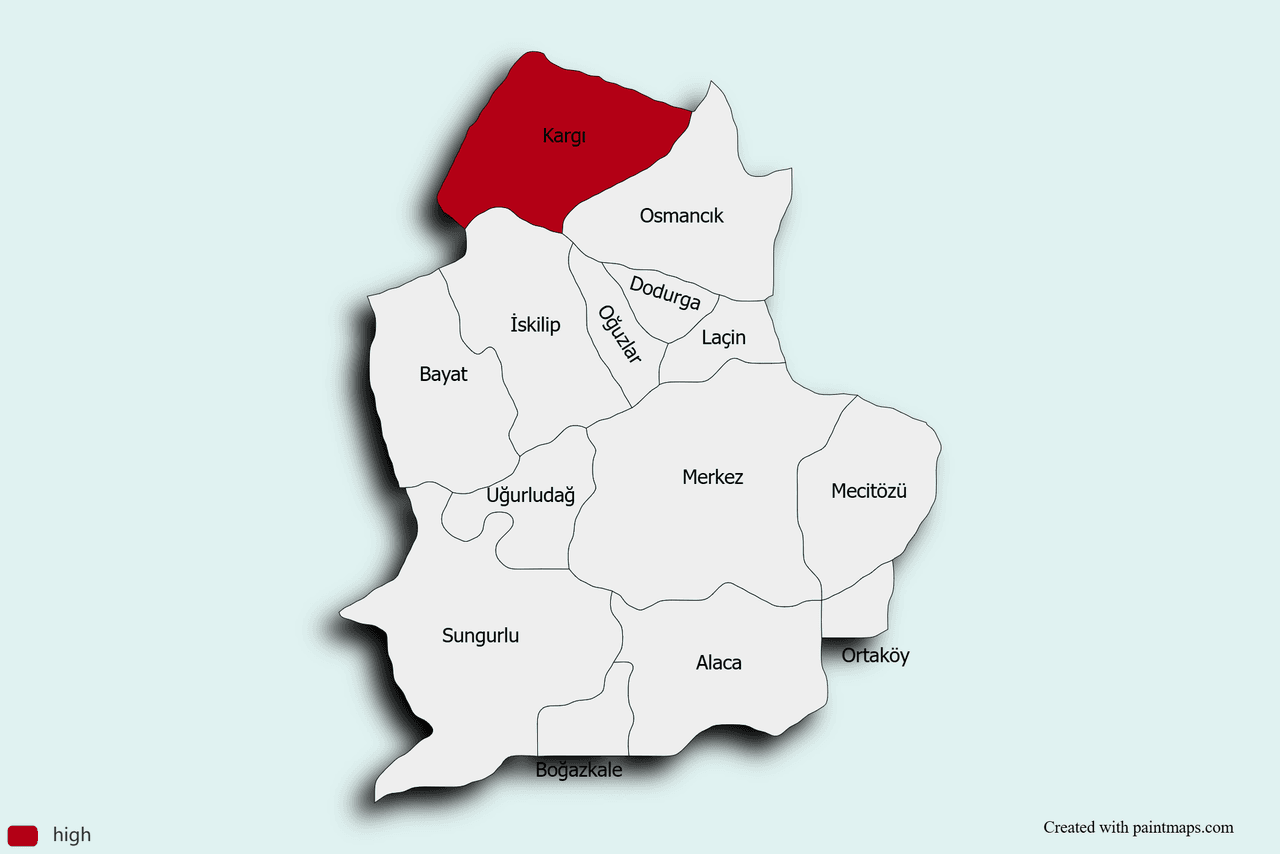
Kargı (District)
Province(s) | Çorum | ||||||||
|---|---|---|---|---|---|---|---|---|---|
Region(s) | Black Sea | ||||||||
Elevation(s) | 420 m | ||||||||
Population (2024) | 15.518 | ||||||||
Mayor(s) | Hamit Dereli | ||||||||
District Governor | Oğuzhan Akman | ||||||||
Postal Code | 19900 | ||||||||
Climate(s) | Continental climate | ||||||||
Economy | Agriculture and livestock | ||||||||
Kargı is a district located in the northwestern part of Çorum, where agriculture and livestock farming are widespread. The district includes 58 villages. Notable natural areas include Karaboya Plateau and Aksu Nature Park.

The historical development of Kargı began with its incorporation into the Turkish dominion of Anatolia. The first Turkish campaigns, initiated in 1015 under the command of Çağrı Bey, paved the way for the gradual conquest of the region following the battles of Pasinler in 1048 and Manzikert in 1071. The territories conquered by Seljuk Sultan Alp Arslan were distributed among his commanders, and Kargı became part of these domains. It is generally accepted that Emir Karategin, a commander loyal to Emir Danişmend Gazi, the founder of the Danişmendids, took control of the region between 1083 and 1084. After the Danişmendid rule, the area came under the authority of the Anatolian Seljuks, followed by the Çobanoğulları and Candaroğulları dynasties, each of which introduced its own local administrative arrangements. Ottoman rule was first established in 1392 during the reign of Yıldırım Bayezid. After the Battle of Ankara in 1402, territories briefly regained by the Candaroğulları were reincorporated into the Ottoman Empire in 1430 and organized as a kazas of the Çankırı Sanjak. The region’s status within Ottoman territory was further consolidated during the reign of Fatih Sultan Mehmet. Following the declaration of the Republic, administrative reforms led to the granting of district status to the settlement, formerly known as Blaene, by Law No. 3012 dated 15 June 1936. It was determined that the name Kargı had been in use since the first quarter of the 16th century.
Kargı is located 106 km from the city center of Çorum along the Osmancık–Tosya road axis. The district consists of two main topographic regions separated by mountain ranges and plateaus to the north and the descending Kızılırmak River valley to the south. In the northern section, the plateaus of Eğinönü, Aksu, Karandu, Göl, Örencik, Karaboya and Gökçedoğan form a connected plateau chain, while the southern valley features expansive alluvial soils suitable for agriculture. The district covers an area of 1,277 km², with an average elevation of 450 m for the district center.
Kargı lies within a transitional climate zone influenced by the Black Sea climate. This influence is reflected in an annual average precipitation of 360.3 mm. The relatively uniform distribution of rainfall, compared to coastal regions, results in mild summers and relatively cold winters. The rugged topography, particularly on the northern plateaus, creates microclimatic diversity; higher elevations exhibit lower temperatures and relatively higher precipitation.
The total population of Kargı district was 17,050 in 2007 and declined to 15,518 by 2024. During this period, population increases of 191, 489 and 576 persons occurred respectively in 2012–2013, 2017–2018 and 2022–2023, while other years saw varying degrees of decline. According to 2024 data, the male population stands at 7,535 (48.56%) and the female population at 7,983 (51.44%), with gender differences typically remaining within a few hundred persons. Annual population fluctuations have followed a variable trend, explained by various factors including local registration updates and migration patterns.
The economy of Kargı is based primarily on agriculture, livestock farming and aquatic product production. Rice (paddy) and okra cultivation is common in the alluvial soils of the Kızılırmak valley; these products serve both fresh consumption and processing facilities. Trout production in the Aksu and Gökçedoğan reservoirs located in the northern plateaus supports the aquatic products sector and contributes to regional trade channels. Beekeeping activities are carried out using hives sustained by the rich vegetation of the plateaus, while livestock farming is predominantly conducted through integrated small and large animal systems.
In the secondary sector, tarhana production, legume packaging and local flour-based food processing facilities enhance economic diversity. Traditional handcrafting of Kargı cloth, with a history approaching a century, along with the drying and packaging of tarhana, provides a foundation for both regional culture and small-scale employment. In the tertiary sector, plateau tourism and nature tourism generate opportunities for service trade, accommodation and food and beverage enterprises.
The tourism potential arises from the combined value of natural and historical heritage. The plateau communities of Eğinönü, Aksu, Karandu, Göl, Örencik, Karaboya and Gökçedoğan in the north offer ecotourism opportunities through stone and wooden structures built in accordance with local architectural traditions. Hiking trails, lakeside rest areas and trout farms constitute key components of nature tourism. Historical remnants such as Kızılcaoluk Waterfall, Dipsiz Lake, Hacıhamza Castle and Hacıhamza Bath, along with the Oğuz and Örencik Mosques, contribute to the cultural diversity of the region.
Cultural richness has developed in tandem with traditional handicrafts and agricultural production. Home-based production methods such as Kargı cloth weaving, tarhana drying and packaging are exhibited in local markets and museum-town presentation spaces, contributing to cultural continuity. Tarhana, a traditional food item made from a mixture of dried legumes and cereals, holds an important place in the daily life of the local population.
The culinary tradition is shaped by ingredients derived from agriculture and aquatic resources. Rice, okra and trout are the primary products meeting the district’s essential protein and carbohydrate needs. Tarhana soup, okra dishes and rice pilaf frequently appear on the menus of local restaurants and accommodation facilities. These dishes, prepared using traditional methods, are regarded as elements reflecting the region’s nutritional culture and socio-economic structure.
T. C. Kargı Municipality. n.d. “Tarihçe.” Kargı Belediyesi. Accessed May 4, 2025. h
T. C. Ministry of Culture and Tourism. n.d. “Kargı Yaylası–Eğnönü.” Kültür Portalı. Accessed May 4, 2025. https://www.kulturportali.gov.tr/turkiye/corum/gezilecekyer/kargi-yaylasi–egnonu-
T. C. Ministry of Culture and TourismÇorum İl Directorate of Culture and Tourism. n.d. “Kargı.” Çorum Provincial Directorate of Culture and Tourism. Accessed May 4, 2025. https://corum.ktb.gov.tr/TR-58698/kargi.html
T. C. Çorum Valiliği. “Kargı.” Çorum Valiliği. Accessed May 4, 2025. http://corum.gov.tr/kargi
T. C.Kargı Kaymakamlığı Governorship. n.d. “İlçe Resimleri.” Kargı District Governorship. Accessed May 4, 2025. http://www.kargi.gov.tr/ilce-resimleri
Türkiye İstatistik Kurumu (TÜİK). Adrese Dayalı Nüfus Kayıt Sistemi Sonuçları, 2024. Accessed April 20, 2025. https://data.tuik.gov.tr/Bulten/Index?p=Adrese-Dayali-Nufus-Kayit-Sistemi-Sonuclari-2024-53783

Kargı (District)
Province(s) | Çorum | ||||||||
|---|---|---|---|---|---|---|---|---|---|
Region(s) | Black Sea | ||||||||
Elevation(s) | 420 m | ||||||||
Population (2024) | 15.518 | ||||||||
Mayor(s) | Hamit Dereli | ||||||||
District Governor | Oğuzhan Akman | ||||||||
Postal Code | 19900 | ||||||||
Climate(s) | Continental climate | ||||||||
Economy | Agriculture and livestock | ||||||||
History
Geography and Climate
Population and Demographics
Economy
Tourism – Culture – Cuisine