This article was automatically translated from the original Turkish version.
+1 More
Location | Istanbul | ||||||||
|---|---|---|---|---|---|---|---|---|---|
Original Construction | 4th century | ||||||||
Major Restoration | 11th century | ||||||||
Reconstruction | 1120 | ||||||||
Artistic Peak | 1305–1321 | ||||||||
Conversion to Mosque | 1511 | ||||||||
Conversion to Museum | 1945 | ||||||||
Restoration to Mosque Status | 2020 | ||||||||
Opening for Worship and Visit | 6 May 2024 | ||||||||
Plan Type | Greek cross-shaped naos Kiborion planned | ||||||||
Main Sections | Annex Parekklesion (chapel) Outer Nartex Inner Narthex Naos | ||||||||
Number of Domes | 6 | ||||||||
Kariye Camii, located in Istanbul’s Edirnekapı neighborhood, is a significant structure from the Byzantine era, originally known as the Chora Monastery Church. The Greek word “khora” means “rural area” or “outside the city.” The building derived its name from its location beyond the walls of Constantinople during the Byzantine period. Over time, the term “khora” came to be used in Turkish as “kariye.”

Kariye Camii (Encyclopedia of Islam)
The exact date of the initial construction of the Chora Church is unknown, but it is understood that the site gained sacred significance in the early 4th century when the tombs of Saint Babylas and his disciples were relocated to this area, followed shortly by the construction of a chapel. During the reign of Emperor Justinian, a new church was built in place of the chapel, and records indicate that the structure was rebuilt after an earthquake in 557.
One of the monastery’s most brilliant periods occurred in the early 9th century with the contributions of the Patriarch Michael Synkellos. In the last quarter of the 11th century, Maria Doukaina, the mother-in-law of Emperor Alexios I Komnenos, commissioned the rebuilding of the structure. Remains from this phase can still be observed on the lower walls of the naos in the present building. Around 1120, a new construction phase initiated by Alexios’s son Isaac Komnenos created a more monumental interior space and shaped key elements of the current structure.
The structure that survives today was extensively restored in the early 14th century by Theodoros Metochites, treasurer to Emperor Andronikos II Palaiologos. During this period, an exonarthex (outer narthex) and a funerary chapel known as the parekklesion were added to the south, and the interior was adorned with mosaics and frescoes. In 1511, it was converted into a mosque by Hadım Atik Ali Pasha and transformed into a museum in 1945. It regained its status as a mosque in 2020 and was reopened for worship and visitation in 2024.
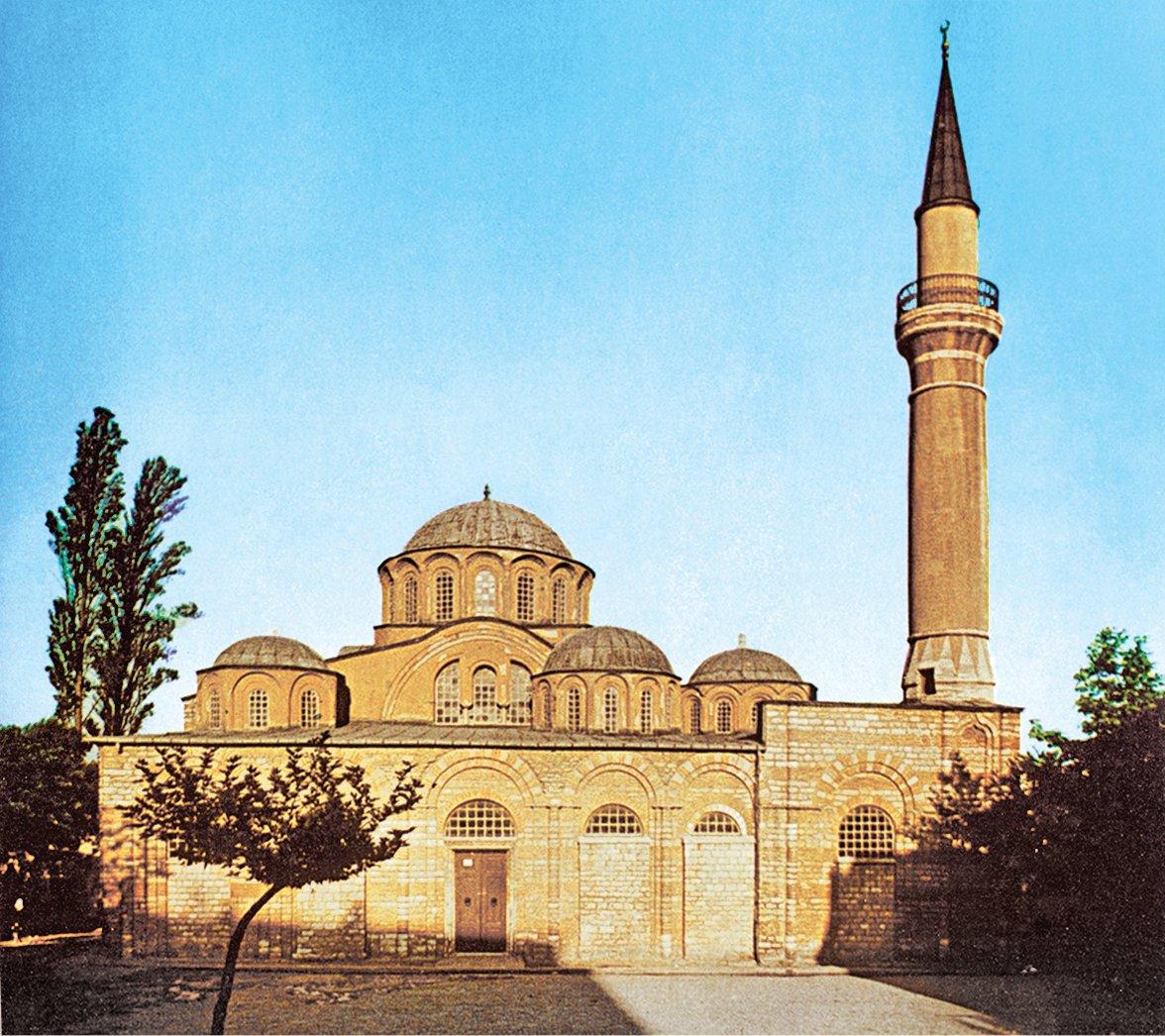
The building consists of five main sections: the naos, a two-story annex to the north, the inner narthex, the outer narthex, and the parekklesion. The main space of the church follows a Greek cross plan, covered by a central dome supported by four arches. This dome, with a high drum, has a diameter of 7.70 meters. There are a total of six domes: two in the inner narthex, two beside the apse, and one in the parekklesion. The domes of the inner narthex feature depictions of Jesus and Mary. The dome of the parekklesion, with a diameter of 4.50 meters, is decorated with a fresco of the Virgin and Child Jesus.
The exterior façade is enlivened by alternating stone and brickwork, half-pilasters, round arches, and niches. In the arches of the section where the minaret stands at the southwest corner, monograms of Metochites have been identified. The building incorporates colored marble cladding brought from Greece, Afyon, and North Africa.
The interior of Kariye is adorned with mosaics and frescoes dating to the 14th century. These decorations rank among the finest examples of late Byzantine art. Scenes from the life of Jesus are depicted in the outer narthex, while scenes from the life of Mary are shown in the inner narthex. The naos contains representations of Christ Pantocrator and the Virgin Mary. The plasticity of the figures, the sense of depth, and the dynamic narrative style in the mosaics go beyond classical Byzantine conventions.
The frescoes in the parekklesion include scenes from the Old Testament. The “Anastasis” (Resurrection) scene in the apse is one of the most striking examples in this section. The “Last Judgment” is also rendered as a fresco in the same area. One of the burial niches in the parekklesion is known to belong to Theodoros Metochites.
The structure underwent various repairs during the Ottoman period. After the 1766 earthquake, it was restored by the architect İsmail Halife, and in the 19th century by the Greek architect Peloppida Kouppas. Between 1948 and 1958, comprehensive restorations were carried out by the American Byzantine Institute and the Dumbarton Oaks Center for Byzantine Studies. During this process, the mosaics and frescoes were cleaned, and much of the interior decoration was revealed. Layers of plaster and paint beneath the wall paintings were removed, and missing sections were stabilized using conservation techniques. A restoration and conservation project initiated by the Ministry of Culture and Tourism in 2013 was undertaken to prevent further deterioration and ensure the building’s longevity.
After regaining its status as a mosque in 2020, the building was reopened for worship and visitation in 2024 following the completion of restoration works. The central section of the mosque (the naos) is designated for prayer. Visiting hours and regulations are determined by the Ministry of Culture and Tourism. Some of the interior mosaics are covered in accordance with the requirements of worship, but the structure as a whole is preserved as cultural heritage.
Çağlar, Berna. “Kariye Camisi’ndeki (Chora Manastırı Kilisesi) Duvar Resimlerinin Koruma ve Onarım Süreçleri Üzerine.” *Sanat Tarihi Dergisi* 24, no. 2 (2015): 45–59. Accessed July 10, 2025. https://dergipark.org.tr/tr/download/article-file/192500
“Kariye (Chora) Museum.” Republic of Türkiye Ministry of Culture and Tourism. Accessed July 10, 2025. https://www.ktb.gov.tr/EN-113780/kariye-carie-museum.html
“Kariye Camii.” *Diyanet İslam Ansiklopedisi*. Accessed July 10, 2025. https://islamansiklopedisi.org.tr/kariye-camii
“Kariye Camii.” *Kutsal Kitap*. Accessed July 10, 2025. https://www.kutsalkitap.org/kariye-camii
“Kariye Müzesi.” Müze.gen.tr. Accessed July 10, 2025. https://muze.gen.tr/muze-detay/kariye
“Kariye Müzesi.” Muzeler.org. Accessed July 10, 2025. https://muzeler.org/kariye-muzesi--809454

Location | Istanbul | ||||||||
|---|---|---|---|---|---|---|---|---|---|
Original Construction | 4th century | ||||||||
Major Restoration | 11th century | ||||||||
Reconstruction | 1120 | ||||||||
Artistic Peak | 1305–1321 | ||||||||
Conversion to Mosque | 1511 | ||||||||
Conversion to Museum | 1945 | ||||||||
Restoration to Mosque Status | 2020 | ||||||||
Opening for Worship and Visit | 6 May 2024 | ||||||||
Plan Type | Greek cross-shaped naos Kiborion planned | ||||||||
Main Sections | Annex Parekklesion (chapel) Outer Nartex Inner Narthex Naos | ||||||||
Number of Domes | 6 | ||||||||
No Discussion Added Yet
Start discussion for "Kariye (Chora) Camii" article
History
Architectural Features
Artistic Elements
Restoration and Conservation Processes
Current Status