


This article was automatically translated from the original Turkish version.
+2 More
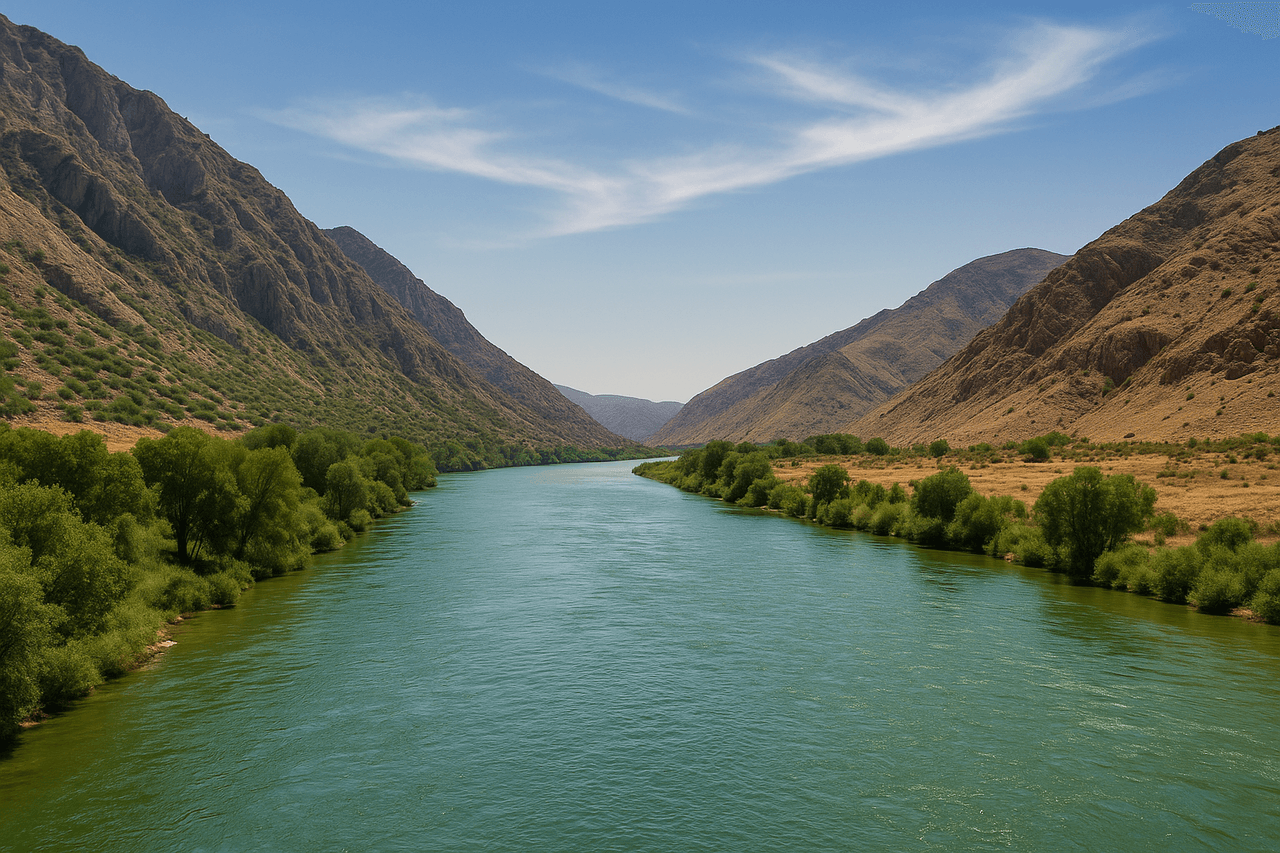
Karun River
Location | Southwestern Iran (particularly Khuzestan Province) | ||||||||
|---|---|---|---|---|---|---|---|---|---|
Length(s) | Approximately 900 km | ||||||||
Basin Area | Approximately 67,500 km² | ||||||||
Karun River is a major river located in southwestern Iran, recognized as the country’s longest and most water-rich river. With a length of approximately 900 km, the Karun originates from the high peaks of the Zagros Mountains, particularly the Zard Kuh region (4548 m), and flows through Iran’s Khuzestan Province before joining the Arvand Rūd (Shatt al-Arab) River, which empties into the Strait of Hormuz.
The Karun River basin covers an area of approximately 67,500 km² and includes the provinces of Isfahan, Chaharmahal and Bakhtiari, Lorestan, Kohgiluyeh and Boyer-Ahmad, and Khuzestan. This vast geography, characterized by heterogeneous topography and climatic conditions, is a significant factor influencing the river’s flow regime.
Geologically, the Karun River is part of the Tigris-Euphrates-Karun fluvial system and constitutes an important component of the Mesopotamian foreland basin. The sediments carried by the river are poor in quartz and have formed significant sedimentary deposits shaped by the region’s arid climatic conditions.
The Karun River is of great importance in Iran for controlling river floods, irrigation, and supplying drinking water. Measurements conducted at the Ahvaz hydrological station between 1954 and 2005 recorded the river’s annual:
In recent years, significant declines in the Karun River’s flow regime have been observed due to climate change, dam construction, population growth, and agricultural use. Statistical analyses have revealed a clear downward trend since the 2000s.
The Karun River faces severe water pollution problems due to intensive agriculture, industry, and urban development in its surrounding areas. Studies conducted between 2009 and 2011 detected residues of organochlorine pesticides (OCPs) in the river water. In particular:
According to World Health Organization (WHO) standards, these levels exceed ecological safety thresholds and pose a threat to aquatic life.
The Karun River holds strategic importance for the region not only hydrologically but also historically and culturally. Since ancient times, particularly during the Susiana civilization, it has been used for agriculture and transportation and played a decisive role in the development of major cities such as Ahvaz.
Moreover, the sediments transported by the river have been one of the key dynamics shaping the geological evolution of the Mesopotamian region. In this regard, the Karun is regarded as a natural system of geoarchaeological significance in scientific research.
Behfar, Abdolazim, Zahra Nazari, Mohammad Hassan Rabiee, Gholamreza Raeesi, Mohammad Reza Oveisi, Nafiseh Sadeghi, and Behrooz Jannat. 2013. "The Organochlorine Pesticides Residue Levels in Karun River Water." Jundishapur Journal of Natural Pharmaceutical Products 8, no. 1 (2013): 41–46. https://pmc.ncbi.nlm.nih.gov/articles/PMC3941877/pdf/jjnpp-08-41.pdf
Garzanti, Eduardo, Ali Ismail Al-Juboury, Yousef Zoleikhaei, Pieter Vermeesch, Jaafar Jotheri, Dicle Bal Akkoca, Ahmed Kadhim Obaid, Mark B. Allen, Sergio Andó, Mara Limonta, Marta Padoan, Alberto Resentini, Martin Rittner, and Giovanni Vezzoli. "The Euphrates-Tigris-Karun River System: Provenance, Recycling and Dispersal of Quartz-Poor Foreland-Basin Sediments in Arid Climate." Earth-Science Reviews 2016: 107–128. Accessed May 5, 2025. https://pdf.sciencedirectassets.com/271741/1-s2.0-S0012825216X00098/1-s2.0-S0012825216303166/main.pdf?X-Amz-Security-Token=IQoJb3JpZ2luX2VjEHMaCXVzLWVhc3QtMSJHMEUCIQC3UMMUqEdETCkqmNgIHHNeSfsJ6yQe4LOE%2FgTdxgH1gwIgUI66OKvWoDNoPVs7YQl8yReULCZhwvqyH35J%2FXR%2FQ34qswUITBAFGgwwNTkwMDM1NDY4NjUiDBYRLLJdOtWBNNp8bCqQBdIx0EgxkBsFMjf3a7pPJbdHtMiXhkUdFSNZNTihi6Pdlq5TY0oF%2BJdyH2rfyN9o7R0ZqRNiR0qXZ91zHzcE5q7V8iO5FrVkiMaseR8lBwRlZnZ%2FJIVXyHAXF3eudhcas1ww6XSrLC9WgyvTFTRGGgr%2BokhcNF3aS27MOV%2F3i4T87RqdUYLUTqs%2F6SxoltKBQOi7q3OW8MFUGZedxoZkaFBd5TkAurhmcrv5z9Ps988e3MtEMv5iVueraazVnFBO5KcKYD%2BKA5nx2K4LnStfB8u2LGm1PPgGJHb0ldnIh2yGcVxR%2FjT2DsaCufaMiuzrbYAe2Bi9iPsrLifnWD65FM7pUpQBv9qP5BoptnL5pgF2b03Ki6VqclBN4P9%2FPIO1hPIcBAjC9eEUuox3pdxtUMOVEFng2qNuiPZkNv2jYRT7BNGtv2FHoIVNMQC02tpNnXLs2OV073lkL0ZfzZdekprDwNmlrJJXzbsps6WbL%2F25zDS3MI9Gqtn66GRJsEuL9oloqDy8igrU7qQJzBIgBHNlIXNss28TAnKUJzX6Toa48o6gXjNhQqtFhsL9yWu2EcijGV7g3Nbj5swHizcxLHvxJN9FW0POWE0dZ1gpVv%2BXc0R9gfJcHquD4rZkPT8mCfdtUa1%2BWP2DNWipp7DFKNdT5XYRCMVAWXIp28oBYaH7s0mhFfzEBQq12%2FJsDva0tPu9os2To8YCBUAweAj6RP2MJH69Je2ZXghmzPMIGkxIsLFwTDNw5uY2AC8f5D%2FcOAISFSYIGCDt9qSo79XKn5%2FQKclL6UcOM5rto7RZPv4grViq36Nmnji8BhETES52YmUht%2F0VaTiPNUJltwndnw%2FS9KWduu2acl6H0asi4QfaMKzQh8IGOrEBitIyKP184wpl7EOVNaujWh78zf8kXFBegrKvDzRt1YREyzhcvmoYSNH0%2Fl7BDS2RiNMjdnc4pL6a8Qn59HtuJulm8WNCDRVgc7WRhyOtaZ9VLv6qYS4FGSgTUs15zodm10N6omI2G7B054D1pFETt%2BP4auZMUw4H6tpP0cBVXRlT%2F6cRM7quOUh1ILXrZBcVU8IkmGkxvWE6idIDdTVTzsNySlN7gPa78I9lVnCAKWM3&X-Amz-Algorithm=AWS4-HMAC-SHA256&X-Amz-Date=20250605T194337Z&X-Amz-SignedHeaders=host&X-Amz-Expires=300&X-Amz-Credential=ASIAQ3PHCVTYVETUEYGO%2F20250605%2Fus-east-1%2Fs3%2Faws4_request&X-Amz-Signature=91bfbbbb835ab1f34d3e930ccdd2fd72b3f1198e52d8a463e4fd3e27ee1cf5d5&hash=081e08bd9e3b320e178adef91ab9b857e2961fd6780bd197209b711b0a6235c3&host=68042c943591013ac2b2430a89b270f6af2c76d8dfd086a07176afe7c76c2c61&pii=S0012825216303166&tid=spdf-ee88572f-19e9-4706-8d3f-ee757ab546f9&sid=f7c9e5a05e44654d176a0c503ec55d850ab0gxrqb&type=client&tsoh=d3d3LnNjaWVuY2VkaXJlY3QuY29t&rh=d3d3LnNjaWVuY2VkaXJlY3QuY29t&ua=0e145b510055505b055c53&rr=94b228f3382cba2b&cc=tr
Salarijazi, Meysam, Ali-Mohammad Akhond-Ali, Arash Adib, and Alireza Daneshkhah. "Trend and Change-Point Detection for the Annual Stream-Flow Series of the Karun River at the Ahvaz Hydrometric Station." African Journal of Agricultural Research 7, no. 32 (2012): 4540–4552. https://academicjournals.org/journal/AJAR/article-full-text-pdf/00C31C933597 Accessed May 5, 2025.

Karun River
Location | Southwestern Iran (particularly Khuzestan Province) | ||||||||
|---|---|---|---|---|---|---|---|---|---|
Length(s) | Approximately 900 km | ||||||||
Basin Area | Approximately 67,500 km² | ||||||||
Geographical and Geological Characteristics
Hydrological Characteristics
Pollution and Environmental Impacts
Ecological and Historical Significance