This article was automatically translated from the original Turkish version.
Type of Geographical Indication | Mahreç Sign | ||||||||
|---|---|---|---|---|---|---|---|---|---|
Registration Number | 711 | ||||||||
Registration Date | 29.03.2021 | ||||||||
Product / Product Group(s) | Processed and unprocessed meat products | ||||||||
Province(s) | Kastamonu | ||||||||
Applicant/Registrant(s) | Kastamonu Chamber of Tradesmen and Artisans | ||||||||
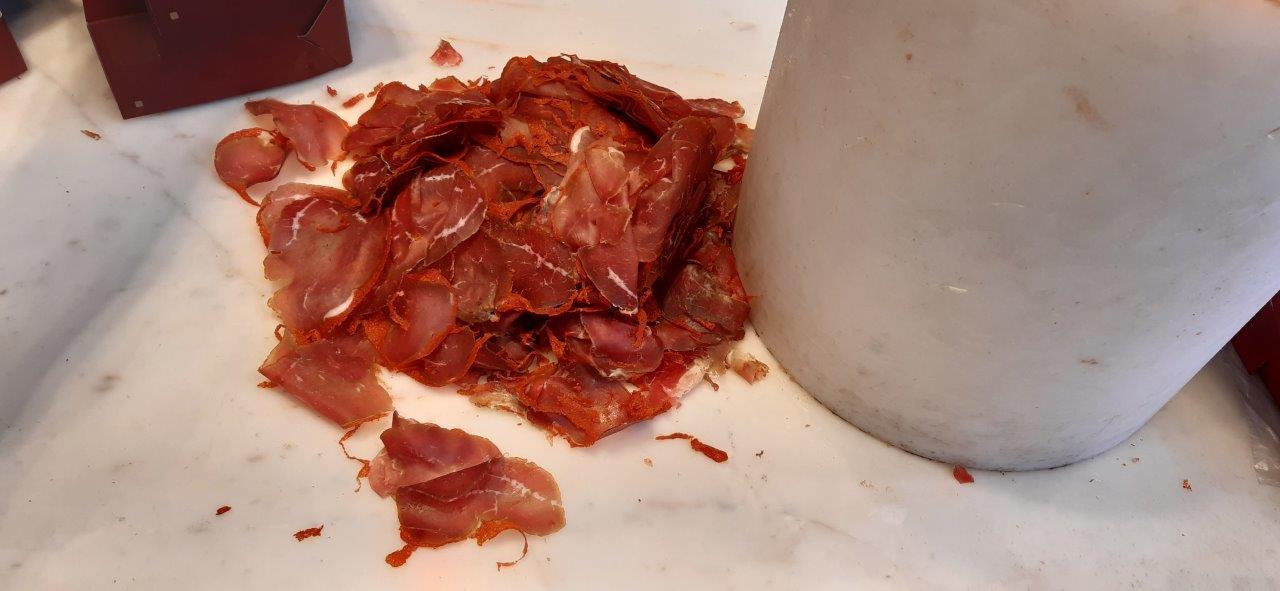
Kastamonu pastırma is a traditional meat product specific to the province of Kastamonu. The production process involves making deep incisions (shaklama) into boneless back meat, salting it with rock salt, pressing it after resting, washing it, drying it in the sun, and then coating it with a special paste containing the geographical indication-registered Taşköprü garlic. This product is typically produced between September and April and is distinguished by its unique flavor and texture. It was officially registered by the Turkish Patent and Trademark Office on 29.03.2021.
The distinctive structure of Kastamonu pastırma is determined by the selection of raw materials, production method, and final product qualities.
The production of Kastamonu pastırma follows traditional stages:
The geographical boundary of Kastamonu pastırma is limited to the province of Kastamonu. Since the distinctive features of the product—meat selection and preparation, traditional drying using the Ilgaz Mountain breeze, use of the geographical indication-registered Taşköprü garlic in the paste, and manual thin slicing of the block—require specialized craftsmanship, all stages of production must be carried out within this geographical boundary.
Monitoring of the product is conducted at least once annually by a monitoring body of at least four members coordinated by the Kastamonu Chamber of Tradesmen and Artisans. Additional inspections may be carried out in the event of complaints.
During inspections, samples are collected by the monitoring body, and inspection reports are submitted to the Turkish Patent and Trademark Office within the timeframes specified by applicable regulations.
Turkish Patent and Trademark Office. "Kastamonu Pastırması Coğrafi İşaret Sicil Başvuru Belgesi." Accessed October 24, 2025. https://ci.turkpatent.gov.tr/Files/GeographicalSigns/82d9d3be-46bc-4d3b-a335-8bfb841c029e.pdf.
Turkish Patent and Trademark Office. "Kastamonu Pastırması." Geographical Indications Portal. Accessed October 24, 2025. https://ci.turkpatent.gov.tr/cografi-isaretler/detay/38472.

Type of Geographical Indication | Mahreç Sign | ||||||||
|---|---|---|---|---|---|---|---|---|---|
Registration Number | 711 | ||||||||
Registration Date | 29.03.2021 | ||||||||
Product / Product Group(s) | Processed and unprocessed meat products | ||||||||
Province(s) | Kastamonu | ||||||||
Applicant/Registrant(s) | Kastamonu Chamber of Tradesmen and Artisans | ||||||||
Product Characteristics
Raw Materials
Final Product Qualities
Production Method
Paste Composition
Geographical Boundary
Monitoring
Monitoring Body Members
Monitoring Criteria