



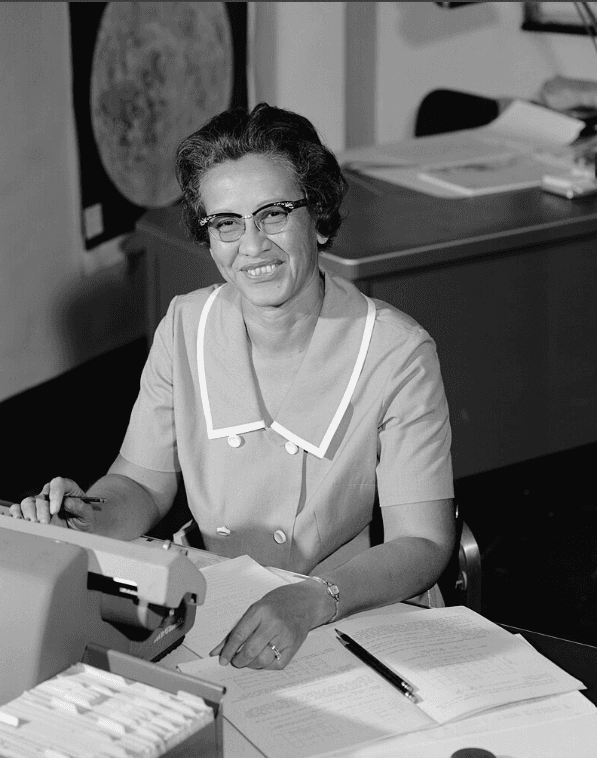
She was born on August 26, 1918, in the town of White Sulphur Springs, West Virginia. During a time when racial discrimination was widespread in the United States, she stood out as one of the few African American women to achieve notable scientific success.
Her father worked in farming and her mother was a teacher. Her family placed great importance on education. Her aptitude for mathematics was recognized at an early age. She graduated from high school at the age of 14. In 1937, she graduated from West Virginia State College with high honors in mathematics and French. In 1939, she became one of the first African American women admitted to graduate school at West Virginia University.
In 1953, she began working at the National Advisory Committee for Aeronautics (NACA), the United States’ aeronautics research agency. She served as one of the “human computers,” performing complex calculations by hand. In 1958, she continued her career at NASA, which replaced NACA.
She gained recognition for her expertise in orbital mechanics. She played a pivotal role in the 1962 mission that placed John Glenn into Earth orbit as part of Project Mercury. Glenn specifically requested that Katherine Johnson manually verify the computer-generated calculations before his flight.
She also took responsibility for calculating trajectories for the Apollo 11 lunar landing mission and the Space Shuttle program. Following the malfunction during the Apollo 13 mission in 1970, she was among the experts consulted to calculate the return trajectory.
During her time at NASA, she faced numerous discriminatory practices due to both her gender and her identity as an African American woman. However, her technical competence and flawless calculations earned her the trust of engineering teams. Throughout her career, she served as a role model for the advancement of women and minority groups in scientific fields.
She retired from NASA in 1986. After retirement, she became an inspiration for efforts to increase the representation of women and minorities in science, technology, engineering, and mathematics (STEM).
In 2015, she was awarded the Presidential Medal of Freedom by United States President Barack Obama. In 2016, she gained widespread recognition through the book Hidden Figures by Margot Lee Shetterly and the film of the same name.
In 2017, NASA honored her by naming a building complex the Katherine G. Johnson Computational Research Facility. She passed away on February 24, 2020, at the age of 101. She left behind not only a legacy of contributions to space research but also a lasting impact on equality and equal opportunity.
NASA. "Katherine Johnson Biography." Accessed May 1, 2025. https://www.nasa.gov/content/katherine-johnson-biography

Early Life and Education
Scientific Contributions and Achievements
Challenges and Struggles
Legacy and Impact