


This article was automatically translated from the original Turkish version.

Kavaklıdere Walnut (Generated by Artificial Intelligence.)
Registration Number | 528 | ||||||||
|---|---|---|---|---|---|---|---|---|---|
Geographical Boundary | Muğla Province Kavaklıdere District | ||||||||
Shell Thickness | 2.47 mm | ||||||||
Circumference | 101 mm | ||||||||
Climate(s) | Cool and Humid | ||||||||
Kavaklıdere walnut is a walnut variety cultivated in the Kavaklıdere district of Muğla Province and officially registered with its place of origin in 2020. Registration details are as follows: Registration No: 528, Application No: C2016/090, Application Date: 19.09.2016, Registered by: Muğla Chamber of Commerce and Industry. The geographical indication appears on the product packaging together with the place of origin emblem.
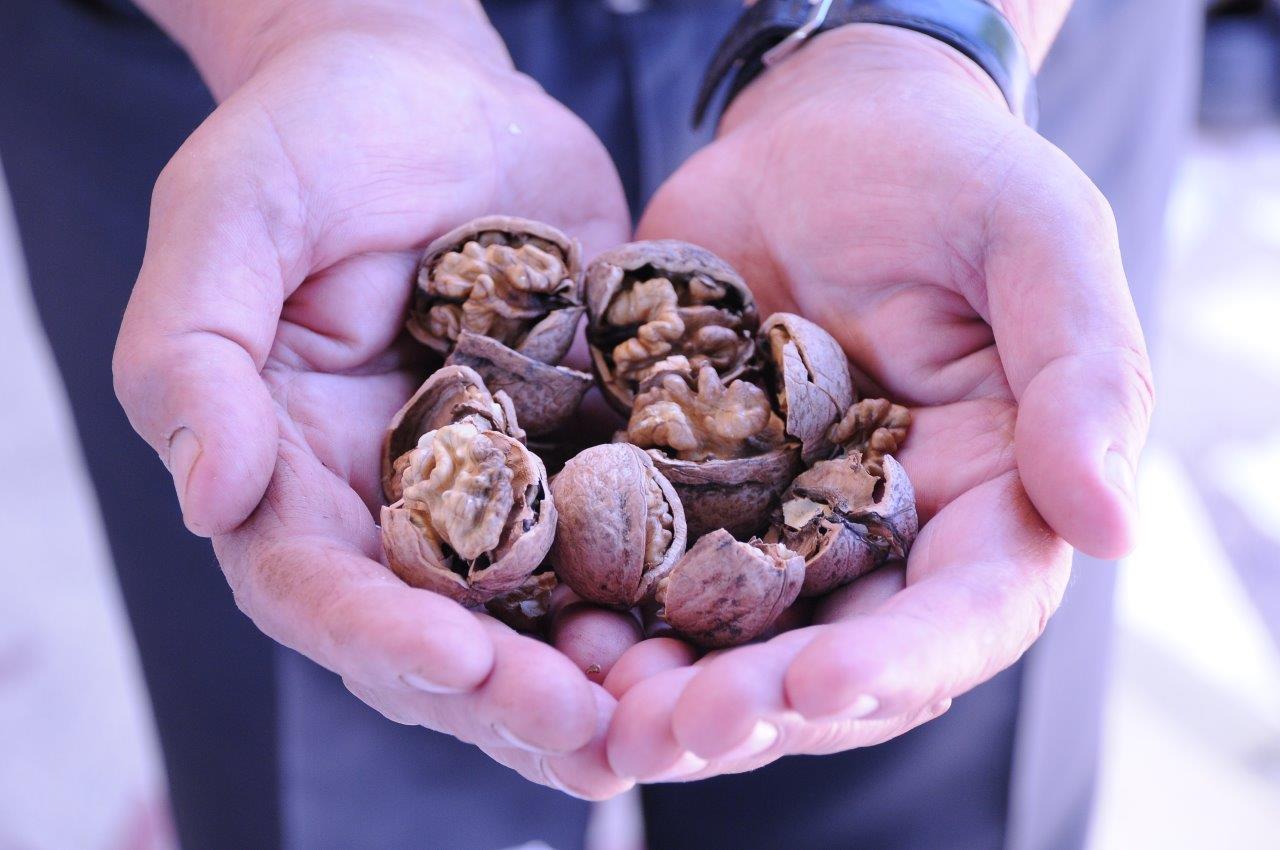
Kavaklıdere Walnut (Turkish Patent)
The Kavaklıdere walnut is a large variety with a shell that is white-yellow, white-light brown or white-brown in color and features white spots. Its average weight is 12.10 g, with the edible kernel weighing 5.20 g (43%) and the shell 6.90 g (57%). The average shell thickness is 2.47 mm. Its dimensions are: height 48.3 mm, width 46.1 mm, depth 45.1 mm, and circumference 101 mm. Approximately 55.57% of the kernel consists of fat, 17.16% protein, 1.57% carbohydrates, and 2.48% mineral components. One hundred grams of walnut provides approximately 2406.04 kJ / 575.05 kcal of energy.
The Kavaklıdere walnut thrives in cool and humid climates on sandy loam soils with a pH range of 6.0 to 7.5. Seedlings are grafted using cleft grafting, while mature trees are grafted using bark grafting. Seedlings are planted in holes measuring 1x1x1 m, and superphosphate, potassium sulfate fertilizers, and composted animal manure are applied to the soil. Pruning is carried out annually in February and March. Irrigation is applied weekly during the seedling stage and minimally for mature trees. The Kavaklıdere walnut is a self-pollinating variety.
Harvesting takes place in October, yielding approximately 30 to 40 kg of product per tree. The produce is processed through cracking, sizing, transportation, and packaging at the facilities of the Kavaklıdere Agricultural Development Cooperative before being marketed. The facility has a daily processing capacity of 3 tons.
Inspections are conducted under the coordination of the Muğla Chamber of Commerce and Industry, in collaboration with Muğla Sıtkı Koçman University, the Muğla Branch of the Turkish Chamber of Agricultural Engineers, and the Muğla Provincial Directorate of Agriculture and Forestry. Inspection covers the production area, including control of tree planting, physical and chemical characteristics. The packaging bears the label “Kavaklıdere Walnut” together with the place of origin emblem.
T.C. Ministry of Agriculture and Forestry. “Tescilli Muğla Cevizi İçin İşleme Tesisi Kuruldu.” Tarım Orman Ekranı, December 12, 2023. Accessed August 16, 2025. https://www.tarimtv.gov.tr/tr/video-detay/tescilli-mugla-cevizi-icin-isleme-tesisi-kuruldu-18213.
Turk Patent and Trademark Office. "Kavaklıdere Cevizi – Coğrafi İşaret Detayı." Geographical Indications Portal. Accessed August 16, 2025. https://ci.turkpatent.gov.tr/cografi-isaretler/detay/38226.
Turk Patent and Trademark Office. "No: 528 – Geographical Indication – Kavaklıdere Walnut." Geographical Indications Portal. Accessed August 16, 2025. https://ci.turkpatent.gov.tr/Files/GeographicalSigns/3c04b492-3528-4379-895b-a0fd4c984dea.pdf.

Kavaklıdere Walnut (Generated by Artificial Intelligence.)
Registration Number | 528 | ||||||||
|---|---|---|---|---|---|---|---|---|---|
Geographical Boundary | Muğla Province Kavaklıdere District | ||||||||
Shell Thickness | 2.47 mm | ||||||||
Circumference | 101 mm | ||||||||
Climate(s) | Cool and Humid | ||||||||
Physical and Nutritional Properties
Cultivation Conditions and Agricultural Practices
Harvest and Product Evaluation
Inspection and Registration Procedures