

This article was automatically translated from the original Turkish version.
Type of Geographical İndication | Mahreç Sign | ||||||||
|---|---|---|---|---|---|---|---|---|---|
Registration Number | 35 | ||||||||
Registration Date | 25.06.2002 | ||||||||
Product / Product Group(s) | Processed and unprocessed meat products | ||||||||
Province(s) | Kayseri | ||||||||
Applicant/Registrant(s) | Kayseri Chamber of Commerce | ||||||||
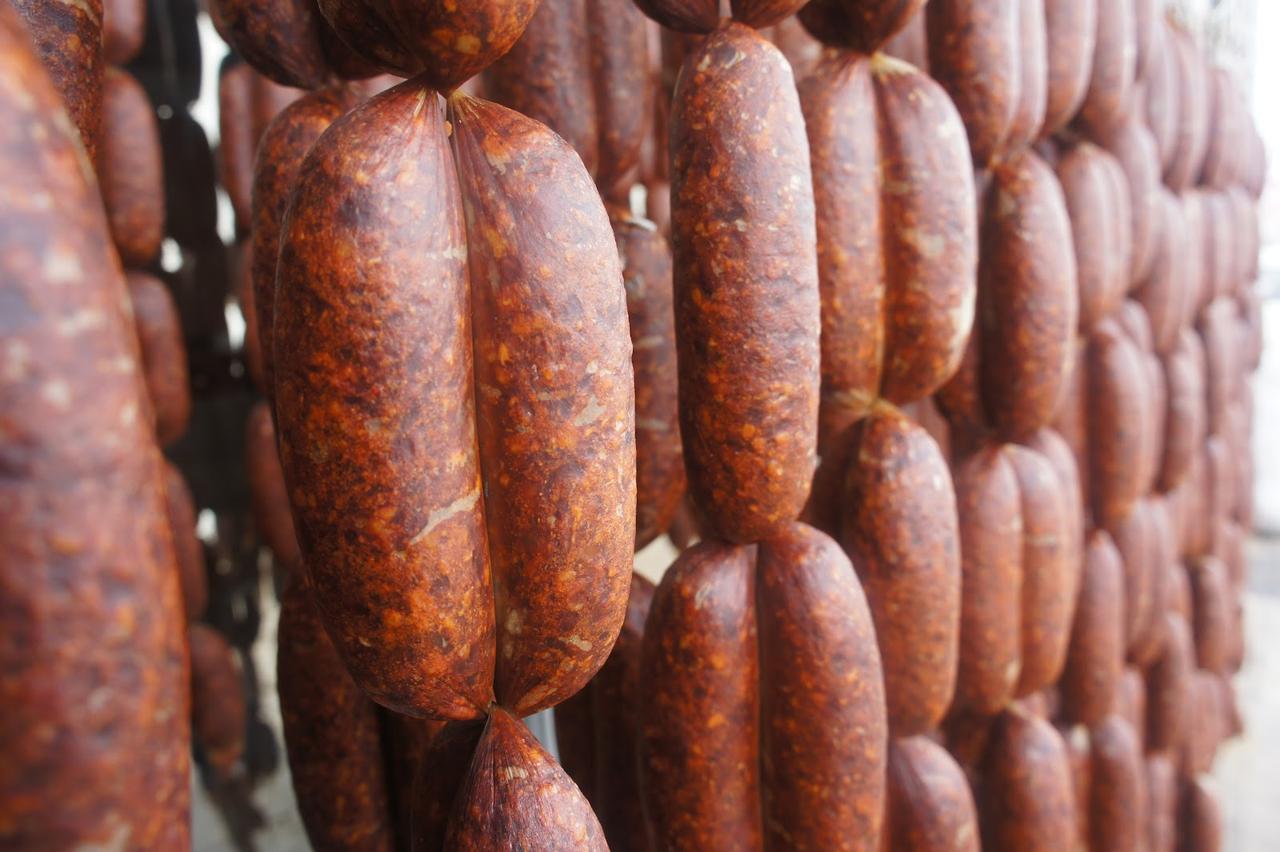
Kayseri sucuğu is a fermented meat product unique to Kayseri province in Türkiye, officially registered with a geographical indication. It is produced by mixing minced beef with garlic and various spices, then stuffing the mixture into natural casings. The product is distinguished by its pronounced spiciness and intense garlic-cumin aroma; it has a finger-like shape, a dark red color, and a mosaic-like texture of white spots.
Kayseri sucuğu is rooted in a long-standing production tradition shaped by the region’s climatic and cultural conditions. In eras before refrigeration technology, drying methods developed to prevent meat spoilage transformed sucuk production into an established practice. Particularly during the autumn “pastırma yazısı” period, when dry winds from Mount Erciyes and high day-night temperature differences prevail, sucuk could be naturally fermented and matured outdoors. These natural conditions play a decisive role in developing the product’s characteristic flavor.
Praise for Kayseri sucuğu appears in Evliya Çelebi’s 17th-century Seyahatname, while the 1928 Askeri Tıbbi Baytarı Mecmuası also emphasizes Kayseri’s superiority in sucuk production. 【1】
Kayseri sucuğu is produced using both traditional and industrial methods. In both cases, the fundamental stages are identical: beef and internal fat are ground through a meat grinder, mixed with garlic and spices, stuffed into natural casings, and hung in finger-shaped segments. The product is fermented for 3 to 5 days under controlled humidity, temperature, and air circulation.
The selection of ingredients, preparation, mixing duration, and ripening control for Kayseri sucuğu require specialized skill. This accumulated knowledge establishes a direct link to the geographical area. Therefore, all production stages must be carried out exclusively within the boundaries of Kayseri province.
Kayseri sucuğu was registered with a geographical indication on 28 January 2001, with the registration process completed on 25 June 2002. Inspections are conducted at least once annually by a supervisory body composed of relevant public institutions and expert representatives coordinated by the Kayseri Chamber of Commerce, and more frequently if necessary. Inspections verify compliance with production methods, ingredients, physical and chemical properties, and the correct use of labels and emblems.
Kayseri sucuğu holds an important place in the city’s culinary culture. It attracts significant interest from both local and international tourists, as evidenced by the Sucuk Ekmek Festival held at the Erciyes Ski Center. The product is recognized as a renowned local asset contributing significantly to Kayseri’s economy.
Turk Patent and Trademark Office. "Kayseri Sucuğu Coğrafi İşaret Sicil Belgesi (Tescil No: 35)." Turk Patent and Trademark Office Geographical Indications Portal. Accessed October 24, 2025. https://ci.turkpatent.gov.tr/Files/GeographicalSigns/44f71030-9f19-45d5-87b5-14c98f4757ee.pdf.
Turkish Patent and Trademark Office. "Kayseri Sucuğu." Geographical Indications Portal. Accessed October 24, 2025. https://ci.turkpatent.gov.tr/cografi-isaretler/detay/37897.
[1]
Türk Patent ve Marka Kurumu, Kayseri Sucuğu Coğrafi İşaret Sicil Belgesi (Tescil No: 35) (Türk Patent ve Marka Kurumu Coğrafi İşaretler Portalı, erişim 24 Ekim 2025), 3, https://ci.turkpatent.gov.tr/Files/GeographicalSigns/44f71030-9f19-45d5-87b5-14c98f4757ee.pdf.

Type of Geographical İndication | Mahreç Sign | ||||||||
|---|---|---|---|---|---|---|---|---|---|
Registration Number | 35 | ||||||||
Registration Date | 25.06.2002 | ||||||||
Product / Product Group(s) | Processed and unprocessed meat products | ||||||||
Province(s) | Kayseri | ||||||||
Applicant/Registrant(s) | Kayseri Chamber of Commerce | ||||||||
Historical Background
Production Characteristics
Traditional Production Ingredients (per 100 kg dough)
Industrial Production Ingredients
Physical and Chemical Properties
Geographical Indication and Production Conditions
Registration and Oversight
Cultural and Economic Value