


This article was automatically translated from the original Turkish version.
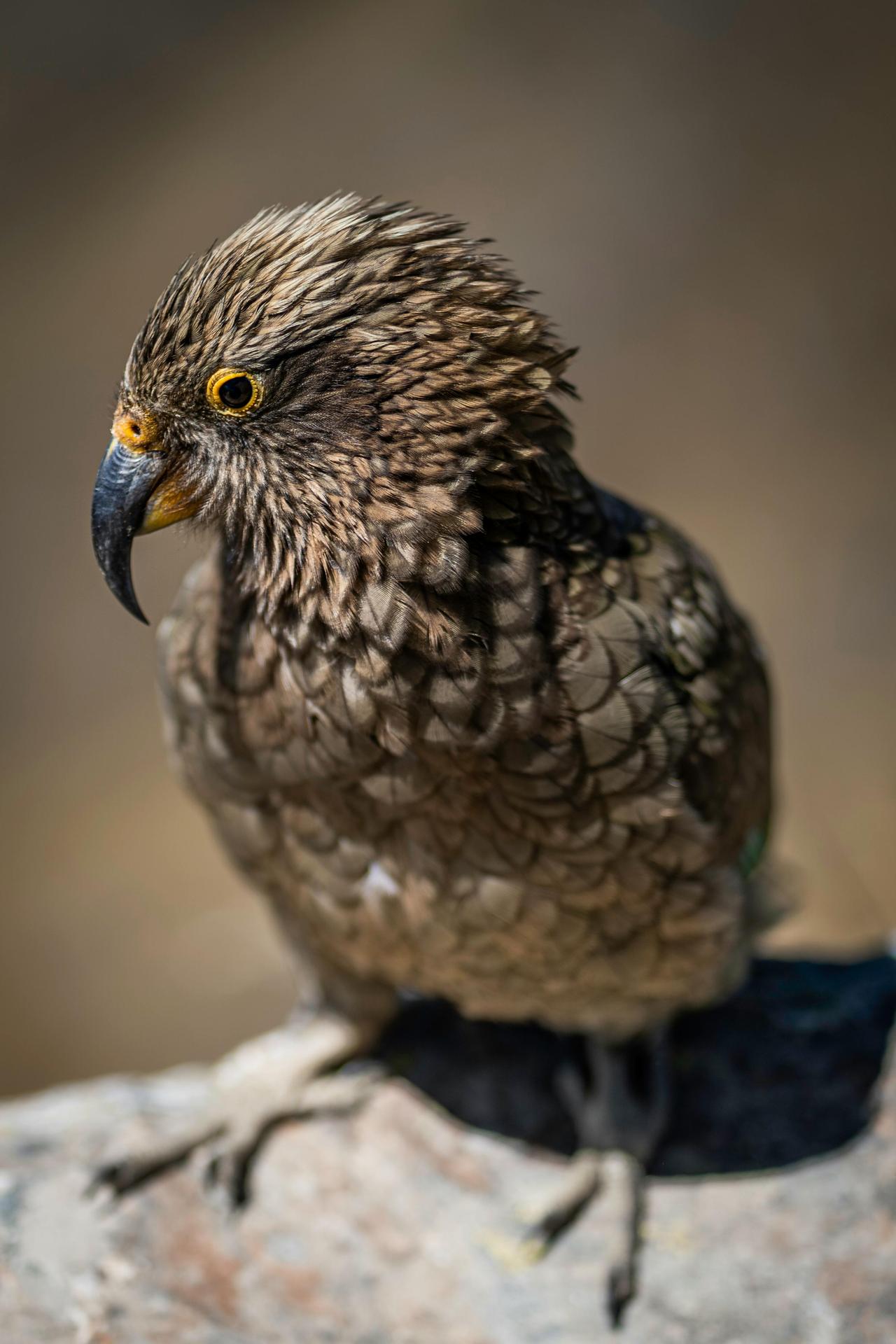
Kea (Nestor notabilis)
Team(s) | Psittaciformes (Parrots) | ||||||||
|---|---|---|---|---|---|---|---|---|---|
Family | Strigopidae | ||||||||
Species Name | Nestor notabilis | ||||||||
Distribution(s) | New Zealand – South Island only | ||||||||
Conservation Status | IUCN – Threatened | ||||||||
Kea (Nestor notabilis) is a large parrot species endemic to New Zealand’s South Island, adapted to alpine habitats and renowned for its high cognitive abilities. The Kea is the world’s only known mountain parrot and serves as an important model in ecological and evolutionary research due to its behavioral flexibility, social structure, and environmental adaptability.

Kea Parrot ()
The Kea measures approximately 48 cm in length and can weigh up to 1 kg in males and an average of 800 g in females. Both sexes are covered in olive-green plumage, with striking orange-red coloration visible under the wings. The beak is blackish, long, and curved; this structure aids in processing food and interacting with the environment. Males have beaks approximately 12% longer than those of females. Juveniles until maturity have a distinct yellow coloration around the cere, eye rings, and surrounding areas, which darkens with age.
The Kea is found only on New Zealand’s South Island, spanning an area of about 3.5 million hectares. Its primary range extends along the Southern Alps, occurring across a wide spectrum from montane forests to subalpine and alpine zones. It is occasionally observed at elevations near sea level. Its habitat includes natural forests, grasslands, shrublands, rocky areas, and regions near human settlements.
The Kea is notable for its high intelligence, playful tendencies, and problem-solving abilities. Various experiments conducted by the University of Vienna have observed that Keas exhibit advanced cognitive skills such as social learning, cooperation, and tool use. In particular, in a test known as the “support problem,” they successfully assessed whether a reward was placed on a supporting surface. Some individuals demonstrated performance comparable to that of chimpanzees in these tests.
Keas are social birds that form loose groups with long-term pair bonds. Juveniles travel in groups, facilitating learning. Their social structure is flexible, and individuals communicate using a variety of vocal and visual signals. The underwing feathers of the Kea carry visual signals that become prominent under ultraviolet light.

Kea Parrot ()
The Kea nests in ground burrows and follows a monogamous breeding system. Nest sites are typically natural cavities such as those beneath tree roots, rock crevices, or decaying logs. The breeding season occurs between July and January; the female lays between one and five eggs, averaging three. Incubation lasts 22 to 24 days, and chicks remain in the nest for 90 to 100 days. All care is provided by the female, while the male supplies her with food.
The Kea is an omnivorous species. Its diet includes fruit, seeds, nectar, leaves, insect larvae, grubs found in rotting wood, carrion, and occasionally the chicks of other birds. It also feeds on the carcasses of alpine animals such as chamois, deer, and sheep left behind after predation. Rarely, Keas land on the backs of sheep and tear at the skin to access subcutaneous fat; this behavior led to intense hunting of Keas during the 19th and 20th centuries.
The International Union for Conservation of Nature (IUCN) classified the Kea as Endangered in 2017. The New Zealand government also classifies it as Nationally Endangered. Populations are under pressure due to historical bounties that resulted in the killing of approximately 150,000 individuals, and ongoing threats including invasive predators, lead poisoning, pesticides, and habitat loss. Recent estimates suggest a total population of around 6,000 individuals. In a study by Van Klink and Crowell, it was found that during 1080 pesticide applications in the Otira region, bird repellents were inadequate, resulting in the poisoning of 5 out of 34 individuals (14.7%).
The Kea is regarded as a taonga (treasure with spiritual value) in Māori culture. The Waitaha Māori people viewed the Kea as a guardian of the mountains in their search for pounamu (greenstone). Nevertheless, the perception that Keas damage sheep has sometimes negatively affected human-Kea relationships.
Alexander Dodd. "Bird Preening in Close Up Photography JPG." Pexels. Accessed May 12, 2025. https://www.pexels.com/photo/bird-preening-in-close-up-photography-4118918/
Barni1. "Kea, Mountain Parrot, Mischievous Image JPG." Pixabay. Accessed May 12, 2025. https://pixabay.com/tr/photos/kea-da%C4%9F-papa%C4%9Fan-yaramaz-2138420/
BirdLife International. "Nestor notabilis." The IUCN Red List of Threatened Species. Accessed May 12, 2025. https://dx.doi.org/10.2305/IUCN.UK.2017-3.RLTS.T22684831A119243358.en
Dussex, Nicolas, et al. "Kea (Nestor notabilis): A Review of Ecology, Threats, and Research Priorities." *Science for Conservation* 339 (2023): 1–64. Accessed May 12, 2025. https://www.doc.govt.nz/globalassets/documents/science-and-technical/sfc339entire.pdf
Kea Conservation Trust. "Kea Facts." Kea Conservation Trust. Accessed May 12, 2025. https://www.keaconservation.co.nz/kea-information/kea-facts/
Klosterman, Kimberly. Kea (Nestor notabilis) Care Manual. Silver Spring, MD: Association of Zoos and Aquariums, 2019.
Mackay, Jemma. "Kea Papağanı Portresi JPG." Pexels. Accessed May 12, 2025. https://www.pexels.com/tr-tr/fotograf/kea-papagani-portresi-22679268/
Mudassir Ali. "Photo of a Brown Bird JPG." Pexels. Accessed May 12, 2025. https://www.pexels.com/photo/photo-of-a-brown-bird-6993730/
New Zealand Birds Online. "Kea." New Zealand Birds Online. Accessed May 12, 2025. https://www.nzbirdsonline.org.nz/species/kea

Kea (Nestor notabilis)
Team(s) | Psittaciformes (Parrots) | ||||||||
|---|---|---|---|---|---|---|---|---|---|
Family | Strigopidae | ||||||||
Species Name | Nestor notabilis | ||||||||
Distribution(s) | New Zealand – South Island only | ||||||||
Conservation Status | IUCN – Threatened | ||||||||
No Discussion Added Yet
Start discussion for "Kea Parrot (Nestor notabilis)" article
Morphological Characteristics
Distribution and Habitat
Behavior and Ecology
Reproduction
Diet
Conservation Status
Cultural Significance