

This article was automatically translated from the original Turkish version.
Mass | Approximately 2.88 Jupiter masses | ||||||||
|---|---|---|---|---|---|---|---|---|---|
Diameter | Approximately 1.891 Jupiter radii | ||||||||
Density | Approximately 0.53 g/cm³ | ||||||||
Surface Gravity | Approximately 5.15 m/s² | ||||||||
Rotation Period | Synchronized to its star | ||||||||
KELT-9b is a gas giant exoplanet that stands out among extrasolar planets due to its physical and atmospheric properties. Discovered in 2016, it has become a significant subject in scientific research as one of the planets with the highest surface temperatures ever detected.
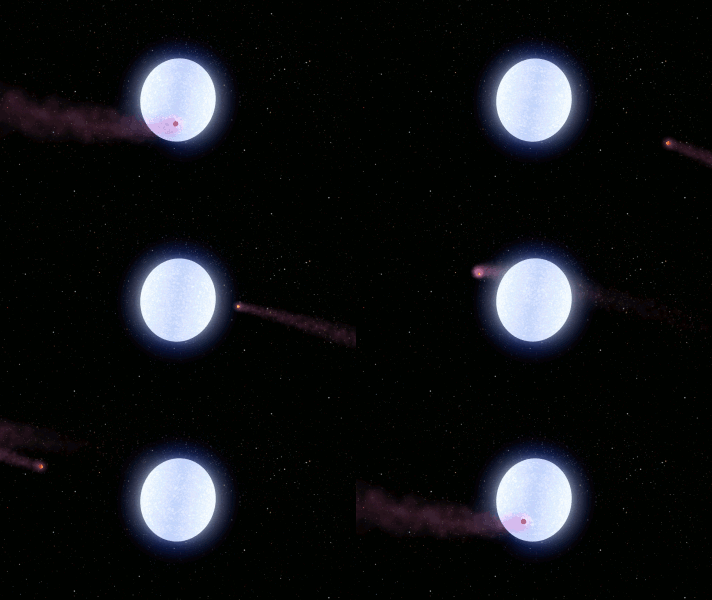
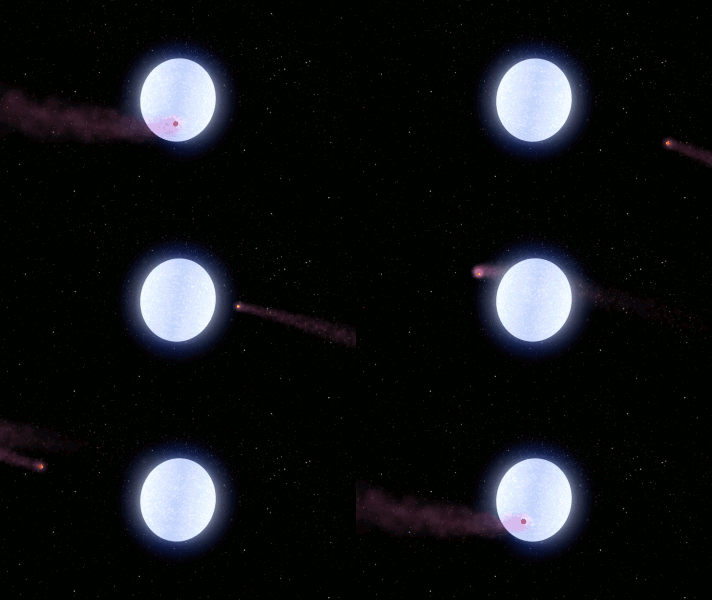
KELT-9b. (NASA)
KELT-9b was discovered in 2016 as part of the KELT (Kilodegree Extremely Little Telescope) project. This discovery was made during a sky survey led by Ohio State University in the United States. The finding was later confirmed through telescope observations and spectral analysis. The planet’s discovery was announced to the scientific community in 2017 with publication in the journal Nature.
KELT-9b orbits KELT-9 (HD 195689), an A0-A1 class blue-white subgiant star located approximately 670 light-years away in the constellation Hercules. This star is significantly hotter and more massive than the Sun, with a surface temperature of about 10,170 K.

KELT-9b. (NASA)
KELT-9b resides in an extremely close orbit around its star, completing one full revolution in just about 1.48 Earth days. Its distance from the star is approximately 0.03462 AU (about 5.18 million kilometers). This short orbital period subjects the planet to an extreme level of stellar radiation.
KELT-9b is a gas giant exoplanet classified as an “ultra-hot Jupiter.” Its key physical properties are listed below:
Its low density indicates atmospheric expansion caused by extreme temperatures.
KELT-9b is one of the exoplanets with the highest observed atmospheric temperatures. The day-side temperature is approximately 4,300 K, comparable to the surface temperatures of many stars. A significant temperature difference has been observed between the planet’s day and night sides.
Spectroscopic analyses of its atmosphere have revealed the following findings:
This atmospheric structure is pushed to extreme limits by the planet’s proximity to its star and the intense ultraviolet radiation it receives. Photoevaporation (radiation-driven gas loss) has been observed in the upper layers of KELT-9b’s atmosphere, indicating that the planet is losing mass over time.
KELT-9b. (NASA YouTube)
Due to its extreme proximity to its host star, KELT-9b is almost certainly in a state of tidal locking. In this condition, one hemisphere of the planet permanently faces the star while the other remains in darkness. This leads to extreme temperature contrasts and powerful wind systems in the atmosphere.
KELT-9b diverges from classical gas giants due to its extreme atmospheric conditions and serves as a critical test case for models of atmospheric physics and chemistry. The presence of elements such as iron and titanium in gaseous form allows direct observation of the physical regimes in which such metals vaporize. Additionally, it is one of the rare systems where atmospheric mass loss can be studied directly. KELT-9b’s high temperature, unique atmospheric composition, and close proximity to its star position it beyond the scope of classical Jupiter-like exoplanet models.
European Space Agency. “KELT-9b, the Hottest Known Exoplanet.” YouTube. Accessed July 17, 2025. https://www.youtube.com/watch?v=bLMIo9Q5mDA.
Jensen, A. G., K. C. Colón, J. J. Lissauer, et al. “The CUTE Ultraviolet Transit Light Curve of KELT-9 b.” *Astronomy & Astrophysics* 666 (2022): A118. Accessed July 17, 2025. https://ui.adsabs.harvard.edu/abs/2022A%26A...666A.118J/abstract.
NASA Exoplanet Science Institute. “Overview: KELT-9 b.” *NASA Exoplanet Archive*. Accessed July 17, 2025. https://exoplanetarchive.ipac.caltech.edu/overview/kelt-9.
NASA. “KELT-9b.” *NASA Exoplanet Catalog*. Accessed July 17, 2025. https://science.nasa.gov/exoplanet-catalog/kelt-9-b/.
NASA. “Video of KELT-9b.” *NASA Science*. Accessed July 17, 2025. https://science.nasa.gov/resource/video-of-kelt-9b/.

Mass | Approximately 2.88 Jupiter masses | ||||||||
|---|---|---|---|---|---|---|---|---|---|
Diameter | Approximately 1.891 Jupiter radii | ||||||||
Density | Approximately 0.53 g/cm³ | ||||||||
Surface Gravity | Approximately 5.15 m/s² | ||||||||
Rotation Period | Synchronized to its star | ||||||||
Discovery Information
Orbit and Host Star
Physical Characteristics
Atmospheric Characteristics
Orbital Dynamics and Tidal Locking
Scientific Significance