


This article was automatically translated from the original Turkish version.
+2 More
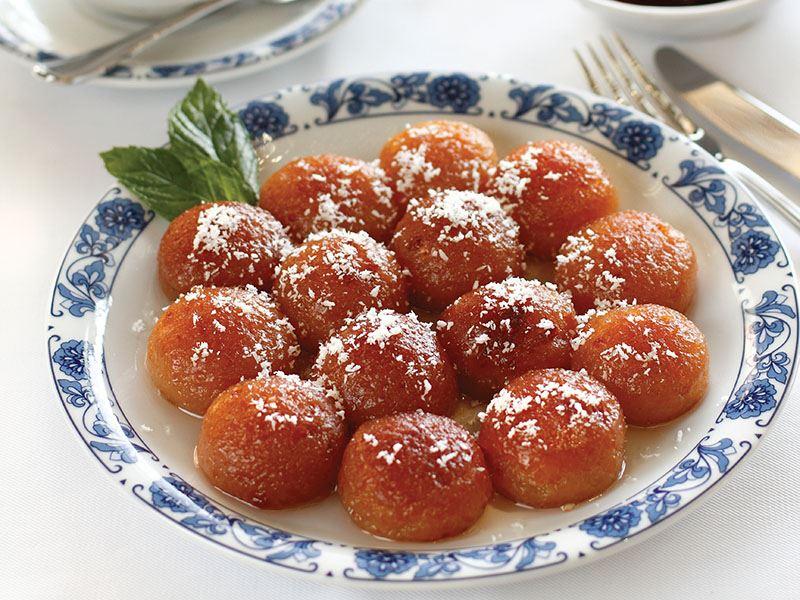
Kemalpaşa Sweet
Registration Number | 784 | ||||||||
|---|---|---|---|---|---|---|---|---|---|
Registration Date | 18.06.2021 | ||||||||
Application Number | C2017/156 | ||||||||
Application Date | 11.10.2017 | ||||||||
Name of the Geographical Indication | Kemalpaşa Sweet / Mustafakemalpaşa Cheese Sweet / Mustafakemalpaşa Sweet | ||||||||
Product / Product Group(s) | Sweet / Baking and Confectionery Products Sweets Dough Products | ||||||||
Type of Geographical Indication | Certification Mark | ||||||||
Applicant/Registrant(s) | Mustafakemalpaşa Chamber of Commerce and Industry | ||||||||
Address of the Registrant | Atatürk Mah. Fevzi Paşa Cad. No:200 Mustafakemalpaşa / BURSA | ||||||||
Geographical Boundary | Mustafakemalpaşa District Bursa Province | ||||||||
Kemalpaşa Sweet is a traditional dessert made by baking a dough composed of fresh unsalted teleme cheese, semolina, flour, eggs, and leavening agents into a hemispherical shape, followed by syrup soaking. This product is closely associated with the Mustafakemalpaşa district of Bursa Province in Türkiye. It is defined by its shape, porous internal structure, and the technical stages of its production process. Depending on whether it is baked once or twice, the dessert may exhibit different structural characteristics and becomes ready for consumption after syrup soaking. Its production is the result of a historical evolution spanning from traditional home-based methods to industrial-scale manufacturing.

Kemalpaşa Sweet (generated by artificial intelligence).
Kemalpaşa Sweet is a traditional dessert prepared by shaping a dough made from fresh unsalted teleme cheese, semolina, flour, eggs, and leavening agents (sodium bicarbonate and/or ammonium bicarbonate) into a hemispherical form, baking it, and then soaking it in syrup. Teleme cheese is the defining ingredient of this dessert and the primary element that distinguishes it from others. Over time, the dessert has also been referred to as “Mustafakemalpaşa Cheese Sweet” and “Mustafakemalpaşa Sweet”.
The origins of Kemalpaşa Sweet trace back approximately a century to a cheese dessert prepared by a migrant woman for her children at home. In the 1920s, the product was first introduced for consumption by the people of Mustafakemalpaşa district. At that time, the local ice cream vendor Ahmet Bey recognized its commercial potential and began selling it, paving the way for its widespread popularity. As the number of producers increased, the recipe evolved through various formulations, and from the 1970s onward, the dessert began to gain recognition beyond the district. These developments led to an increase in small-scale production units, and traditional production methods gradually adapted to industrial techniques.
Between 1955 and 1965, cheese made primarily from sheep’s milk was intensively used in the production of the sweet, making production seasonal. Due to rising demand and changing consumer preferences, production gradually shifted to using cow’s milk. After the 1970s, labor-intensive production gave way to mechanized manufacturing. Particularly during the 1980s, technological innovations such as double baking and cutting machines extended the product’s shelf life and facilitated distribution.
Kemalpaşa Sweet is produced in a hemispherical shape. The ratio of its diameter to its thickness ranges between 1.30 and 1.80. Products baked once have a spongy and elastic texture, while those baked twice are firmer but must not attain a biscuit-like consistency. Double baking reduces moisture content to below 10%, whereas in single-baked products, moisture content does not exceed 35%.
The porosity of the internal structure is directly proportional to the amount of teleme cheese used and is considered an indicator of quality. In terms of color, the product may vary from light yellow to brown; however, a burnt appearance is not acceptable. The baked product must be free of foreign tastes or odors and must have a homogeneous structure.
The following chemical characteristics have been established for Kemalpaşa Sweet:
The dough for Kemalpaşa Sweet is prepared using the following basic ingredients:
The milk used for teleme production is strained and heated to 65–70 °C, then cooled to 34 °C. At this temperature, starter culture is added at a rate of 150–250 ml per 1000 liters of milk to initiate fermentation. After approximately 1 to 1.5 hours, the resulting teleme is strained to separate the whey and prepared for use.
To prepare the dessert dough, chopped fresh teleme, semolina, flour, eggs, and leavening agents are mixed. The teleme content must constitute at least 30% of the dough. The egg content is adjusted to 2%, and the diluted leavening agent content is maintained between 0.2% and 1%. Wheat flour is added at a maximum of 30%, and semolina at a maximum of 50%, completing the kneading process.
The prepared dough is divided into portions using manual or mechanical systems and arranged on trays. The shaped dough is baked at a temperature of 240–300 °C for approximately 15–20 minutes. During this process, the dough assumes a hemispherical form and dries from the outer surface toward the center. The color may change from yellow to brown depending on the baking duration.
To extend shelf life, a second baking at 100–120 °C for 1 to 1.5 hours may be applied after the initial baking. This method reduces moisture content to below 10% in double-baked products and below 35% in single-baked products.
To prepare the syrup, at least 700 grams of sugar are added to one liter of water and boiled over heat. Once the sugar has fully dissolved, single-baked or double-baked portions (weighing 140–150 grams each) are immersed in the syrup. The desserts are boiled for 15–20 minutes, fully submerged and occasionally stirred, until fully saturated.
Kemalpaşa Sweet is packaged in accordance with the Turkish Food Codex, either in syrup-soaked form or in dry form (single or double baked). If the product or its packaging does not bear the appropriate label and logos, the geographical indication designation and the official emblem must be clearly displayed at the production or sales location.
Although the production and processing of the product can be carried out throughout Türkiye, the region designated for the geographical indication is the Mustafakemalpaşa district of Bursa Province. Inspection activities are conducted by the Turkish Standards Institute (TSE) under the coordination of the Mustafakemalpaşa Chamber of Commerce and Industry. During inspections, criteria such as compliance with production methods, adherence to physical and chemical specifications, and correct use of the logo and designation are evaluated.
Turk Patent and Trademark Office. "Bursa Kemalpaşa Tatlısı Coğrafi İşaret Bilgisi." Accessed May 23, 2025. https://ci.turkpatent.gov.tr/cografi-isaretler/detay/38383
Turk Patent and Trademark Office. "Bursa Kemalpaşa Tatlısı Coğrafi İşaret Tescil Belgesi ve Teknik Şartname (PDF)." Accessed May 23, 2025. https://ci.turkpatent.gov.tr/Files/GeographicalSigns/43fb127e-bc4b-4fe7-a814-f1ffb7171d5f.pdf

Kemalpaşa Sweet
Registration Number | 784 | ||||||||
|---|---|---|---|---|---|---|---|---|---|
Registration Date | 18.06.2021 | ||||||||
Application Number | C2017/156 | ||||||||
Application Date | 11.10.2017 | ||||||||
Name of the Geographical Indication | Kemalpaşa Sweet / Mustafakemalpaşa Cheese Sweet / Mustafakemalpaşa Sweet | ||||||||
Product / Product Group(s) | Sweet / Baking and Confectionery Products Sweets Dough Products | ||||||||
Type of Geographical Indication | Certification Mark | ||||||||
Applicant/Registrant(s) | Mustafakemalpaşa Chamber of Commerce and Industry | ||||||||
Address of the Registrant | Atatürk Mah. Fevzi Paşa Cad. No:200 Mustafakemalpaşa / BURSA | ||||||||
Geographical Boundary | Mustafakemalpaşa District Bursa Province | ||||||||
Characteristics
History
Physical Characteristics
Chemical Characteristics
Production Process
Ingredients Used
Teleme Cheese Preparation
Dough Preparation
Shaping and Baking
Syrup Soaking
Commercialization and Packaging
Geographical Boundary and Oversight