


This article was automatically translated from the original Turkish version.
+1 More
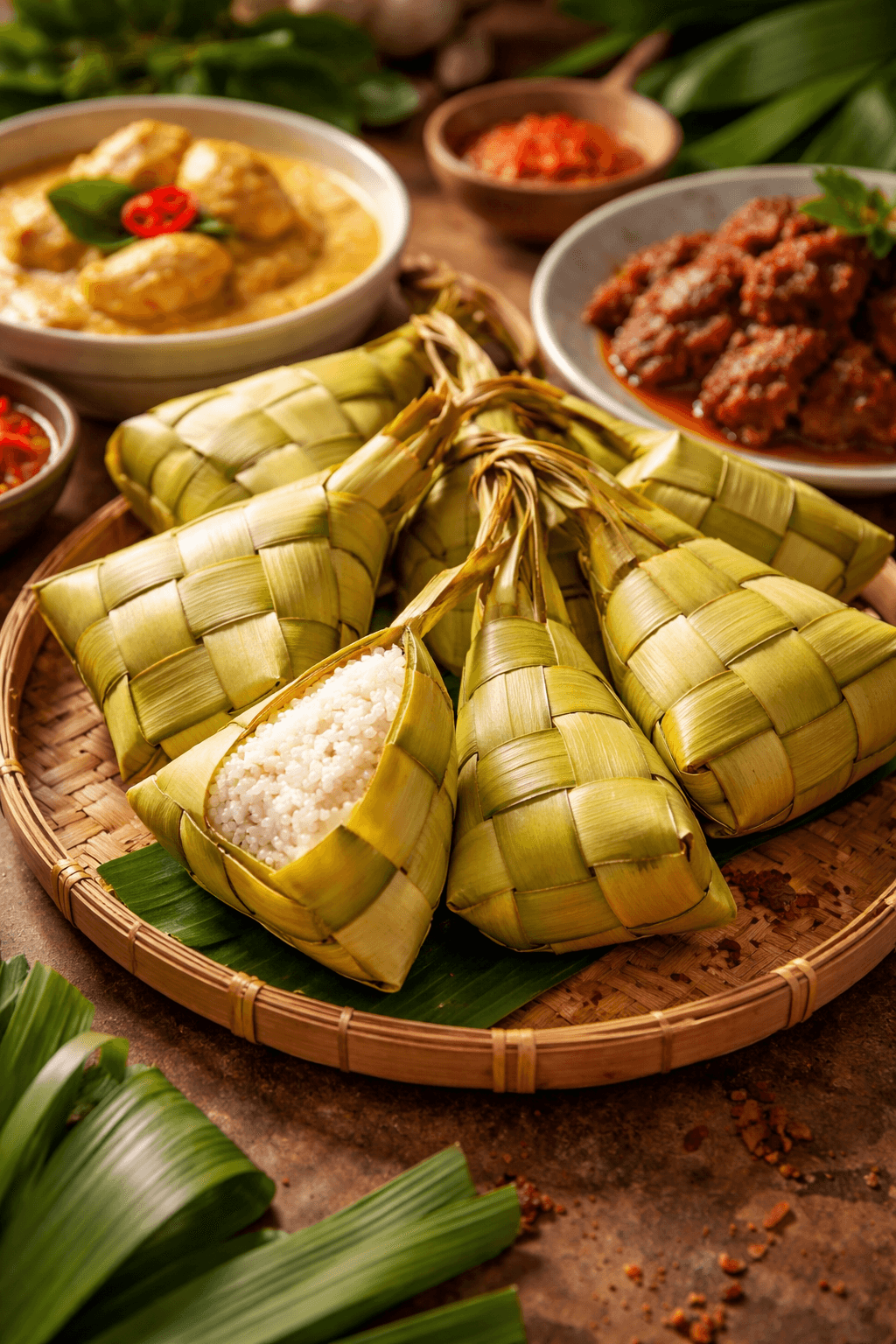
(Generated with Artificial Intelligence.)
Ketupat
Type(s) | Traditional rice product | ||||||||
|---|---|---|---|---|---|---|---|---|---|
Origin(s) | Indonesia | ||||||||
Area(s) of Use | Festival tables Daily meals | ||||||||
Regional Names | Kupat, Tipat, Ketupat Pulut | ||||||||
Accompanying Dishes | Meat dishes, Vegetable dishes, Sauces | ||||||||
Related Traditions | Bakda Lebaran, Bakda Kupat | ||||||||
Cultural Context | Ramadan Bayramı, Eid al-Fitr | ||||||||
Distribution Area | Indonesia, Malaysia, Brunei, Singapore | ||||||||
Preparation Method | Leaf weaving, Long-duration boiling | ||||||||
Shape | Baklava, Triangle | ||||||||
Cover Material | Young coconut leaves (janur), palm leaves | ||||||||
Main Material | Rice | ||||||||
Ketupat is a traditional rice product made by stuffing young coconut leaves into woven pouches and boiling them for an extended period. It is typically prepared in a diamond shape, though some variants are triangular. Rice is the main ingredient, while the pouches are most commonly made from young coconut leaves known as janur. Ketupat is a widely known and consumed food in Indonesia, as well as in Malaysia, Brunei, and Singapore.
Ketupat is especially associated with Eid al-Fitr among Muslim communities in Indonesia and Southeast Asia, serving as a traditional food with local cultural significance. However, in some regions it is also consumed as part of daily meals. Ketupat is generally served alongside meat dishes, vegetable dishes, or sauces, and exhibits regional variations in presentation and consumption.
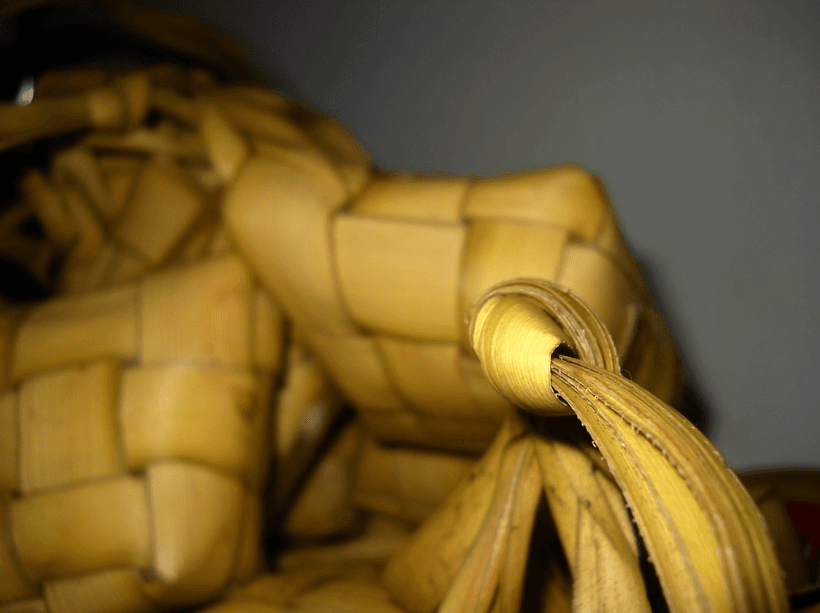
Ketupat (Flickr)
Ketupat is also known by the variant form kupat in Javanese and Sundanese languages. Within Javanese folk etymology, the term is linked to the phrase ngaku lepat, meaning “to admit one’s mistake.”【1】 In this context, ketupat acquires symbolic meaning through the tradition of mutual giving and seeking forgiveness during Eid al-Fitr.
Ketupat is also associated with the concept of laku papat, which refers to a four-stage framework composed of the terms lebaran, luberan, leburan, and laburan. Lebaran signifies the forgiveness granted and the end of the fasting month; luberan represents sharing and charity; leburan stands for mutual forgiveness; and laburan symbolizes purification and spiritual renewal. This conceptual framework defines the religious and social significance of ketupat. In Sundanese culture, the word kupat is linked to the verb ngupat, meaning “not to speak ill of others.”【2】
Ketupat emerged as a traditional food linked to religious and cultural practices that developed alongside the spread of Islam in Indonesia. Its origins are associated with Sunan Kalijaga, a key figure in the Islamization of Java during the 15th and 16th centuries. During this period, ketupat became an integral part of religious rituals, particularly in the Demak region of Central Java.
The ketupat tradition became institutionalized alongside the practices of Bakda Lebaran and Bakda Kupat. Bakda Lebaran refers to acts of worship and mutual visits on the first day of Eid al-Fitr, while Bakda Kupat takes place approximately one week after Eid, during which ketupat is prepared, cooked, and shared. These practices helped integrate ketupat into the social and religious customs following Eid al-Fitr.
Over time, the ketupat tradition spread beyond Java, becoming established in various regions of Indonesia and adopted in areas such as Malaysia, Brunei, and Singapore. During this diffusion, ketupat developed regional variations in preparation and presentation, yet retained its traditional association with the period following Eid al-Fitr.
Ketupat is regarded in Indonesia, particularly in Javanese culture, as a food imbued with philosophical and symbolic meaning. The rice used in its preparation is associated with worldly desires, while the coconut leaves (janur) symbolize conscience and inner enlightenment, in line with the Javanese concepts of “sejatining nur” or “jatining nur.” The combination of these two elements reflects the idea that one must control worldly cravings.
The intricate woven structure of ketupat symbolizes the complexities and mistakes encountered in life. The white rice inside represents the purity of the heart after forgiveness. The regular diamond shape is linked to the spiritual gains achieved through the acts of worship performed throughout the month of Ramadan. The yellowish-green leaf casing is regarded in some local beliefs as a protective element, symbolizing the warding off of negativity.
Ketupat is a traditional food product made from rice enclosed in woven plant leaves. Rice is the primary ingredient. Regional practices vary in the type of rice used; some areas prefer medium- or low-amylase rice for its softer texture, while others favor high-amylase rice for its firmer consistency. Variants using glutinous rice are also found.
The most common material for the pouch is young coconut leaves, known as janur, valued for their flexibility and suitability for weaving. In some regions, palm leaves or leaves from the palas (fan palm) are used instead. The type of leaf influences whether the final shape is diamond or triangular.
The preparation process begins with washing and draining the rice to remove impurities. In some methods, the rice is briefly soaked in water. The leaves are woven into pouches by interlacing two long leaves, a technique known as anyaman. The pouches are then filled with rice to approximately two-thirds or three-quarters of their capacity, allowing room for expansion during cooking.
The filled ketupat are boiled for an extended period in water that fully submerges them. Traditionally, cooking lasts between four and five hours, during which the water level must be maintained. After cooking, the ketupat are removed from the water, rinsed in cold water, and dried by air circulation or hanging to remove surface moisture. This drying process enhances shelf life.
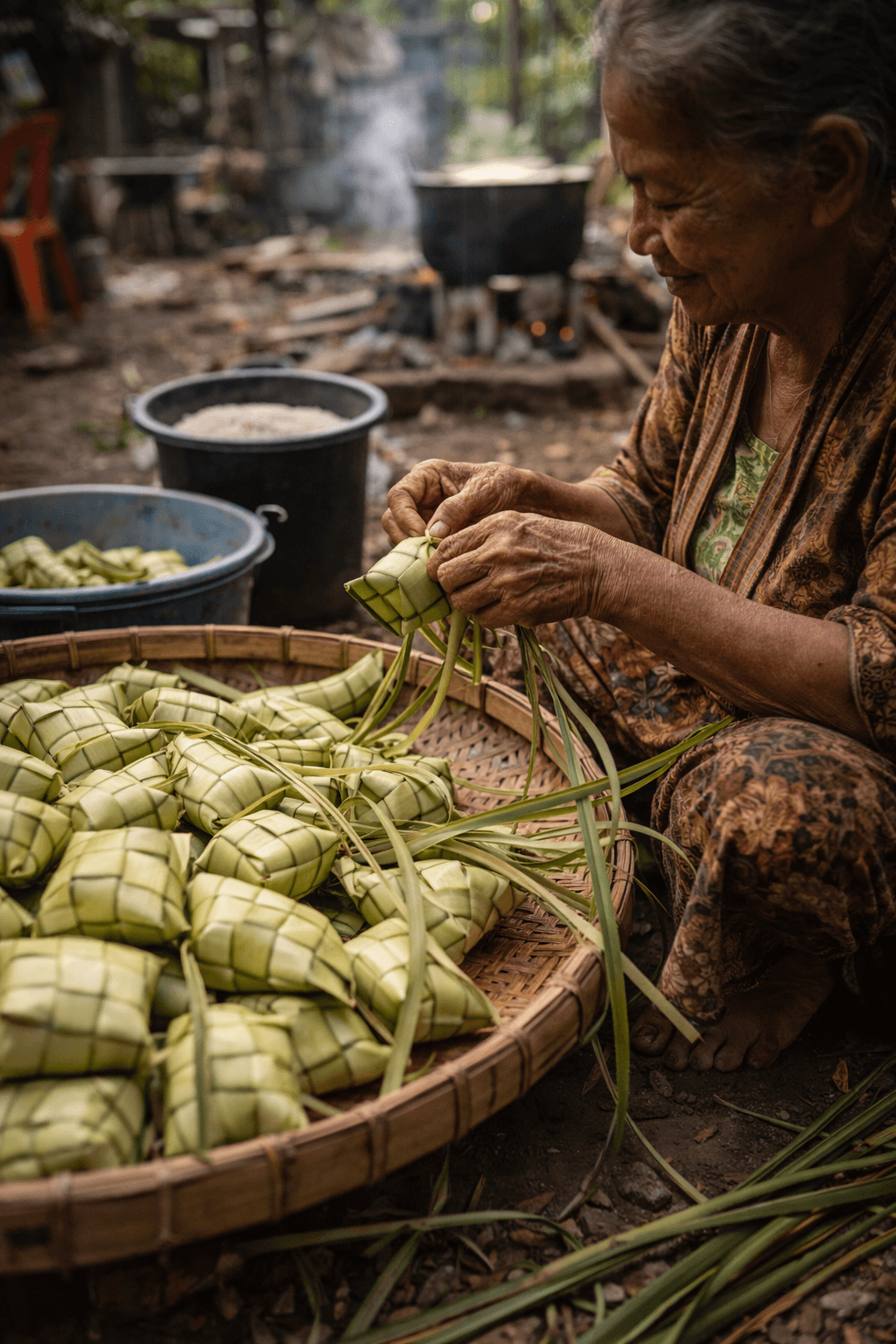
Indonesian Woman Preparing Ketupat (Generated by Artificial Intelligence.)
Ketupat varies across different regions of Indonesia and the Malay world in terms of rice type, leaf casing, shape, and accompanying dishes, reflecting its integration into local culinary traditions.
Java: In Java, ketupat is closely tied to post-Eid traditions. In Central Java, a small variant called sumpil is prepared and sometimes served during religious ceremonies or weddings. In West Java, ketupat is commonly eaten with tofu and peanut sauce and is also part of daily meals. In East Java, larger ketupat are prepared and served with vegetable or coconut milk-based dishes.
Bali: In Bali, ketupat is known as tipat. Tipat is typically square-shaped and used in Hindu rituals. It is also consumed daily alongside meat and vegetable dishes.
Sumatra: In Sumatra, ketupat is mostly made with sticky rice (ketan). Some variants are cooked in coconut milk and are commonly served with meat dishes such as rendang. The rice type and cooking method give these ketupat a richer, more aromatic texture.
Kalimantan: In Kalimantan, ketupat is typically made with high-amylase rice for its firm texture. In South Kalimantan, the variant known as ketupat Kandangan is distinguished by being served with fish and holds an important place in local cuisine.
Outside Indonesia, particularly in Malaysia, Brunei, and Singapore, ketupat is recognized as a food closely associated with Eid al-Fitr. In northern Malaysia, a triangular variant called ketupat pulut, made with glutinous rice and wrapped in palas leaves, is common.
Ketupat is typically served sliced or cubed. The leaf casing may be removed before serving, or the ketupat may be presented with the casing intact and unwrapped during consumption. The cutting method and presentation vary regionally.
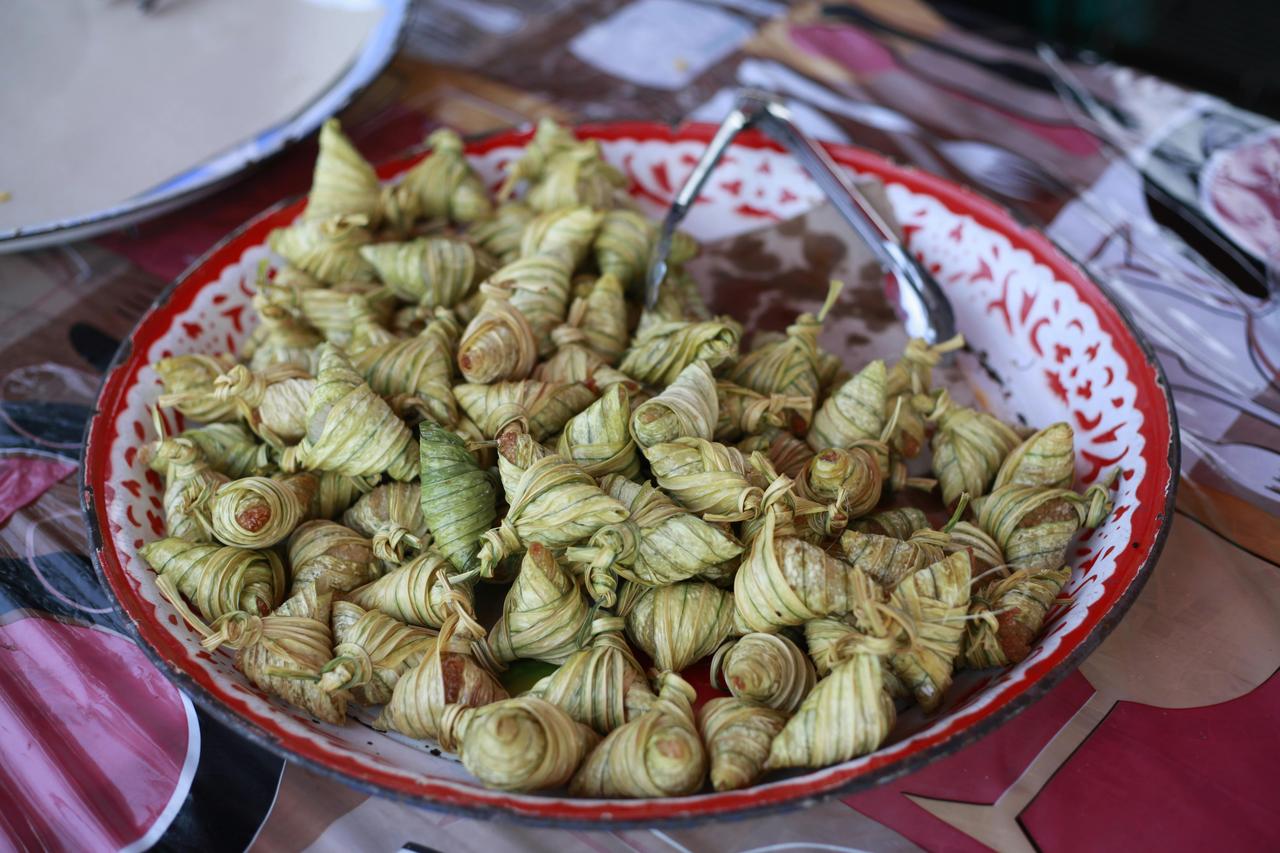
Ketupat Bowl (Pexels)
Ketupat is commonly served alongside main dishes. It is frequently paired with coconut milk-based dishes, peanut sauces, and spiced meat dishes. In some regions, it is also served with fish or eggs.
In some areas, ketupat is consumed as part of daily meals and may be eaten for breakfast, lunch, or dinner.
Consumption methods vary regionally. In some places, forks and spoons are used, while in others, ketupat is eaten by hand. It can be served hot, cold, or reheated by steaming after cooling.
Ketupat continues to preserve its traditional context but has adapted to more practical production and consumption methods in modern times. In daily consumption, it has been partially replaced in some regions by similar rice-based products. The time-consuming nature of leaf weaving and difficulties in sourcing raw materials have contributed to this shift.
Modern practices include the use of pre-made casings, pre-packaged ketupat, and refrigerated storage. Today, ketupat is no longer limited to home preparation but is also widely available in restaurants and retail outlets.
Angelina Rianti, Agnes E. Novenia, Alvin Christopher, Devi Lestari, and Elfa K. Parassih. “Ketupat as traditional food of Indonesian culture.” *Journal of Ethnic Foods* 5, no. 1 (2018): 4–9. Accessed January 28, 2026. https://doi.org/10.1016/j.jef.2018.01.001
Bonny Tan. “Ketupat.” *Singapore Infopedia*. Accessed January 28, 2026. https://www.nlb.gov.sg/main/article-detail?cmsuuid=cf26883a-d1ab-426c-908a-322fb5561a0c
Febri Krisnawati, Nurtikawati, and Shinta Arjunita Saputri. “Tradisi Bada Kupat dalam Budaya Jawa di Kelurahan Penanggo Jaya Kecamatan Lambandia Kabupaten Kolaka Timur.” *LISANI: Jurnal Kelisanan Sastra dan Budaya* 6, no. 1 (2023): 1–11. Accessed January 28, 2026. https://garuda.kemdiktisaintek.go.id/documents/detail/4138518?
IPB University. “Eid is coming soon! Here are 5 tips to prevent ketupat from spoiling according to IPB University experts.” IPB University News. Accessed January 28, 2026. https://www.ipb.ac.id/news/index/2025/03/eid-is-coming-soon-here-are-5-tips-to-prevent-ketupat-from-spoiling-according-to-ipb-university-experts/
Iskandar Al Imran. "Close-Up of a Bowl Full of Ketupat." Pexels. Accessed January 28, 2026. https://www.pexels.com/photo/close-up-of-a-bowl-full-of-ketupat-17134468/
Monash University Malaysia. “Ketupat: More than just a rice cake”. Monash University Malaysia. Accessed January 28, 2026. https://www.monash.edu.my/news-and-events/trending/ketupat-more-than-just-a-rice-cake
Muhammad Zaki, Nani Ratnaningsih, and Marwanti. “Ketupat Kandangan: A Symbol of Islamic Values in Banjar Cuisine and Its Implications for Cultural Identity and the Local Economy.” *Al-Banjari: Jurnal Ilmiah Ilmu-Ilmu Keislaman* 23, no. 2 (2024): 209–233. Accessed January 28, 2026. https://jurnal.uin-antasari.ac.id/index.php/al-banjari/article/download/15480/4364
Oxford English Dictionary. "ketupat, n." *Oxford English Dictionary*. Accessed January 28, 2026. https://www.oed.com/dictionary/ketupat_n?tl=true&tab=meaning_and_use
Setiarto, R. Haryo Bimo, and Vika Tresnadiana Herlina. “Ketupat: a culinary heritage of Indonesia in Eid Al-Fitr tradition.” *Journal of Ethnic Foods* 11, no. 45 (2024): 1–9. Accessed January 28, 2026. https://doi.org/10.1186/s42779-024-00259-x
Wicaksono, Abdillah. "Ketupat." Flickr. Accessed January 28, 2026. https://www.flickr.com/photos/79723524@N03/7837476810/
[1]
Rianti, Angelina, Agnes E. Novenia, Alvin Christopher, Devi Lestari ve Elvina K. Parassih. “Ketupat as traditional food of Indonesian culture,” Journal of Ethnic Foods. 5. 1. (2018): page 5, https://doi.org/10.1016/j.jef.2018.01.001
[2]
A.e., page 5,

(Generated with Artificial Intelligence.)
Ketupat
Type(s) | Traditional rice product | ||||||||
|---|---|---|---|---|---|---|---|---|---|
Origin(s) | Indonesia | ||||||||
Area(s) of Use | Festival tables Daily meals | ||||||||
Regional Names | Kupat, Tipat, Ketupat Pulut | ||||||||
Accompanying Dishes | Meat dishes, Vegetable dishes, Sauces | ||||||||
Related Traditions | Bakda Lebaran, Bakda Kupat | ||||||||
Cultural Context | Ramadan Bayramı, Eid al-Fitr | ||||||||
Distribution Area | Indonesia, Malaysia, Brunei, Singapore | ||||||||
Preparation Method | Leaf weaving, Long-duration boiling | ||||||||
Shape | Baklava, Triangle | ||||||||
Cover Material | Young coconut leaves (janur), palm leaves | ||||||||
Main Material | Rice | ||||||||
Etymology and Nomenclature
Historical Origins
Philosophical and Symbolic Meanings
Ingredients and Preparation
Regional Variants
Presentation and Consumption
Contemporary Practices and Transformation