This article was automatically translated from the original Turkish version.
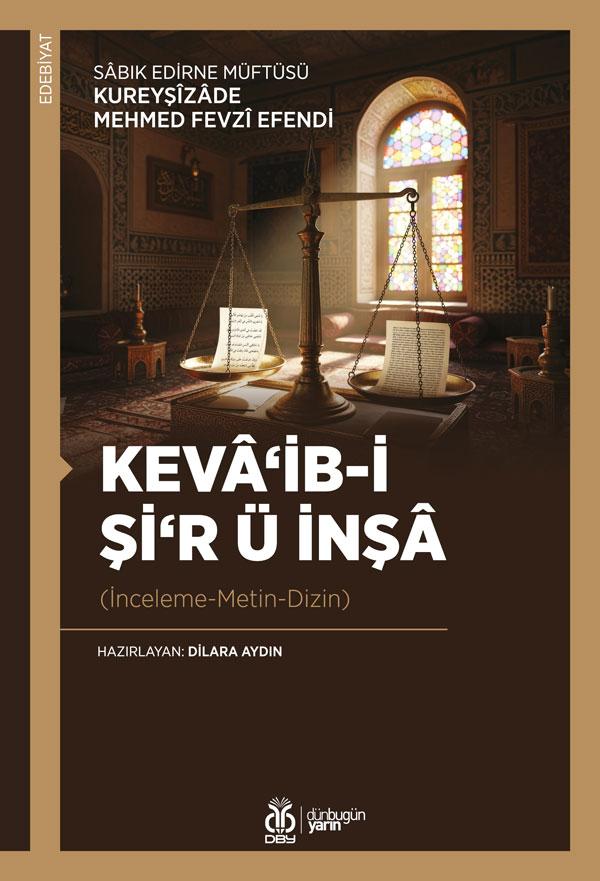
Full Title of the Book | Kevâʿib-i Şiʿr ü İnşâ (Study – Text – Index) | ||||||||
|---|---|---|---|---|---|---|---|---|---|
Author(s) | Kureyşîzâde Mehmed Fevzî Efendi (Former Mufti of Edirne) | ||||||||
Preparer | Dilara Aydın | ||||||||
Editor | Fatih Odunkıran | ||||||||
Publisher(s) | DBY Publications | ||||||||
Publication Year | 2025 | ||||||||
Series | DBY Publications Literature Series – 242 | ||||||||
ISBN | 978-625-5905-17-8 | ||||||||
Number of Pages | 380 | ||||||||
Language(s) | Arabic Persian Ottoman Turkish Turkish | ||||||||
Type(s) | Münşeât journal / Literary-study work | ||||||||
Printing Feature | Transcribed text from the original stone-print edition | ||||||||
Kevâʿib-i Şiʿr ü İnşâ is a münşeât compilation composed during the final period of the Ottoman State by Sâbık Edirne Müftüsü Kureyşîzâde Mehmed Fevzî Efendi. This work has been prepared with a detailed study and index by Dilara Aydın, and published in 2025 by Dün Bugün Yarın Yayınları (DBY) under the editorship of Fatih Odunkıran.
This scholarly publication in the field of language and literature is the 242nd volume in the DBY Publications Literature Series and consists of 380 pages. It features a quadrilingual character with texts in Turkish, Ottoman Turkish, Persian, and Arabic.
The work is structured around a comprehensive analytical framework comprising an “Introduction,” three main sections (First, Second, and Third Sections), followed by the “Text” and “Index” sections.
The “Introduction” provides detailed information on the historical development of the inşâ tradition in Turkish, Arabic, and Persian literatures; defines key terms such as “inşâ,” “münşeât,” “münşî,” “mektup,” and “kâtip”; and examines the genres of münşeât according to writing style, along with their content, classification, orthographic techniques, and stylistic features.
The first section, titled “The Life, Works, and Intellectual, Literary, and Political Personality of Mehmed Fevzî Efendi,” explores the author’s seventy-four-year life, his family, professional career, social environment, and literary output. This section draws on both the author’s own statements and archival documents to offer a comprehensive evaluation of his intellectual, literary, and political identity.
The second section, titled “Kevâʿib-i Şiʿr ü İnşâ,” examines the purpose of the work’s composition, its date of authorship, its position within the genre of münşeât, its organizational peculiarities, and the content of its texts. Additionally, Mehmed Fevzî Efendi’s borrowings, rhymes, and application of prosodic patterns are analyzed with illustrative examples.
The third section, titled “An Analysis of Kevâʿib-i Şiʿr ü İnşâ According to Inşâ Theory,” categorizes the letters in the work into official and private types, explains them with examples, and analyzes their structure according to the conventional divisions of introduction, body, and conclusion. At the end of this section, the work’s structure—reminiscent of a dîvân arrangement—is presented as an innovative attempt to establish a new inşâ framework; the relationship between its poetic sections and the letters is also assessed.
The fourth section, titled “Text,” presents a transcription of the original printed edition of Kevâʿib-i Şiʿr ü İnşâ using a transcription alphabet that reflects the characteristics of nineteenth-century Ottoman Turkish. The “Index” section at the end of the work provides readers with easy access to proper names, concepts, and terms appearing in the text.
Kevâʿib-i Şiʿr ü İnşâ is an original münşeât compilation containing both official and private prose and verse letters as well as literary poems. The author intended the work not merely as a collection of inşâ examples but also as a dîvân-style arrangement. For this reason, the work transcends the boundaries of the classical münşeât tradition by including 78 songs, 78 ghazals arranged according to the hurûf-ı hecâ system, eulogies addressed to the Prophet Muhammad and Medina, ten münâcât composed in three languages, and nineteen na‘t poems.
It is noted that Mehmed Fevzî Efendi chose the term “Kevâʿib” to mean “things of equal value,” applying it as the title of his work. Thus, he emphasized the equivalence of the ghazals and songs both symbolically and structurally. The author also referred to the work as “Kevâʿib-i Şiʿr ü İnşâ-yı ʿAzîziyye,” indicating that it was composed during the reign of Sultan Abdülaziz and written with the aim of contributing to the empire’s intellectual and scholarly policies of the time.
The date of composition has been determined, based on the author’s own verses, as 1276 AH / 1859–60 CE. The printed edition was written in the calligraphy of Hattat Hacı Mustafa Râkım and was most likely printed at the Bosnian Hacı Muharrem Press in Istanbul.
According to Fevzî Efendi, his purpose in writing the work extended beyond literary ambition to include an educational objective:
•To develop the inşâ skills of novice scribes,
•To present the work to master authors for correction of errors,
•To offer, however modestly, a contribution to the beneficial publications circulating during the reign of Sultan Abdülaziz.
In this regard, Kevâʿib-i Şiʿr ü İnşâ stands out as one of the last powerful examples that preserved the classical style despite changing correspondence practices after the Tanzimat era.
Kevâʿib-i Şiʿr ü İnşâ is not merely an example of inşâ writing; it is also a multifaceted cultural document reflecting the relationship between language, art, and education in the Ottoman intellectual world. Mehmed Fevzî Efendi’s insistence on the classical style represents the continuity of tradition within the post-Tanzimat atmosphere of “renewal.” The trilingual texts contained in the work are also significant for demonstrating the multicultural mindset of the Ottoman intellectual elite.
In these respects, the work serves as a reference source for researchers working in the fields of Ottoman literature, correspondence traditions, classical style, and the history of education.
Kureyşîzâde Mehmed Fevzî Efendi. Kevâʿib-i Şiʿr ü İnşâ (İnceleme-Metin-Dizin). Ed. Dilara Aydın. Ed. Fatih Odunkıran. DBY Yayınları, İstanbul, 2025. ISBN: 978-625-5905-17-8.

Full Title of the Book | Kevâʿib-i Şiʿr ü İnşâ (Study – Text – Index) | ||||||||
|---|---|---|---|---|---|---|---|---|---|
Author(s) | Kureyşîzâde Mehmed Fevzî Efendi (Former Mufti of Edirne) | ||||||||
Preparer | Dilara Aydın | ||||||||
Editor | Fatih Odunkıran | ||||||||
Publisher(s) | DBY Publications | ||||||||
Publication Year | 2025 | ||||||||
Series | DBY Publications Literature Series – 242 | ||||||||
ISBN | 978-625-5905-17-8 | ||||||||
Number of Pages | 380 | ||||||||
Language(s) | Arabic Persian Ottoman Turkish Turkish | ||||||||
Type(s) | Münşeât journal / Literary-study work | ||||||||
Printing Feature | Transcribed text from the original stone-print edition | ||||||||
No Discussion Added Yet
Start discussion for "Kevaʿib-i Şiʿr ü İnşa (Book)" article
Structure
Content
Evaluation