
This article was automatically translated from the original Turkish version.
Kickboxing
Origin(s) | Born in Japan in the 1960s it is a fusion of Asian martial arts and boxing. | ||||||||
|---|---|---|---|---|---|---|---|---|---|
Federation | International WAKO, in Türkiye, is the Türkiye Kick Boxing Federation | ||||||||
Disciplines | Tatemi: Point Fighting, Light Contact, Kick Light; Ring: Full Contact, Low Kick, K-1 Rules | ||||||||
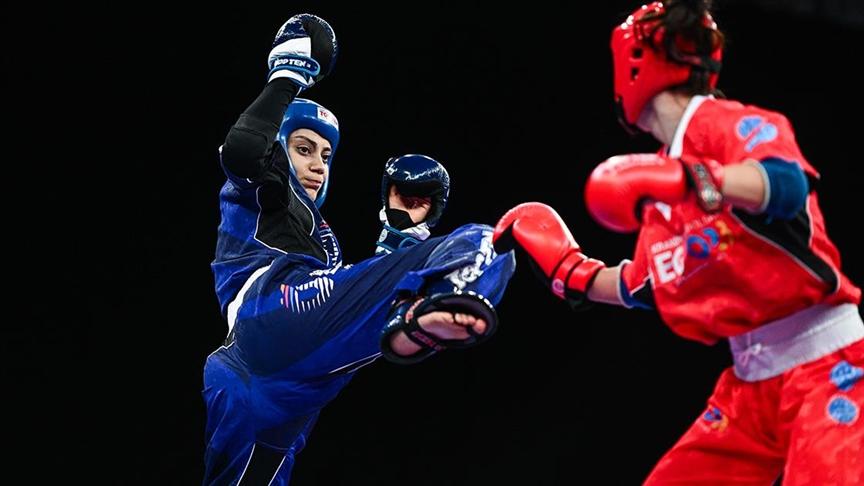
Kickboxing is a modern combat sport based on punching and kicking techniques, practiced on a ring or mat, with both defensive and competitive objectives. Developing from disciplines such as karate, Muay Thai (Thai boxing), and Western boxing, kickboxing has become widespread globally as a discipline requiring both technical skill and physical strength.
The origins of kickboxing trace back to Asian martial arts, particularly karate and Muay Thai. Japanese kickboxing emerged in the 1960s, while the American version took shape in the 1970s. The professionalization of Japanese kickboxing under the name K-1 in 1993 accelerated its global recognition.
In Europe, kickboxing began to spread in 1976 and acquired a more institutional structure through the WAKO (World Association of Kickboxing Organizations), founded under the leadership of Berlin-based sports figure Georg Bruckner. The first World Championship was held in 1978 with the participation of 110 athletes from 18 countries. WAKO played a major role in popularizing the sport, standardizing its rules, and promoting its professionalization.
In 1991, WAKO introduced the “Low Kick” branch, which developed techniques closer to Muay Thai. Subsequently, Thai/Kick Boxing was incorporated in 2000, followed by Kick Light in 2010. Today, WAKO represents kickboxing internationally across five continents, with more than 110 countries and millions of athletes.
Kickboxing is also widely practiced in Türkiye. The Turkish National Team has frequently placed among the top five in World and European Championships, achieving significant success. As of 2017, the number of active licensed athletes exceeded 29,000, and the total number of people engaged in kickboxing surpassed 180,000. The Turkish Kickboxing Federation organizes numerous national competitions and operates in alignment with WAKO.
Kickboxing is divided into seven main categories, comprising both tatami (mat) and ring disciplines:
Each branch has its own rule structure, match duration, striking techniques, and scoring system. In tatami disciplines, control and technique are prioritized, while in ring disciplines, physical strength and endurance take precedence. In all competitions, athletes are required to wear protective equipment such as gloves, mouthguards, and headgear.
The scoring system varies by discipline. In tatami events, technical execution carries greater weight, while in ring events, each valid strike is worth one point. Examples include:
Kickboxing is not merely a combat sport; it is also a lifestyle that enhances physical fitness and improves mind-body coordination:
During training, weights can be attached to the hands and feet to combine cardiovascular and strength exercises. Body resistance increases, toxin elimination accelerates, and metabolism improves.
WAKO is today the largest kickboxing organization in the world. It gained official recognition from GAISF and OCA in 2007 and participated in SportAccord’s “Martial Arts Games” in 2010. By organizing hundreds of national and international events, WAKO leads the development of the sport globally.
Anadolu Ajansı. "3. Avrupa Oyunları’nda Kick Boksta 3 Bronz Madalya." Anadolu Ajansı, June 28, 2023. Accessed May 7, 2025. https://www.aa.com.tr/tr/spor/3-avrupa-oyunlarinda-kick-boksta-3-bronz-madalya/2934797.
Türkiye Kick Boks Federasyonu. "Tarihçe." Accessed May 7, 2025. https://kickboks.gov.tr/sayfa/tarihce.html.
Viralspor. "Kick Boks Nedir? Kuralları Nelerdir?" Accessed May 7, 2025. https://www.viralspor.com/kick-boks-nedir-kurallari-nelerdir/.

Kickboxing
Origin(s) | Born in Japan in the 1960s it is a fusion of Asian martial arts and boxing. | ||||||||
|---|---|---|---|---|---|---|---|---|---|
Federation | International WAKO, in Türkiye, is the Türkiye Kick Boxing Federation | ||||||||
Disciplines | Tatemi: Point Fighting, Light Contact, Kick Light; Ring: Full Contact, Low Kick, K-1 Rules | ||||||||
History
Kickboxing in Türkiye
Branches and Rules
Tatami Branches (Practiced on a Mat):
Scoring System
Benefits of Kickboxing
WAKO and International Kickboxing