

This article was automatically translated from the original Turkish version.
Muay Thai
Origin(s) | Thailand | ||||||||
|---|---|---|---|---|---|---|---|---|---|
Federation | Türkiye Muay Thai Federasyonu | ||||||||
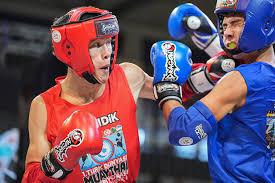
Muay Thai is a traditional martial art and ring sport originating from Thailand, also known as the “Art of Eight Limbs.” This name derives from the fact that Muay Thai is a combat system that employs fists, elbows, knees, and kicks in unison, treating the eight points of the body as weapons. Its origins extend back centuries, rooted in Thailand’s military history and cultural traditions.
The history of Muay Thai traces back to Muay Boran, a combat system based on Thailand’s ancient warfare methods. Muay Boran was developed for hand-to-hand or rudimentary weapon-based combat on battlefields. This art, practiced in various regional styles across Thailand, gradually evolved into a unified fighting system and became what is now known as Muay Thai.
During the Ayutthaya Kingdom period (14th–18th centuries), Muay Thai became not only a form of military training but also a cultural activity. Warriors trained to use their hands and feet as weapons in combat, refining their fighting skills. Additionally, combat demonstrations held during festivals and religious ceremonies helped popularize Muay Thai among the general public.
From the early 17th century onward, Muay Thai began to transform into a sport under the influence of modern boxing rules. The use of gloves became mandatory, time limits and scoring systems were introduced. In the 1920s, professional matches started being held in Thai stadiums, and Muay Thai developed into a ring sport with a rapidly growing audience.
Today, Muay Thai is recognized as Thailand’s national sport and has become a martial discipline taught in thousands of gyms worldwide. International tournaments held in Europe, America, and Asia have elevated it to a global platform. In 2021, the International Olympic Committee (IOC) officially recognized Muay Thai, paving the way for its potential inclusion in the Olympic Games.
The distinguishing feature of Muay Thai is its use of the entire body as both offensive and defensive weaponry. In addition to punches, elbows, knees, and kicks, clinching—controlling an opponent by gripping the neck area—is a key technical element. Alongside its technical repertoire, physical conditioning, endurance, timing, and mental resilience are fundamental components of Muay Thai. The philosophy of Muay Thai is built not only on physical superiority but also on respect, discipline, and self-sacrifice. Every fighter is expected to show respect to their instructor and opponent. In this sense, Muay Thai is regarded not merely as a combat sport but as a way of life.
Muay Thai has become an integral part of Thai culture, serving both as a symbol of national identity and as a tool for social cohesion. In rural areas, many young people use Muay Thai as a pathway to build lives in cities and provide economic support for their families. The disciplined lifestyle promoted by the sport also plays a significant role in combating addiction and crime.
Tiger Muay Thai. “Muay Thai Hakkında: Tarihçe.” *Tiger Muay Thai*. Accessed April 29, 2025. https://www.tigermuaythai.com/about-muay-thai/history.
Turkey Muaythai Federation. "Muaythai Tarihçesi." *Muaythai.gov.tr*. April 1, 2015. Accessed April 29, 2025. https://www.muaythai.gov.tr/2015/04/01/muaythai-tarihcesi/.

Muay Thai
Origin(s) | Thailand | ||||||||
|---|---|---|---|---|---|---|---|---|---|
Federation | Türkiye Muay Thai Federasyonu | ||||||||
History and Origins
Cultural Elements and Rituals Modernization and Global Spread
Technique and Philosophy
Cultural Impact of Muay Thai