This article was automatically translated from the original Turkish version.
Location | Hawaii Island Hawaii Volcanoes National Park | ||||||||
|---|---|---|---|---|---|---|---|---|---|
Latitude/Longitude | 19.421° N / 155.287° W | ||||||||
Elevation(s) | 1222 m (4009 ft) | ||||||||
Volcano Type | Shield | ||||||||
Composition | Basalt | ||||||||
Last Eruption | 24 November 2025 | ||||||||
Kilauea is the youngest and most active volcano on the Island of Hawaii and one of the most active volcanoes on Earth. Throughout recorded history, it has experienced only brief periods of dormancy and has covered approximately 90% of its surface with lava flows over the past 1000 years. Its name is believed to mean “spouting” or “much spreading.”【1】
Formed approximately 280,000 years ago on the ocean floor, Kilauea is a typical shield volcano with long, broad slopes. Today, it covers an area slightly smaller than that of the island of Oʻahu. It is one of the five volcanoes that make up the Island of Hawaii and is located on the southeast flank of Mauna Loa. Although for many years Kilauea was thought to be an extension of Mauna Loa, research has shown that it possesses an independent magma system extending down to about 60 kilometers beneath the surface.
Kilauea has erupted dozens of times since 1952. The major eruption sequence that began in 1983 led to lava flows advancing along the East Rift Zone, causing destructive impacts particularly in the Royal Gardens area. During this eight-year period, approximately 875 acres of land were covered by lava and 39 homes were destroyed. This phase was part of the volcano’s nearly continuous activity over the past 200 years.
Between 1983 and 2018, nearly uninterrupted eruptive activity occurred at the PuʻuʻŌʻō and Kupaianaha vents. In 2018, a major collapse event in the East Rift Zone increased the depth of the Halemaʻumaʻu crater to 487 meters and its width to 2.4 kilometers. This process resulted in the disappearance of the summit lava lake and the reshaping of the caldera.
In 2019, scientists observed for the first time in modern history the formation of a water lake within the Halemaʻumaʻu crater. However, this lake completely vaporized on 20 December 2020 when new lava reached the crater floor.
Since December 2020, a series of summit eruptions have occurred at Halemaʻumaʻu, gradually filling the collapsed area of the crater. In 2024, eruptive activity expanded beyond the caldera, with new intrusions observed in the Southwest Rift Zone and lava outflows detected in the upper portions of the East Rift Zone.
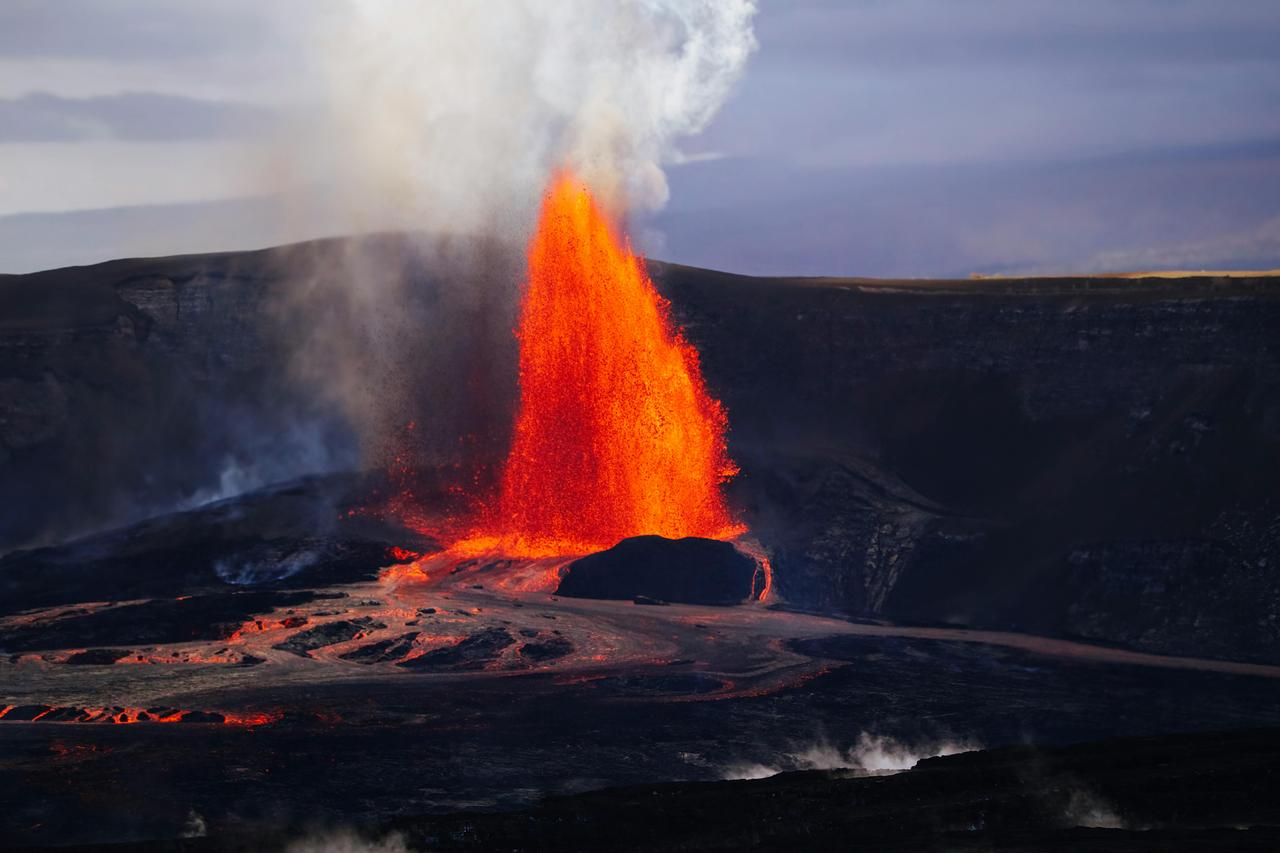
Since 23 December 2024, intermittent lava fountaining has continued at the Halemaʻumaʻu crater on Kilauea’s summit. The volcano has been intermittently active for approximately a year, with a total of 37 eruptions recorded since last December. On 24 November 2025 Turkey time, it resumed lava emissions.
The USGS and the Hawaiian Volcano Observatory have announced that the volcano has entered a new phase of lava emission, with strong activity expected particularly on 24–25 November. While these eruptions within the boundaries of Hawaiʻi Volcanoes National Park have not threatened populated areas, safety measures in the region have been heightened.
Kilauea is not only a geological feature but also a symbol in Hawaiian mythology. Considered the home of Pelehonuamea, this volcano represents the island’s formation process and the cycle of creation. Hawaiian chants and oral traditions convey the volcano’s centuries-long activity through symbolic language.
Today, Kilauea is a major focus for both scientific research and natural heritage. Its ongoing eruptions serve as a laboratory for understanding Earth’s internal dynamics, while also providing thousands of visitors each year with close-up observation opportunities as the centerpiece of Hawaiʻi Volcanoes National Park.
American Museum of Natural History. "Kilauea volcano Hawaii." amnh.org. Accessed October 19, 2025. https://www.amnh.org/exhibitions/permanent/planet-earth/why-are-there-ocean-basins-continents-and-mountains/non-explosive-volcanism/kilauea-volcano-hawaii
Anadolu Ajansı. "Hawaii'de Kilauea Yanardağı yeniden lav püskürtüyor." Accessed November 24, 2025. https://www.aa.com.tr/tr/vg/video-galeri/hawaiide-kilauea-yanardagi-yeniden-lav-puskurtuyor/0
JURNAL.İST. "Yanardağda korkutan hareketlilik: Lavlar gökyüzüne fırladı." gzt. Accessed November 24, 2025. https://www.gzt.com/jurnalist/hawaiide-kilauea-yanardagi-yeniden-faaliyete-gecti-lav-akintilari-basladi-dunya-haberleri-3822067
Lee, James. "Kīlauea Yanardağı'nda Dramatik Lav Patlaması JPG." Pexels. Accessed October 19, 2025. https://www.pexels.com/tr-tr/fotograf/kilauea-yanardagi-nda-dramatik-lav-patlamasi-33295503/
National Park Service. "Kīlauea." *nps.gov.* Accessed October 19, 2025. https://www.nps.gov/havo/learn/nature/kilauea.htm
U.S. Geological Survey. "Kīlauea Volcano Updates." USGS. Accessed October 19, 2025. https://www.usgs.gov/volcanoes/kilauea
[1]
National Park Service, "Kīlauea," nps.gov, erişim: 19 Ekim 2025, https://www.nps.gov/havo/learn/nature/kilauea.htm

Location | Hawaii Island Hawaii Volcanoes National Park | ||||||||
|---|---|---|---|---|---|---|---|---|---|
Latitude/Longitude | 19.421° N / 155.287° W | ||||||||
Elevation(s) | 1222 m (4009 ft) | ||||||||
Volcano Type | Shield | ||||||||
Composition | Basalt | ||||||||
Last Eruption | 24 November 2025 | ||||||||
Geographical and Geological Features
Historical Eruptions and Impacts
Recent Activity
Cultural and Natural Significance