

This article was automatically translated from the original Turkish version.
+2 More
Location | Bademli Neighborhood İzmir Ödemiş | ||||||||
|---|---|---|---|---|---|---|---|---|---|
Important Features | Exterior wall paintings (depictions of Mecca and Medina), intricate calligraphy, forest and floral landscapes | ||||||||
Material(s) | Wood paint tile plaster | ||||||||
Conservation Status | Registered in the inventory of the İzmir Provincial Directorate of Culture and Tourism open for worship | ||||||||
The Kılcızade Mehmet Ağa Mosque, located in the Bademli neighborhood of the Ödemiş district in İzmir, is one of the notable examples of Anatolian Turkish architecture from the Westernization period, distinguished by both its architectural and decorative features. Although the exact construction date of the building is unknown, an inscription above the entrance to the prayer hall indicates that in 1811, Ödemiş Voyvoda Kılcızade Mehmet Ağa undertook extensive restoration and expansion work. The mosque, with a plan close to a square and a flat wooden ceiling internally and a broken roof externally, reflects the stylistic characteristics of its era through its rich decorative program on both facades and interior spaces.
No direct documentary evidence exists regarding the mosque’s original construction. However, its current architectural and decorative features suggest it was likely built at the end of the 18th century or the beginning of the 19th century. Kılcızade Seyyit Mehmet Ağa, born in 1747, served as the Voyvoda of Ödemiş during his time and restored and expanded the mosque in 1811. This renovation played a crucial role in shaping the structure’s present form. The restoration efforts focused particularly on the facade decorations and wooden ceiling craftsmanship.
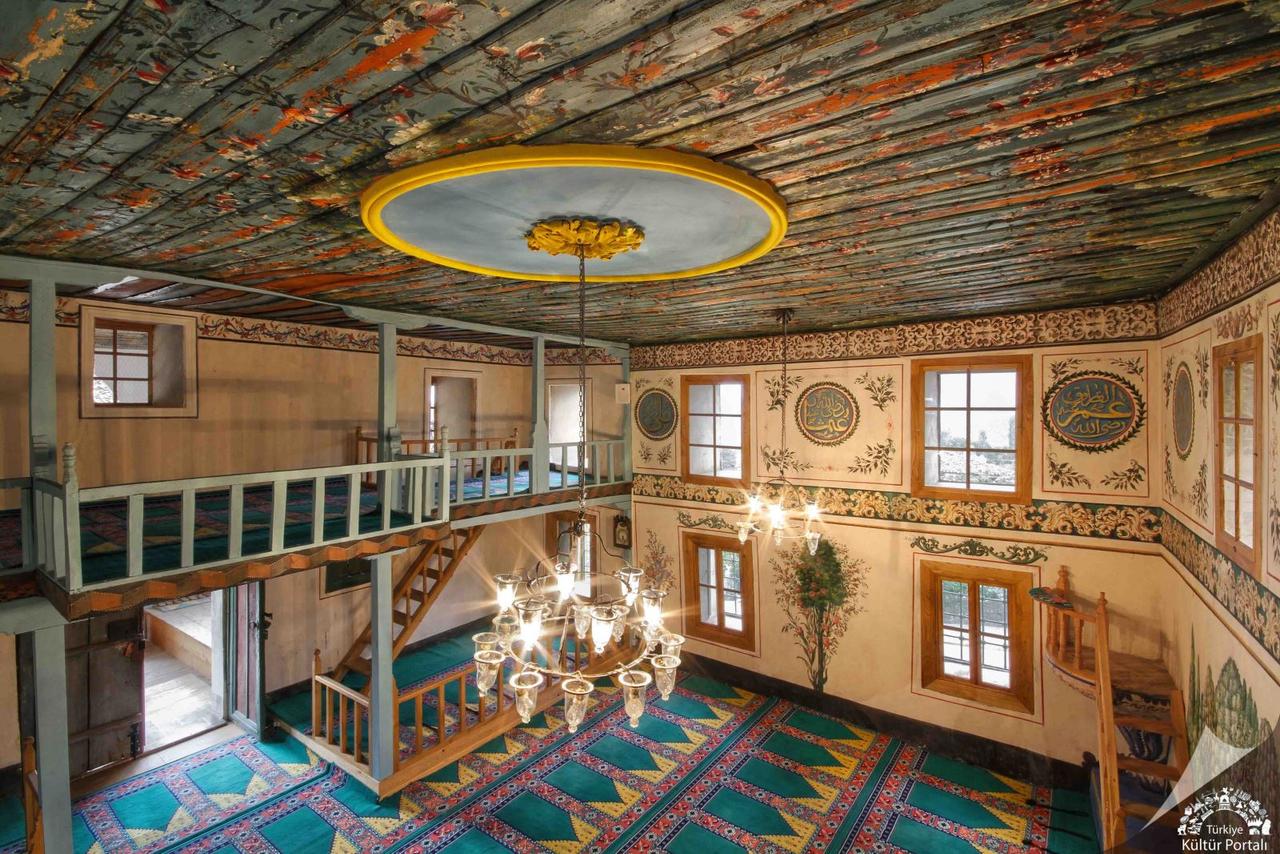
The mosque has a plan close to a square rectangle. The prayer hall is covered by a flat wooden ceiling, the central portion of which is recessed and divided by moldings into triangular and rectangular sections, each filled with floral motifs. The exterior is covered by a broken roof with Marseille-type tiles. The final congregation area is located on the main facade, where the wooden ceiling exhibits characteristic examples of local woodwork from the period. The wooden columns supporting the final congregation area contribute to an open and light spatial impression.
One of the mosque’s most striking features is that it contains some of the rare surviving exterior wall paintings in Anatolia. Colorful painted decorations, executed directly on plastered surfaces, are visible across the façades. On the east, west, and south facades, rectangular or near-square frames have been drawn between the upper row of windows to create panel-like compositions, within which landscapes, still lifes, and religious scenes have been placed. Particularly, on the right side of the main entrance, Mecca (the Kaaba) and on the left, Medina (the Ravza-i Mutahhara) are depicted in miniature style. This practice is considered among the rare examples of Westernization-era painting applied to mosque façades.
The walls of the prayer hall feature a rich penwork decoration program executed on both wood and plaster. Plant motifs, floral bouquets, floral compositions in vases, forest landscapes, and various symbolic representations are used extensively. The forest landscape on the south wall, with dimensions rivaling the height of the mihrab, presents a monumental appearance. Forest motifs also appear beneath the mihrab niche and on the prayer hall ceiling. Additionally, motifs such as swords, scales, balances, and lanterns found within the mosque reflect the symbolic and decorative sensibilities of the period. These dense vegetal and figurative decorations within the interior space are arranged to evoke the atmosphere of a heavenly garden.
The Kılcızade Mehmet Ağa Mosque is among the examples that blend the Baroque and Rococo influences prevalent in Ottoman architecture from the 18th century onward with the local Anatolian style. The exterior wall paintings, particularly the depictions of Mecca and Medina, serve as rare documents reflecting the religious and aesthetic perceptions of the local population. The wooden ceiling decorations present an adaptation of techniques commonly found in secular architecture of the period, applied to religious architecture.
The mosque is registered in the inventory of the İzmir Provincial Directorate of Culture and Tourism. Although the facade decorations have been partially degraded due to environmental factors, they largely retain their originality. A portion of the interior decorations requires restoration. The building remains open for worship and is actively used by the people of Bademli.
Accessed October 21, 2025. https://www.aa.com.tr/tr/kultur/ahlatta-acilan-kurslarla-geleneksel-tas-isciligi-yasatiliyor/3116279.
Kılcızade Mehmet Ağa Camii. (2025, July 10). Kültür Portalı. Accessed August 16, 2025. Accessed August 16, 2025.
Toprak, Adıgüzel Yıldız. "Kılcızâde Mehmet Ağa Camii'nde Bulunan Bir Manzara Resmindeki Ağaç Tasvirlerinin Batı Tarzı Resme Geçiş Bağlamında Değerlendirilmesi." Academia.edu. Accessed August 16, 2025.
Visit İzmir. "Kılcızade Mehmet Ağa Camisi." Accessed August 16, 2025.
Location | Bademli Neighborhood İzmir Ödemiş | ||||||||
|---|---|---|---|---|---|---|---|---|---|
Important Features | Exterior wall paintings (depictions of Mecca and Medina), intricate calligraphy, forest and floral landscapes | ||||||||
Material(s) | Wood paint tile plaster | ||||||||
Conservation Status | Registered in the inventory of the İzmir Provincial Directorate of Culture and Tourism open for worship | ||||||||
No Discussion Added Yet
Start discussion for "Kılcızade Mehmet Ağa Camii" article
History
Architectural Features
Façade Decorations
Interior Decorations
Art Historical and Stylistic Assessment
Conservation and Current Status