


This article was automatically translated from the original Turkish version.
The King Vulture (Sarcoramphus papa) is a large raptor belonging to the New World vulture family Cathartidae. Taxonomically classified within the order Cathartiformes of the class Aves, this species is primarily found in the tropical forests of Central and South America. As an obligate scavenger that feeds on carrion, the King Vulture plays a vital role in the decomposition of organic matter within ecosystems. It is distinguished from other Cathartidae members by its unique morphological and behavioral traits.
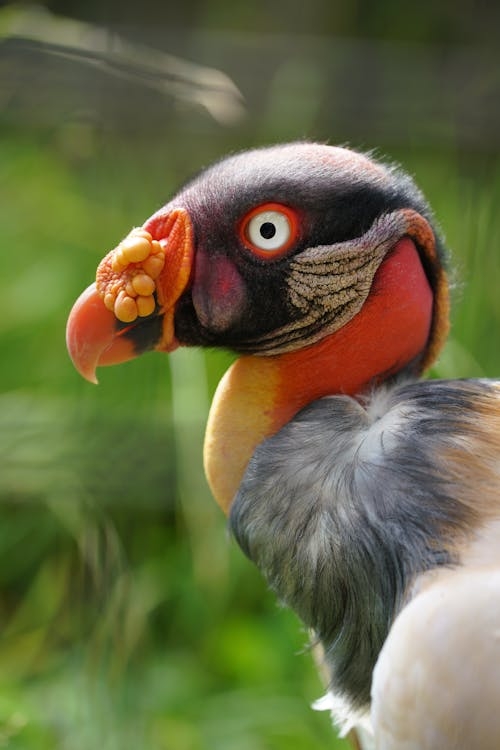
Adult King Vultures measure on average 71–81 cm in length and weigh between 3 and 4.5 kg. Their wingspan ranges from approximately 1.2 to 1.7 meters. Their plumage is predominantly white and cream-colored, with black pigmentation on the wingtips and tail. The most distinctive feature is its bare, brightly colored head. The skin of the head and neck displays a combination of red, orange, yellow, and purple hues; this intense pigmentation facilitates individual identification.
The beak is thick, powerful, and hooked, adapted for tearing through tough skin and cartilage of carcasses. The eyes are white and prominent due to their large corneas. The feet are weakly taloned and better suited for walking than grasping carrion.

King Vulture (Pexels)
The King Vulture ranges from southern Mexico through Panama, Colombia, Venezuela, Ecuador, Peru, Bolivia, Brazil, Paraguay, and into northern Argentina. Its distribution is generally restricted to moist tropical and subtropical forests at elevations between 0 and 1,500 meters. Preferred habitats include undisturbed rainforests, gallery forests, and secondary forests. Some individuals have been observed adapting to open areas or grassland-forest transition zones.
This species typically nests on tree tops or rocky outcrops and is found in isolated regions. It exhibits a lower population density compared to other Cathartidae species and is more frequently observed in areas distant from human settlements and with minimal anthropogenic activity.
The King Vulture is a diurnal bird. It has been observed engaging in basking behavior during the morning hours, which may serve functional roles in thermoregulation and reduction of microorganisms on its body surface. The bare head and neck regions are important for both thermoregulation and hierarchical social communication. To lower body temperature, it may defecate on its legs, a behavior known as urohidrosis; this has also been documented in the Andean Condor and the Turkey Vulture.

King Vulture (Pexels)
The King Vulture is an obligate necrophage, feeding exclusively on carrion. Its preferred food sources include small to medium-sized mammals such as sloths and primates, reptiles, and birds. Its beak is particularly advantageous compared to other vultures in opening thick-skinned and armored carcasses. This ability allows it to initiate the feeding process, thereby facilitating access for other vulture species. Consequently, some studies have designated the species as a “primary scavenger” within carrion ecosystems.
Its sense of smell is not as highly developed as in some other Cathartidae species; therefore, it is believed to locate carrion primarily by sight. It is often observed following the movements of species with superior olfactory abilities, such as the Turkey Vulture (Cathartes aura), to locate food sources.
The King Vulture is generally monogamous, with pairs forming long-term bonds. The breeding season varies by region. Females typically lay a single egg in sheltered ground areas or tree cavities. The incubation period lasts an average of 52 to 58 days, during which both parents participate. Chicks emerge covered in white down and remain in the nest for approximately three months, receiving food from their parents. Fledging usually occurs between 90 and 120 days. Parents have been reported to continue observing and feeding their young for up to a year. Reproductive success is directly linked to environmental stress factors.
King Vultures are typically observed alone or in pairs. At carcasses, they often assume a dominant role over other Cathartidae species due to their larger size and powerful beaks. However, direct aggression is uncommon. Social interactions observed at feeding sites may reflect a hierarchical structure among individuals. The intensity of interspecific competition varies depending on the size of the carcass and the surrounding environment.
The King Vulture is the only living species within the monotypic genus Sarcoramphus. Fossil records indicate the existence of related species dating back to the Pleistocene. Molecular phylogenetic analyses have revealed that this species shares certain genetic similarities with the Andean Condor (Vultur gryphus), yet follows a distinct evolutionary trajectory in terms of morphology and ecology. Members of the Cathartidae family, despite occupying ecological niches similar to those of Old World vultures, have separate evolutionary origins.
The International Union for Conservation of Nature (IUCN) classifies the King Vulture as “Least Concern.” However, population trends generally show a declining pattern. According to IUCN data, the total population is estimated to be below 50,000 individuals, with approximately 10,000 mature individuals. These figures are based on distribution data and modeling rather than direct counts. Major threats include habitat destruction (deforestation for agriculture and settlement), human-caused mortality (poisoning, illegal hunting), collisions with power lines, and reduction in food availability.
Conservation of the King Vulture necessitates sustainable management of forest habitats. Ornithological monitoring programs focus on identifying nesting sites and population densities. Satellite telemetry and banding studies contribute to a better understanding of the species’ migration patterns and habitat preferences. In some cases, artificial structures have been documented as alternative nesting sites; their preservation may positively impact local populations.
Environmental education programs targeting rural communities aim to raise awareness of the species’ ecological role as a scavenger. Collaborative conservation models involving civil society organizations, local governments, and academic institutions are recommended to ensure the species’ long-term viability.

No Discussion Added Yet
Start discussion for "King Vulture (Sarcoramphus papa)" article
Morphological Characteristics
Distribution and Habitat
Behavior and Ecology
Feeding Ecology
Reproductive Biology
Social and Competitive Behaviors
Taxonomy and Fossil Records
Population Status and Conservation Status
Conservation Approaches and Monitoring Programs