


This article was automatically translated from the original Turkish version.
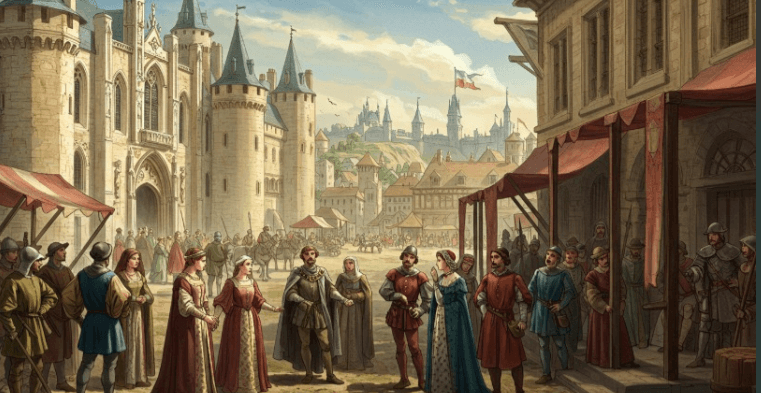
Kingdom of France
Official Name(s) | Kingdom of France (Fransa Krallığı) | ||||||||
|---|---|---|---|---|---|---|---|---|---|
Geographical Location(s) | Western Europe | ||||||||
Establishment | Late 5th century (foundations of the Frankish Kingdom) | ||||||||
Capital(s) | Paris (from the 10th century) | ||||||||
Form of Government(s) | Monarchy (uninterrupted from 987 to 1792 followed by brief restorations) | ||||||||
The Kingdom of France was a monarchy that endured from the early Middle Ages until the late 18th century in Western Europe, with its origins tracing back to the Merovingian and Carolingian dynasties, and whose political and cultural influence was felt across Europe. The balance between feudal structures and centralized monarchy shaped France’s political development. The kingdom played a broad role in shaping the balance of power in Europe, from the Crusades to alliances with the Ottoman Empire, from colonial activities to pre-revolutionary absolutism.
The foundations of the Kingdom of France were laid in the late 5th century when the Frankish Kingdom established dominance over the territories of Gaul. During the decline of the Roman Empire, the Roman patronage system merged with Germanic warrior companionship traditions to form a new political-military structure. Under the Merovingians, this structure was strengthened as nobles acquired vast landholdings and local military power, becoming regional authorities.
During the 8th and 9th centuries under the Carolingian dynasty, feudal relationships became more institutionalized. The Carolingians legitimized their rule through alliances with the Church. During this period, regions such as Champagne witnessed the rise of local dynasties. The County of Champagne, ruled by the Blois–Champagne dynasty, became an important center for both trade and politics from the 11th century onward.
In the 9th century, Viking, Magyar, and Arab raids weakened central authority; vassals loyal to the crown built castles in their territories and became semi-independent lords. In 877, West Frankish King Charles the Bald reinforced the permanence of local power by recognizing hereditary rights in fiefs. This situation created the groundwork for a fragmented feudal structure in France.
During the Capetian dynasty (987–1328), kings employed political and military methods to bring local lords under their authority. Concepts such as fief, vassalage, and oath of fealty became defining features of feudal relations. Economically, the Champagne fairs became the center of international trade in the 12th and 13th centuries. The fairs of Troyes, Provins, Bar-sur-Aube, and Lagny served as key meeting points for trade between Italy and Flanders; counts guaranteed merchants safe passage and protection of their goods.
During this period, France played an active role in the Crusades. Particularly, the County of Champagne was actively involved in the Second and Third Crusades. The counts provided military leadership, strengthening ties between the Kingdom of Jerusalem and other Crusader states and Western Europe.
The Hundred Years’ War between England and France was a prolonged conflict rooted in rival claims to the throne, territorial disputes, and political tensions arising from feudal obligations. Although the English gained the upper hand in the early phases of the war, French morale and military strength were revitalized notably after the emergence of Joan of Arc. By the war’s end, France regained most of its territories from the English and strengthened its centralized monarchy. The power of feudal lords was broken, and royal authority was consolidated.
In the 16th century, France exerted influence both within the European balance of power and in overseas policy. Diplomatic relations with the Ottoman Empire, initiated in 1525, were formalized in 1536 through an alliance signed between Suleiman the Magnificent and Francis I. This alliance granted France its first capitulations and established a strategic partnership against the Habsburgs.
During the same period, France faced internal religious conflicts. In the late 16th century, clashes between Catholics and Protestants threatened the political stability of the monarchy. The Gallican movement advocated for greater independence of the French Catholic Church from papal authority in its internal affairs. Gallicanism, in its royal, parliamentary, and episcopal forms, significantly influenced the balance of power between religious authority and political sovereignty.
From the 17th century onward, France began expanding its overseas territories. New France was established in North America, various colonies were founded in the Caribbean, and trading posts were set up in India. Colonial activities transformed France into a global power. Cultural influence increased alongside economic gains. However, colonial competition with England led to major conflicts in the 18th century, such as the Seven Years’ War, resulting in France losing significant colonies.
In the 18th century, Enlightenment thought brought significant transformations in French society, politics, and philosophy. Ideas such as national sovereignty, individual liberties, and the supremacy of law challenged the monarchical system. The French Revolution, which began in 1789, ended absolute monarchy and introduced constitutional governance and republican principles. The Revolution laid the groundwork for political change not only in France but across Europe. Doctrines that had shaped royal-church relations, such as Gallicanism, lost their influence through the process of secularization. As the Kingdom of France officially came to an end, the foundations of modern France were laid.
Accessed November 26, 2025.
Ceran, İsmail. "XVI. Yüzyılın İlk Yarısında Türk-Fransız İlişkileri, Kanunî Sultan Süleyman - I. François İttifakı." Turkish Studies - International Periodical for the Languages, Literature and History of Turkish or Turkic 9/2 (2014): 391-427. Accessed August 16, 2025.
French-Ottoman Alliance." History Today 63/9 (2013): 40-47. Accessed August 16, 2025.
Çiftçi, Sait Emre. "Champagne Kontluğu’nun Haçlı Seferlerindeki Rolü ve Etkisi." Selçuklu Araştırmaları Dergisi 22 (June 2025): 79-96. Accessed August 16, 2025.
Çiftçi, Sait Emre. "Fransa ve Almanya’da Feodalizmin Askerî ve Siyasi Yönden Gelişimi." Tarih Araştırmaları Dergisi 39/68 (2020): 225-250. Accessed August 16, 2025.
Şahin, Osman, and İskender Oymak. "Fransa Katolik Kilisesi’nde Gallikanizm." Fırat Üniversitesi İlahiyat Fakültesi Dergisi 27/1 (June 2022): 239-259. Accessed August 16, 2025.

Kingdom of France
Official Name(s) | Kingdom of France (Fransa Krallığı) | ||||||||
|---|---|---|---|---|---|---|---|---|---|
Geographical Location(s) | Western Europe | ||||||||
Establishment | Late 5th century (foundations of the Frankish Kingdom) | ||||||||
Capital(s) | Paris (from the 10th century) | ||||||||
Form of Government(s) | Monarchy (uninterrupted from 987 to 1792 followed by brief restorations) | ||||||||
Foundation and Early Period
The Middle Ages and the Strengthening of Feudal Structure
The Hundred Years’ War (1337–1453)
Early Modern Period and the Rise of Absolutism
Colonialism and Global Influence
The Enlightenment, Revolution, and the End of the Monarchy