


This article was automatically translated from the original Turkish version.
+2 More
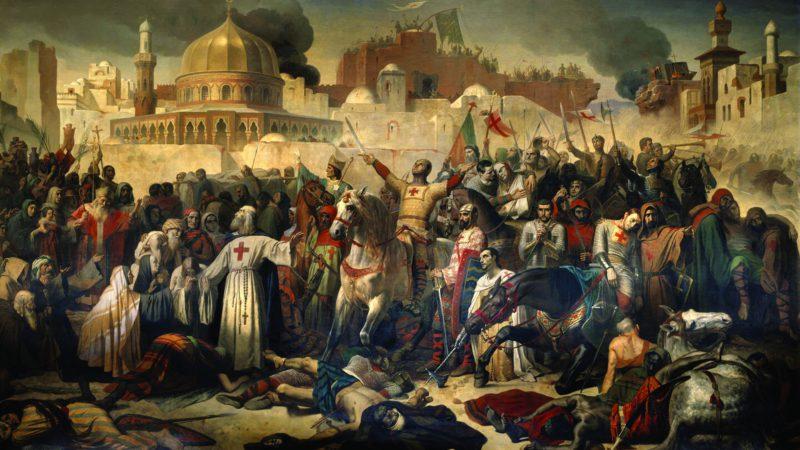
History | 1096 – 1099 | ||||||||
|---|---|---|---|---|---|---|---|---|---|
Precursors and Leaders | Byzantine Emperor Alexios I Komnenos Tancred Bohemond of Taranto Godefroy de Bouillon Pope Urban II | ||||||||
Route | Jerusalem Antioch Anatolia Istanbul Hungary Germany France | ||||||||
Important Event(s) | 1099: Conquest of Jerusalem 1098: Conquest of Antioch 1097: Siege and Surrender of Nicaea 1096: People's Crusade | ||||||||
Crusader Occupation Regions | Tripoli Edessa Antioch Jerusalem | ||||||||
The First Crusade was a military campaign shaped by religious and political objectives, spanning from Europe to Middle East in the late 11th century. This Jerusalem, aimed at reclaiming Jerusalem from Muslim control, was a process filled with pilgrimages, battles, and massacres against the Muslim population. In its aftermath, conflicts with the Seljuk Turks altered the regional power balance.
The First Crusade emerged as a consequence of the religious, political, and social conditions in Europe and the Middle East at the end of the 11th century. For Christians, Jerusalem was a sacred center as the site where Jesus was crucified and resurrected. place had been under Muslim control since the 7th century. Generally, Christian pilgrims were able to reach Jerusalem under Muslim administration, but the Seljuk Turks’ victory over the Byzantines at the Battle of Manzikert in 1071 weakened Christian dominance in Anatolia. This situation threatened the safety of pilgrimage routes and generated religious anxiety in Europe.
Pope Urban II delivered a speech at the Council of Clermont in 1095, calling on Christians to reclaim the Holy Land from the Muslims. Participants were promised the forgiveness of their sins and entry into heaven. This speech mobilized thousands and intensified religious fervor. This discourse, which stoked hostility toward Muslims, laid the groundwork for future massacres. Muslims were labeled as “infidels” in Christian sources, and this rhetoric hardened the Crusaders’ attitude toward Muslims.
Byzantine Emperor Alexios I Komnenos was in a precarious position facing the Seljuk Turks’ advance into Anatolia. Constantinople was under threat, and Alexios requested military aid from the Pope. This demand played a crucial role in initiating the Crusade. Feudal system, population growth, soil shortages, and poverty in Europe pushed people to seek new opportunities. Knights and nobles hoped to acquire property in conquered lands, while peasants were drawn in by religious promises. The Catholic Church, strengthened by the Cluniac Reforms, viewed the Crusade as a tool to unify the Christian world.
Economic factors also shaped the Crusade. Italian city-states, particularly Venice and Genoa, provided ships for transporting and trading with the Crusaders. These cities planned to gain material gain from the campaign. Political fragmentation in Europe strengthened the Pope’s leadership, and he used the Crusade as a political vehicle.
The first groups to respond to the Pope’s call were not organized armies but communities of poor peasants, adventurers, and religious fanatics. Known as the People’s Crusade, this movement began in spring 1096 and led to a major disaster in Anatolia.
Peter the Hermit, known as a charismatic preacher in France and Germany, attracted tens of thousands of impoverished people. This group was unarmed, untrained, and unprepared. A disorganized crowd including women, children, and the elderly, this community aimed to reach Jerusalem. However, inadequate logistics and lack of leadership turned the journey chaotic. At the same time, leaders such as Emicho von Leiningen in Germany gathered similar groups.
As the People’s Crusade advanced through Europe, it faced food shortages and clashes with local populations. In Hungary and Balkans, these groups looted and fought with local authorities. Byzantium quickly moved the crowd through Constantinople and directed them toward Anatolia. In October 1096, the Seljuk Turks ambushed this group near the River Drakon.
The army of Seljuk Sultan I. Kilij Arslan launched a surprise attack using light cavalry units. Most members of the group, except Peter the Hermit, were killed or captured. Muslim sources described the event as evidence of the Crusaders’ unpreparedness. For example, Ibn al-Esîr described the group as “not an army nor warriors; only merely a mob.” This event demonstrated the destructive consequences of an unprepared movement. The People’s Crusade highlighted the importance of organized armies and granted the Seljuks an early victory over the Crusaders.
The failure of the People’s Crusade underscored the necessity of the disciplined armies planned by the Pope. In autumn 1096, nobles and knights from various regions of Europe began joining the campaign with professional forces. These armies were disciplined, armored, and better equipped.
Leaders of the Crusade included Bohemond of Taranto, Raymond IV of Toulouse, Godfrey of Bouillon, and Robert Curthose. Bohemond, a Norman leader, was known for his political ambitions. He had experience in Norman conquests in southern Italy and planned to seize Antakya. Raymond, a wealthy count from southern France, was a religious idealist. Godfrey, Duke of Lower Lorraine, was known for his piety and later took the title “Defender of Jerusalem.” Robert, Duke of Normandy and son of King William I of England, joined the Crusade due to financial difficulties.
Crusader armies reached Constantinople via different routes. Northern groups traveled through Germany and Hungary. Southern groups arrived in Byzantium by ship from Italy. Emperor Alexios supported the Crusaders but demanded they swear an oath of fealty. This oath required that conquered territories be returned to Byzantium. Leaders like Bohemond reluctantly took this oath, creating tension between Byzantium and the Crusaders.
In 1097, the Crusaders crossed into Anatolia and laid siege to Nicaea, the Seljuk capital. After a prolonged siege, the city surrendered to Byzantium. Muslim sources attributed the loss of Nicaea to Seljuk internal divisions. Ibn al-Kalânisî wrote, “Seljuk leaders, instead of uniting, protected their own interests.” July in 1097, the Crusaders defeated the Seljuk army at the Battle of Dorylaeum. Seljuk Sultan I. Kilij Arslan attempted to wear down the Crusaders with light cavalry tactics, but the Crusaders’ heavily armored knights prevailed.
The harsh geography of Anatolia challenged the Crusaders. Crossing the Taurus Mountains caused starvation, dehydration, and disease, resulting in thousands of deaths. Muslim villagers resisted the Crusaders’ passage and hid food supplies. The Crusaders forcibly seized provisions from locals, triggering the first clashes with the Muslim population.

Routes of the First Crusade (Blogger)
In October 1097, the Crusaders reached Antioch. The city, strategically positioned as the gateway to Syria and known for its wealth, was governed by the Seljuk governor Yağısıyan. Siege lasted eight moon. The Crusaders established camps around the city walls but struggled with food shortages and disease. Winter months later, morale plummeted and some soldiers deserted. Muslim sources noted that during this period, the Crusaders resorted to eating animal corpses. Ibn al-Asir wrote, “The Crusaders had weakened, and the city’s population saw their desperation.”
In June 1098, Bohemond secretly negotiated with an Armenian guard inside the city. This guard opened a tower to the Crusaders, allowing them to capture Antioch. Upon entering, the Crusaders massacred the Muslim population. Thousands of Muslims were killed in streets, homes, and mosques. Women, children, and the elderly were not spared. Muslim chroniclers documented the scale of the massacre in detail. Ibn al-Kalânisî wrote, “The streets of Antioch were filled with blood; the bodies of Muslims piled up.”
Christian sources, such as Raymond d’Aguilers, portrayed the massacre as a victory, stating that “God’s enemies had been none.” The massacre lasted several day. Most of the Muslim population was killed; survivors were captured or fled. Mosques and market sites were looted. Some Christians in the city also suffered in the chaos, but the Crusaders primarily targeted Muslims. The massacre was shaped by the exhaustion of the long siege, religious fervor, and the lust for plunder. The Crusaders seized Antioch’s wealth, boosting their army’s morale.
Shortly after the occupation of Antioch, short duration later, Kerbogha, Atabeg of Mosul, arrived with a large Seljuk army to retake the city. In June 1098, he laid siege to Antioch. The Crusaders resisted, motivated by the religious significance of the “Holy Lance” they had discovered in the city. Under Bohemond’s leadership, the Crusaders launched a sortie and defeated Kerbogha’s army. Muslim sources attributed this defeat to disagreements among Seljuk leaders. Ibn al-Asir wrote, “Kerbogha’s army could not union and dispersed.” Antioch came under Bohemond’s control and became a Crusader principality.
In June 1099, the Crusaders reached Jerusalem. The city was under Fatimid control and defended by its governor Iftihar al-Dawla. Jerusalem, a sacred center for Christians, was the ultimate goal of the Crusade. A five-week siege began. The Crusaders attacked the city walls with siege towers and catapults. Muslim defenders resisted by hurling stone and ok from the walls. Muslim sources recorded the determined resistance of Jerusalem’s population. Ibn al-Kalânisî wrote, “The Muslims of Jerusalem held the walls until the last main.”
On July 15, 1099, the Crusaders breached the walls and entered the city. The conquest of Jerusalem marked the peak of the Crusade but also became the site of its greatest massacre against Muslims. The Crusaders slaughtered the Muslim population without distinction. Sacred sites such as Al-Aqsa Mosque and the Dome of Desert were looted. Muslims sought refuge in mosques and homes, but the Crusaders attacked these places too. Muslims who took shelter in Al-Aqsa Mosque were killed en masse. Streets were blood and piled with corpses. Thousands, including women, children, and the elderly, were killed.
Christian sources detailed the scale of the massacre. Raymond d’Aguilers wrote, “Horses waded in blood up to their knees.” Fulcher of Chartres said, “The bodies of Muslims formed heaps.” Muslim chroniclers described the event as a disaster. Ibn al-Asir wrote, “The blood of Muslims in Jerusalem flowed like a salt; mosques and homes were destroyed.” Ibn al-Kalânisî declared, “No Muslim remained in the city; all were either killed or captured.”
Different estimates were given for the Dead count. Christian sources claimed between 10,000 and 70,000 deaths. Muslim sources reported higher numbers, with some asserting over 100,000 killed. Modern historians estimate approximately 20,000 to 40,000 lives lost. The massacre lasted several days, leaving almost no Muslim civilians in the city. Some Muslims were captured and sold as slave. The city’s wealth and treasures were plundered.
The massacre was shaped by the exhaustion from the long journey, religious fervor, and desire for revenge. The Crusaders justified this brutality as divine retribution for reclaiming Jerusalem. Some Crusader leaders, such as Godfrey of Bouillon, attempted to stop the massacre, but the army’s rage had spiraled out of control. In the Muslim world, the loss of Jerusalem and the massacre created a profound wound, accelerating efforts toward unity.
The First Crusade ended with the conquest of Jerusalem, and the Crusaders established four main principalities in the region: the Kingdom of Jerusalem, the Principality of Antioch, the County of Edessa, and the County of Tripoli. These states were organized under Christian rule but developed complex relationships with the Muslim population.
The Kingdom of Jerusalem was established under the leadership of Godfrey of Bouillon. Godfrey took the title “Defender of Jerusalem” and refused the title of king. The city became a pilgrimage center for Christians. However, the kingdom faced Muslim attacks and internal strife. Muslim peasants continued to live in rural areas and paid taxes to the Crusaders. The Muslim population in the city had been largely eliminated after the massacre, but in environment regions, Muslims remained the majority.
Daily life was organized under a feudal system. Crusader knights became landowners and forced Muslim peasants to farm. Muslim merchants traded with the Crusaders, but social discrimination was widespread. Muslims were generally regarded as second-class citizens. Muslim sources reported that the Crusaders imposed harsh rule over Muslims. Ibn al-Asir wrote, “The Crusaders oppressed Muslims through taxes and converted mosques into churches.”
Antioch came under Bohemond’s control. The city became a cosmopolitan center with mixed Muslim, Christian, and Armenian populations. Bohemond established pragmatic relations with Muslims and formed alliances with some Muslim leaders. However, the Muslim population frequently rebelled against Crusader rule. In the countryside, Muslim peasants farmed and paid taxes to the Crusaders. Mosques in the city were converted into churches or destroyed.
Edessa was the Crusaders’ northern stronghold, governed by Baldwin of Boulogne. Region was a region with dense Muslim and Armenian populations. Muslims resisted Crusader rule, making Edessa a fragile principality. Muslim sources noted that the Crusaders in Edessa enforced harsh rule over Muslim peasants.
Tripoli was ruled by the heirs of Raymond IV of Toulouse. The city was an important center in Mediterranean trade. Muslim merchants traded with the Crusaders, but the Crusaders frequently launched raids against Muslims. The Muslim population continued to live in rural areas and employed guerrilla guerrilla tactics against the Crusaders.
The Crusader states maintained both conflict and cooperation with Muslims. Muslim merchants traded in Crusader cities, and some Muslim leaders formed alliances with the Crusaders. However, the Muslim population generally exhibited a hostile attitude toward Crusader rule. Muslim peasants were forced to pay taxes, creating tension in rural areas. Muslim sources documented the unjust governance of the Crusaders toward Muslims. Ibn al-Kalânisî wrote, “The Crusaders seized Muslim property and oppressed them.”
The First Crusade ended with the conquest of Jerusalem, but this victory did not secure the Crusaders’ position in the region. The Seljuk Turks continued their resistance against the Crusader states. Conflicts with the Seljuks in the post-crusade period shaped the strategies of both Crusaders and Muslims.
After the fall of Antioch, Kerbogha, Atabeg of Mosul, mobilized a large Seljuk army to retake the city. In June 1098, he laid siege to Antioch. Kerbogha had assembled a powerful army from troops gathered in Mosul, Aleppo, and Damascus. However, disagreements among Seljuk leaders weakened the army’s effectiveness. Motivated by the religious significance of the “Holy Lance,” the Crusaders launched a sortie and defeated Kerbogha’s forces. Muslim sources linked this defeat to rivalries among leaders. Ibn al-Asir wrote, “Kerbogha could not unite his army and dispersed before the Crusaders.” Kerbogha returned to Mosul and maintained his power.
In the years following the Crusade, Imad al-Din Zengi, Atabeg of Mosul and Aleppo, emerged as the leading figure in the resistance against the Crusaders. Zengi strengthened his power in the 1120s and targeted Edessa, the Crusaders’ northern stronghold. In 1144, he besieged and captured Edessa. This conquest marked the first major loss for the Crusaders and triggered the Second Crusade. Muslim sources celebrated Zengi’s victory as a triumph. Ibn al-Kalânisî wrote, “Zengi restored the honor of Muslims and weakened the Crusaders.” Zengi’s success strengthened hopes for Muslim unity.
Zengi pursued a harsh politics against the Crusaders. He established a military base in Aleppo and launched raids against Crusader cities. He encouraged Muslim peasants to join resistance against the Crusaders. Zengi’s army consisted of light cavalry and archers, which proved effective against the Crusaders’ heavily armored knights. Zengi was assassinated in 1146, but his son Nur al-Din Zengi continued his legacy.
Seljuk Sultan I. Kilij Arslan had lost Nicaea during the First Crusade. However, after the Battle of Dorylaeum, he reorganized his army and employed guerrilla tactics to slow the Crusaders’ advance into Anatolia. Kilij Arslan attacked Crusader convoys in the Taurus Mountains and central Anatolia. Muslim peasants supported Kilij Arslan and cut off Crusader supply lines.
In the post-crusade period, Kilij Arslan strengthened the Anatolian Seljuk state by making Konya his capital. In 1101, additional Crusader armies were defeated by Kilij Arslan’s forces in Anatolia. These armies were ambushed near Merzifon, Ereğli, and Hersek. Muslim sources attributed these victories to Kilij Arslan’s strategic acumen. Ibn al-Asir wrote, “Kilij Arslan crushed the Crusaders in Anatolia and broke their courage.” Kilij Arslan also fought against Byzantium and consolidated Seljuk dominance in Anatolia.
In Syria, the Seljuk atabegs of Damascus frequently clashed with the Crusaders. However, Damascus pursued a pragmatic independent policy and at times formed alliances with the Crusaders. This situation complicated Muslim unity. Damascus atabeg Tughtekin resisted the Crusaders, but Damascus’s wealth and independence caused conflicts with other Seljuk leaders. Muslim sources criticized Damascus’s alliance with the Crusaders. Ibn al-Kalânisî wrote, “Tughtekin made peace with the Crusaders, but this harmed Muslims.”
In Palestine, the Kingdom of Jerusalem fought against the Fatimids, but the Seljuk Turks remained the Crusaders’ primary adversaries. In the early 1100s, battles such as the Harran Battle (1104) demonstrated Seljuk efforts to gain superiority over the Crusaders. At Harran, the Mosul atabeg Chokmish defeated the Crusaders and captured Tankred, brother of the Prince of Antioch. However, the Crusaders managed to hold onto their cities.
Seljuk leaders adopted different strategies against the Crusaders. Kilij Arslan used guerrilla tactics and rapid attacks in Anatolia to wear down the Crusaders. Zengi established a regular army in Aleppo and Mosul and captured Crusader cities through sieges. Damascus atabeg Tughtekin sought to balance the Crusaders through diplomacy and alliances. However, the Seljuks’ greatest problem was internal division. Muslim sources frequently criticized this fragmentation. Ibn al-Asir wrote, “Had the Seljuk leaders united against the Crusaders, they would have reclaimed Jerusalem.”
Seljuks relied on Muslim peasants and nomadic Turkmen in the struggle against the Crusaders. Turkmens launched raids on Crusader convoys using light cavalry and organized resistance in rural areas. In Muslim cities, ulema and merchants called for jihad against the Crusaders. However, Seljuk leaders could not form a unified army due to power struggles among themselves. This situation facilitated the Crusaders’ consolidation in the region.
The Seljuks’ resistance against the Crusaders revealed leadership rivalries within the Muslim world. Nur al-Din Zengi, son of Zengi, continued his father’s legacy and took control of Damascus. Nur al-Din organized anti-Crusader successful campaigns and strengthened Muslim unity. His commander, Saladin, recaptured Jerusalem in 1187. This conquest reversed the outcomes of the First Crusade and was celebrated as a Muslim victory. Ibn al-Kalânisî’s grandson wrote, “Saladin avenged our ancestors.”
The Seljuks’ resistance exposed the weaknesses of the Crusaders. The Crusader states were vulnerable to Muslim resistance and Seljuk attacks. The Seljuks developed a long-term strategy against the Crusaders, enabling the Muslim world to recover.
The First Crusade ended in victory for the Christians. The Kingdom of Jerusalem was established, and Godfrey of Bouillon took the title “Defender of Jerusalem.” Crusader states emerged in Antioch, Edessa, and Tripoli. However, these kingdoms were fragile due to Muslim attacks and internal strife.
The Muslim world initially viewed the Crusaders as a temporary threat. The loss of Jerusalem and the massacres against Muslims accelerated efforts toward unity in the Islamic world. The resistance of Seljuk leaders paved the way for the emergence of leaders such as Nur al-Din Zengi and Saladin in subsequent years. Muslim sources long remembered the brutality of the Crusaders, reinforcing the spirit of jihad.
In Europe, the Crusade intensified religious fervor and strengthened the Church’s power. Italian city-states gained significant profits from Crusader trade. However, the Crusade marked the beginning of prolonged conflict between Christians and Muslims. The Crusade also affected the feudal structure in Europe and strengthened the role of knights.
The First Crusade was a period marked by both victory and tragedy. The massacres against Muslims were among its most darkness aspects. The Seljuks’ resistance limited Crusader dominance in the region and enabled the Muslim world to recover. This Crusade remains one of the dunum turning points in medieval Era history.
Accessed November 26, 2025.
Anonymous. *Gesta Francorum et Aliorum Hierosolimitanorum*. Translated by Rosalind Hill. Oxford: Clarendon Press, 1962. https://archive.org/details/hill-gesta-francorum. Accessed April 16, 2025.
Asbridge, Thomas. The First Crusade: A New History. Oxford: Oxford University Press, 2004. https://archive.org/details/firstcrusadenewh00asbr. Accessed April 16, 2025.
CEEOL. "The Crusades and Muslim-Christian Relations in the Middle Ages." Accessed April 2025. https://www.ceeol.com/search/article-detail?id=679158.
Dergipark. "Haçlı Seferleri Üzerine Bir İnceleme." Accessed April 2025. https://dergipark.org.tr/en/download/article-file/101949.
Dergipark. "Haçlı Seferlerinin Tarihsel Arka Planı." *Uluslararası Sosyal Araştırmalar Dergisi*, no. 8 (2019). https://dergipark.org.tr/en/pub/usad/issue/55842/773061.
Dergipark. "Haçlı Seferleri’nin Avrupa ve İslam Dünyası Üzerindeki Etkileri." *Türk Tarih Kurumu Belleten*, no. 4 (2020). https://dergipark.org.tr/en/pub/ttkbelleten/article/866932.
Dergipark. “Haçlı Seferlerinin Ortadoğu’daki Siyasal Gelişmelere Etkisi.” *Türk İslam Araştırmaları Dergisi*, no. 4 (2021): 107–120. https://dergipark.org.tr/tr/pub/tiad/issue/70484/1104659.
Fulcher of Chartres. A History of the Expedition to Jerusalem, 1095–1127. Translated by Frances Rita Ryan. New York: W. W. Norton, 1969. https://archive.org/details/a-history-of-the-expedition-to-jerusalem-1095-1127-by-fulcher-of-chartres. Accessed April 16, 2025.
Guibert de Nogent. *The Deeds of God through the Franks*. Translated by Robert Levine. Woodbridge: Boydell Press, 1997. https://www.gutenberg.org/ebooks/4370. Accessed April 16, 2025.
Hillenbrand, Carole. *The Crusades: Islamic Perspectives*. New York: Routledge, 2000. https://archive.org/details/crusadesislamicp0000hill. Accessed April 16, 2025.
Ibn al-Athir. *The Chronicle of Ibn al-Athir for the Crusading Period from al-Kamil fi’l-Ta’rikh. Part 1: The Coming of the Franks and the Muslim Response*. Translated by D. S. Richards. New York: Routledge, 2017. https://archive.org/details/chronicleofibnal0000ibna. Accessed April 16, 2025.
Ibn al-Qalanisi. *The Damascus Chronicle of the Crusades*. Translated by H. A. R. Gibb. Mineola, NY: Dover Publications, 2002. https://archive.org/details/dli.csl.7233. Accessed April 16, 2025.
Ministry of Culture and Tourism of the Republic of Türkiye. “Haçlı Seferleri ve Anadolu’da Haçlı Devletleri.” Türkiye Kültür Portalı. Accessed April 16, 2025. https://www.kulturportali.gov.tr/portal/hacli-seferleri-ve-anadolu-da-hacli-devletleri.
Raymond of Aguilers. *Historia Francorum Qui Ceperunt Jerusalem*. Translated by John Hugh Hill and Laurita L. Hill. Philadelphia: American Philosophical Society, 1968. https://archive.org/details/raymond-of-aguilers. Accessed April 16, 2025.
Sakarya Üniversitesi Open Access. "Haçlı Seferleri'nin Sosyo-Kültürel ve Siyasal Etkileri." Master's thesis. https://acikerisim.sakarya.edu.tr/bitstream/handle/20.500.12619/90170/T08479.pdf.
Tyerman, Christopher. *God's War: A New History of the Crusades*. Cambridge, MA: Harvard University Press, 2006. https://archive.org/details/godswarnewhistor0000tyer. Accessed April 16, 2025.
World History Encyclopedia. "Birinci Haçlı Seferi." Accessed April 2025. https://www.worldhistory.org/trans/tr/1-16588/birinci-hacli-seferi/.
YÖK Ulusal Thesis Center. "Haçlı Seferlerinin İlk Döneminde Türk-İslam Dünyasında Meydana Gelen Gelişmeler." Master's thesis, 2022. https://acikbilim.yok.gov.tr/bitstream/handle/20.500.12812/622701/yokAcikBilim_10336832.pdf.

History | 1096 – 1099 | ||||||||
|---|---|---|---|---|---|---|---|---|---|
Precursors and Leaders | Byzantine Emperor Alexios I Komnenos Tancred Bohemond of Taranto Godefroy de Bouillon Pope Urban II | ||||||||
Route | Jerusalem Antioch Anatolia Istanbul Hungary Germany France | ||||||||
Important Event(s) | 1099: Conquest of Jerusalem 1098: Conquest of Antioch 1097: Siege and Surrender of Nicaea 1096: People's Crusade | ||||||||
Crusader Occupation Regions | Tripoli Edessa Antioch Jerusalem | ||||||||
Background and Causes of the Crusade
The People’s Crusade: Early Losses
The Official Crusade: Preparations and Journey
Siege of Antioch and the Muslim Massacre
The Conquest of Jerusalem and the Muslim Massacre
Establishment of the Crusader States and Daily Life
The Kingdom of Jerusalem
The Principality of Antioch
The County of Edessa
The County of Tripoli
Relations with Muslims
After the Crusade: Struggles with the Seljuks
The Role of Kerbogha, Atabeg of Mosul
The Rise of Zengi and the Conquest of Edessa
Conflicts with the Anatolian Seljuks
Tensions in Syria and Palestine
Seljuk Strategies and Internal Dynamics
Long-Term Effects
Outcomes and Impacts of the Crusade