


This article was automatically translated from the original Turkish version.
+1 More
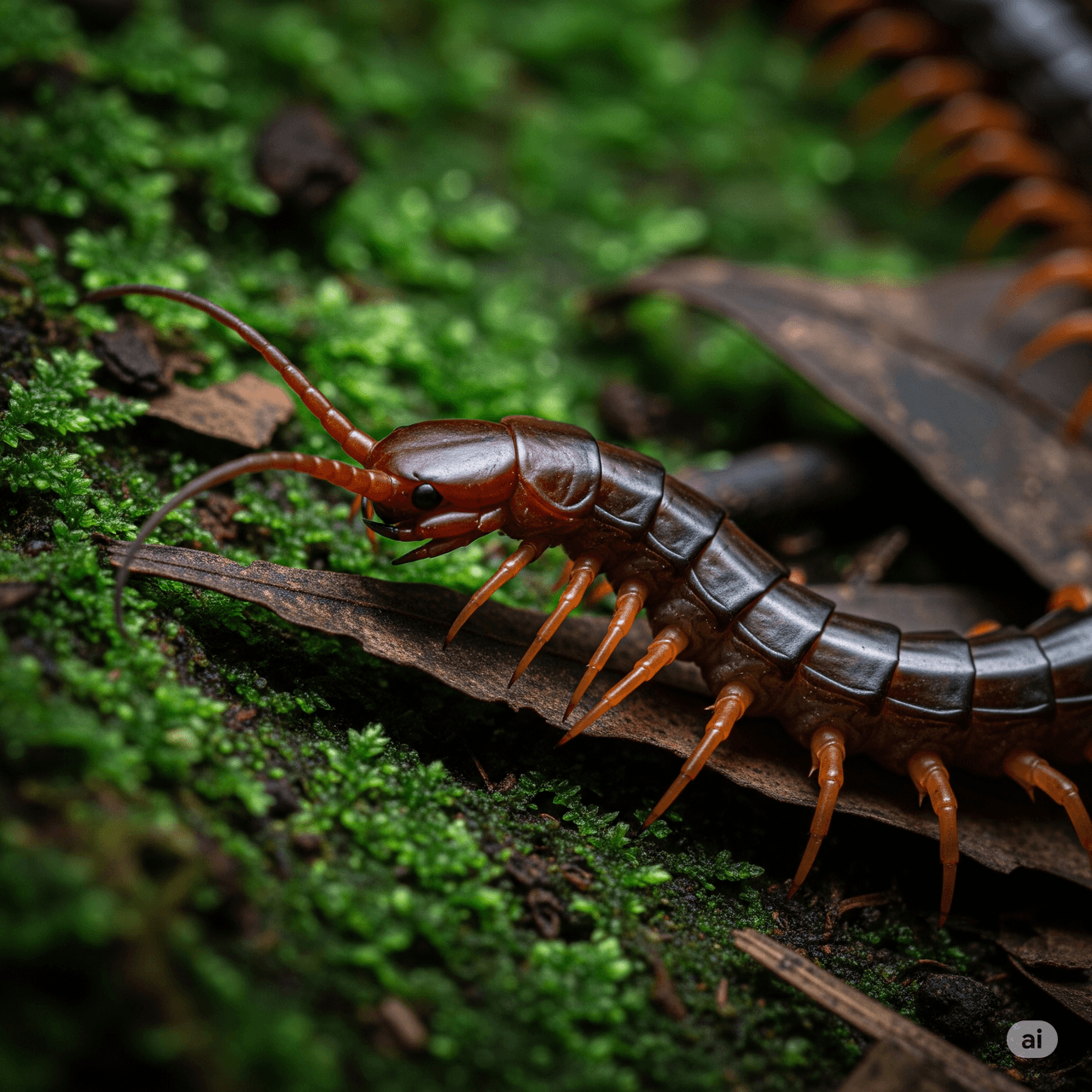
Kırkayak (Diplopoda)
Species Diversity | 12,000 described species | ||||||||
|---|---|---|---|---|---|---|---|---|---|
Segment Characteristic | Diplosegment (two pairs of legs/segment) | ||||||||
Typical Size | 5 mm – 300 mm | ||||||||
Nutrition | Detritivore (leaf litter-fungus) | ||||||||
Defense | Volvation Benzoquinone | ||||||||
Reproduction(s) | anamorphic development Gonopod-mediated spermatophore | ||||||||
Ecosystem Role | humus formation Leaf litter fragmentation | ||||||||
Distribution(s) | All continents except Antarctica most diverse in tropics | ||||||||
Millipedes are multi-segmented, multi-legged terrestrial arthropods belonging to the class Diplopoda. These organisms are commonly found in moist habitats and play a significant role in the decomposition of plant-derived organic matter. Approximately 12,000 species have been described worldwide. Millipedes are members of the subphylum Myriapoda and share this group with other classes including Symphyla, Pauropoda and Chilopoda. Fossil records indicate that the evolutionary origin of the class Diplopoda extends back to the Silurian period.
The body of millipedes consists of a head (cephalon) and a trunk composed of numerous segments. The head bears one pair of antennae, mandibles and up to two pairs of maxillae. In most species, simple eyes are present on the head. The trunk is made up of diplosegments, which are fused pairs of segments. Each diplosegment bears two pairs of legs; this feature is one of the key morphological distinctions between millipedes and centipedes (Chilopoda), which belong to the same subphylum.
The body is covered by a hardened cuticle that functions as an exoskeleton and typically contains calcium carbonate. This structure provides mechanical protection and reduces water loss. In some millipede species, lateral extensions called paranota are present on the body. Defensive adaptations include coiling the body into a spiral form and activating chemical secretory glands (ozopores). These glands secrete various chemical compounds such as benzoquinones, phenols and alkaloids to deter potential predators.
The circulatory system of diplopods is open; hemolymph flows through the body via a heart and vessel-like structures. Respiration occurs via a tracheal system, with gas exchange taking place through openings called spiracles. The digestive system consists of a long gut adapted for detritivorous feeding. This system enables the breakdown of highly cellulose-rich material with the aid of symbiotic microorganisms. Excretion is carried out by Malpighian tubules. The nervous system comprises a pair of ventral nerve cords and segmental ganglia.

Internal Anatomy (Generated by Artificial Intelligence)
Millipedes belong to the class Diplopoda within the subphylum Myriapoda. Sixteen orders have been described within this class. Among these, the orders Polydesmida, Julida, Spirobolida and Spirostreptida exhibit the highest species diversity. Phylogenetic analyses based on molecular and morphological data have demonstrated that Diplopoda forms a sister group to other myriapod classes. Fossil evidence confirms the presence of Diplopoda since the Silurian period. Modern molecular phylogenetic studies suggest that major millipede lineages began to diverge during the Carboniferous period.
Millipedes are represented on all continents except Antarctica. Species diversity is highest in tropical regions. Habitat preferences are strongly linked to moisture levels. Forested areas, leaf litter layers, decaying wood, under stones and moist soil layers constitute their most common habitats. Some species live near the soil surface while others inhabit subterranean galleries or cave systems.
Diplopods generally employ a detritivorous feeding strategy. Leaf litter, decaying wood and other organic materials form their primary food sources. Symbiotic microorganisms in their digestive systems facilitate the breakdown of recalcitrant compounds such as cellulose. This feeding strategy contributes to nutrient cycling and the mineralization of organic matter within ecosystems.

Feeding (Generated by Artificial Intelligence)
Millipedes enhance soil structure by contributing to organic matter decomposition. By physically fragmenting organic material, they facilitate more efficient microbial breakdown. This process accelerates humus formation and increases soil fertility. Additionally, they improve the biological availability of elements in the soil. For these reasons, millipedes are regarded as an important group of macro-decomposers in soil ecosystems.
Most millipede species are nocturnal. During the day they remain hidden in moist and dark environments. Defensive behaviors include coiling the body into a spiral form and releasing chemical secretions in response to threats. Some species protect themselves by curling into a spherical shape (volvation). These adaptations serve to reduce water loss and provide physical defense against predators.

Sexual dimorphism is observed in millipedes. In males, certain pairs of legs are modified into reproductive structures called gonopods, which transfer spermatophores to the female. The female lays fertilized eggs in moist environments. Development occurs through a process known as anamorphosis; individuals gain new body segments and leg pairs with each molt until they reach adulthood. The duration of development can last several years depending on environmental factors.
Agnihotri, R., Bharti, A., Ramesh, A., Prakash, A., and Sharma, M. P. 2021. "Glomalin Related Protein and C16:1ω5 PLFA Associated with AM Fungi as Potential Signatures for Assessing the Soil C Sequestration under Contrasting Soil Management Practices." *European Journal of Soil Biology* 103: 103286. Accessed May 30, 2025. https://doi.org/10.1016/j.ejsobi.2021.103286.
Bodner, M., Vagalinski, B., Makarov, S. E., Antić, D. Ž., Vujisić, L. V., Leis, H., and Raspotnig, G. 2016. "“Quinone Millipedes” Reconsidered: Evidence for a Mosaic-Like Taxonomic Distribution of Phenol-Based Secretions across the Julidae." *Journal of Chemical Ecology* 42 (3): 249–258. Accessed May 30, 2025. https://doi.org/10.1007/s10886-016-0680-4.
Hu, L., Wang, F., Wang, X., Yang, Q., Xiong, Y., and Liu, W. 2015. "Phytoconstituents from the Leaves of Dracaena cochinchinensis (Lour.) S. C. Chen." Biochemical Systematics and Ecology 63: 1–5. Accessed May 30, 2025. https://doi.org/10.1016/j.bse.2015.09.012.
Tóth, Z., and Hornung, E. 2019. "Taxonomic and Functional Response of Millipedes (Diplopoda) to Urban Soil Disturbance in a Metropolitan Area." *Insects* 11 (1): 25. Accessed May 30, 2025. https://doi.org/10.3390/insects11010025.
Williams, R. C., Newman, S. J., and Sinclair, W. 2012. "DNA Barcoding in Nautilus pompilius (Mollusca: Cephalopoda): Evolutionary Divergence of an Ancient Species in Modern Times." Invertebrate Systematics 26 (6): 548. Accessed May 30, 2025. https://www.researchgate.net/publication/236860387_DNA_barcoding_in_Nautilus_pompilius_Mollusca_Cephalopoda_evolutionary_divergence_of_an_ancient_species_in_modern_times

Kırkayak (Diplopoda)
Species Diversity | 12,000 described species | ||||||||
|---|---|---|---|---|---|---|---|---|---|
Segment Characteristic | Diplosegment (two pairs of legs/segment) | ||||||||
Typical Size | 5 mm – 300 mm | ||||||||
Nutrition | Detritivore (leaf litter-fungus) | ||||||||
Defense | Volvation Benzoquinone | ||||||||
Reproduction(s) | anamorphic development Gonopod-mediated spermatophore | ||||||||
Ecosystem Role | humus formation Leaf litter fragmentation | ||||||||
Distribution(s) | All continents except Antarctica most diverse in tropics | ||||||||
No Discussion Added Yet
Start discussion for "Kırkayak (Diplopoda)" article
Morphological and Systematic Features
Body Structure
Internal Organ Systems
Systematic Position
Ecological Characteristics and Habitat Use
Geographic Distribution
Feeding Behavior
Ecosystem Functions
Behavior and Reproduction
Activity and Defense
Reproduction and Development