


This article was automatically translated from the original Turkish version.
+1 More
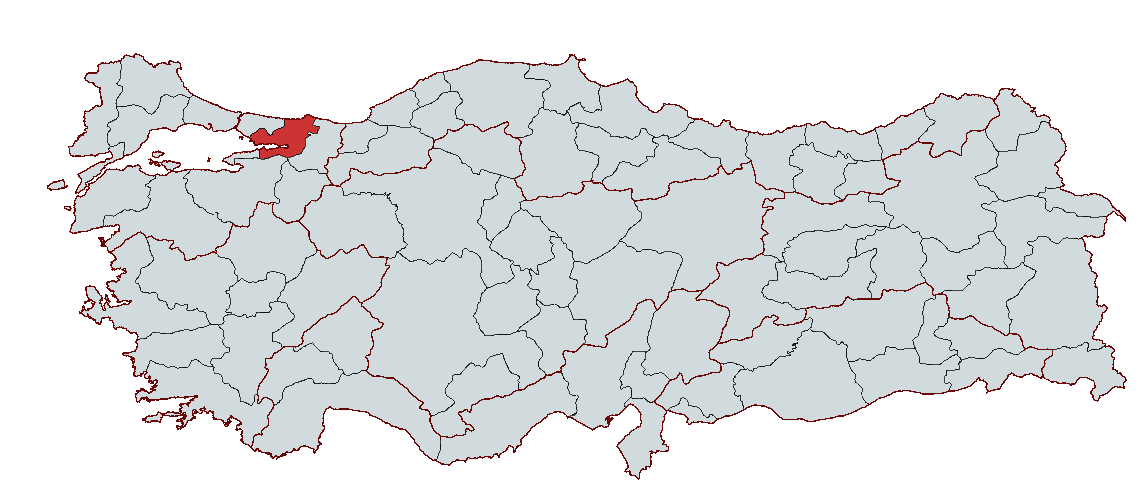
Country | Türkiye | ||||||||
|---|---|---|---|---|---|---|---|---|---|
Region(s) | Marmara | ||||||||
Population | 2.130.006 | ||||||||
Area(s) | 588/km² | ||||||||
Climate(s) | Mediterranean-Black Sea Transition Climate | ||||||||
Important Structure(s) | Sırrı Paşa Konağı Hereke Sarayı Orhan Camii Pertev Paşa Külliyesi Ancient City of Nicomedia | ||||||||
Governor(s) | İlhami Aktaş | ||||||||
Area Code(s) | 262 | ||||||||
License Plate Code | 41 | ||||||||
Kocaeli, located in Türkiye’s Marmara Region, is one of the key centers of trade and industry. Its proximity to Istanbul, extensive transportation networks, and natural harbor give it a strategic position. With a history extending back to the 8th century BCE, Kocaeli was known in antiquity as Nicomedia, the capital of the Kingdom of Bithynia. During the Ottoman period, it emerged as an important important trade center and rapidly expanded during the Republican era through industrialization, becoming one of the country’s most advanced industrial regions. Situated around the Gulf of İzmit, the province also attracts attention for its natural beauty, forests, highland pastures, and coastal strip. With a population exceeding two million, Kocaeli is an important economic and cultural center due to its strong industry, universities, and transportation infrastructure.
The history of Kocaeli extends back to the Prehistoric Age, when human settlements first emerged. Archaeological findings, particularly in the areas around Darıca and Kandıra, reveal traces of habitation from the Paleolithic and Neolithic periods. In the 8th century BCE, Megarian and Athenian colonists established a city named Astakos on the southern shore of the Gulf of İzmit, in what is now the Başiskele region. Ancient sources indicate that Astakos was an important port city that flourished through trade. However, this city was destroyed by the Kingdom of Bithynia in 262 BCE and subsequently rebuilt by King Nicomedes I on the site of present-day İzmit under the name Nicomedia.
Nicomedia became part of the Roman Empire in 74 BCE and served as the capital of the province of Bithynia-Pontus. In 284 CE, Emperor Diocletian declared Nicomedia the eastern capital of the Roman Empire, and the city became the fourth largest in the world after Rome, Alexandria, and Antakya. During the Roman period, Nicomedia experienced significant growth as an administrative, commercial, and military center, acquiring palaces, baths, theaters, and temples.
However, after Emperor Constantine the Great declared Constantinople the capital in 330 CE, Nicomedia gradually lost its former prominence. During the Byzantine Empire, the city remained an important military and commercial center, but suffered repeatedly due to earthquakes and Gothic raids. Severely damaged by major earthquakes in 358, 378, and 554 CE, the city took on a diminished appearance by the late Byzantine era.
In 1078, İzmit and its surroundings came under the control of the Anatolia Seljuk State. However, during the First Crusade (1096–1099), Emperor Alexios I Komnenos of Byzantium recaptured the region. İzmit changed hands several times between Byzantines and Crusaders throughout the 13th century.
In 1329, the Battle of Pelekanon (also known as the Maltepe Battle) took place between the Ottomans and Byzantines, resulting in a heavy defeat for Byzantine Emperor Andronikos III. Following this battle, the Ottomans accelerated their conquest of İzmit, and in 1337 the city was definitively incorporated into Ottoman territory under the command of Akçakoca, one of Gazi’s generals. From this date onward, the city became known as İznikmid and later as İzmid (İzmit).
During the Ottoman period, İzmit developed as a major trade and transportation hub, reaching its peak during the reign of Kanuni Sultan Süleyman. In the 16th century, shipbuilding activities intensified along the Gulf of İzmit, and the city began to transform into an industrial center. In the 19th century, as part of the Ottoman modernization process, railway construction began in İzmit, and the Haydarpaşa-İzmit railway line was completed in 1873, strengthening its connection to Istanbul.
After the defeat of the Ottoman State in the First World War, Kocaeli was first occupied by the British on 6 July 1920 and then by the Greeks on 28 April 1921. However, during the War of Independence, the Turkish army recaptured the city on 28 June 1921, liberating it from occupation.
After the proclamation of the Republic, Kocaeli became one of the fastest-growing provinces, particularly due to industrial investments. In 1934, the İzmit Paper Factory (SEKA) was opened, becoming Türkiye’s first modern paper production center. Industrialization accelerated from the 1950s onward, with petrochemical, automotive, and metal industries concentrating in the region. In the 1990s, major industrial facilities such as TÜPRAŞ, Ford Otosan, and Hyundai Assan established operations in Kocaeli, making it one of Türkiye’s largest industrial centers.
The 7.4 magnitude Gölcük Earthquake on 17 August 1999 caused massive destruction in Kocaeli and its surroundings, claiming thousands of lives and inflicting infrastructure extensive damage. However, following the disaster, comprehensive reconstruction efforts and the rapid recovery of industry enabled Kocaeli to resume its growth trajectory.
Kocaeli is located in the Marmara Region of Türkiye, within the Çatalca-Kocaeli Section. The province lies between 29°22′ and 30°21′ east longitude and 40°31′ and 41°13′ north latitude. It borders Sakarya to the east and southeast, Bursa to the south, Yalova and Istanbul to the west, and the Black Sea to the north. With an area of 3,505 km², Kocaeli is one of Türkiye’s largest provinces by land area. The 30° east longitude line, which passes east of the provincial capital İzmit, serves as the basis for Türkiye’s time zone.
Kocaeli occupies a strategic position at the intersection of major routes connecting Asia and Europe. Its proximity to Istanbul, its natural harbor in the Gulf of İzmit, and its advantages in road, rail, air, and sea transportation have made it a major industrial and commercial center.
Kocaeli’s surface topography is highly varied, with most of its terrain consisting of mountainous and rugged features. The northern part of the region is dominated by the Kocaeli Plateau, while the southern part is occupied by the Samanlı Mountains.
Kocaeli lacks large alluvial plains. Instead, it features smaller flat areas formed by the valleys of stream. The most important plains are:
Rivers originating in Kocaeli flow either into the Black Sea or Sea of Marmara. The most important rivers are:
Kocaeli has no significant natural lakes, but it does contain several dam lakes and artificial reservoirs:
Kocaeli exhibits a transitional climate between the Mediterranean and Black Sea climates. The Mediterranean climate is more pronounced around the Gulf of İzmit and the southern areas, while the Black Sea climate dominates in Kandıra and along the Black Sea coast.
The province’s plant vegetation combines characteristics of both Mediterranean maquis and Black Sea forests:
With a population of 2,130,006, Kocaeli is one of Türkiye’s most populous provinces and the second-largest industrial center in the Marmara Region after Istanbul. The province’s advanced industry, trade, and transportation infrastructure have contributed to rapid population growth. The annual population growth rate is 2.26%, exceeding the national average.
The population distribution by district is as follows:
The highest population density is found in Gebze and İzmit, while the lowest is in Kandıra and Dilovası.
Since the 1950s, Kocaeli has transformed into a rapidly industrializing and migration area. From the 1960s onward, it experienced significant migration from Istanbul, Sakarya, Bursa, and other Anatolian provinces. After 1980, the expansion of industrial facilities and port activities further accelerated migration.
The main factors driving Kocaeli’s population growth include:
Kocaeli is a net recipient of migration, with a population density far exceeding the national average. The population density is 588 persons per km², approximately three times the national average.
The majority of Kocaeli’s population lives in urban areas, with an urbanization rate of 93%. Gebze, İzmit, Darıca, and Körfez districts exhibit high urbanization rates, while Kandıra and Karamürsel retain more rural characteristics.
Industrial activity and intense migration have led to informal settlements and unplanned urban expansion. However, in recent years, new large-scale residential unit projects have accelerated a more modern urbanization process. New residential developments, shopping centers, and transportation investments in Gebze, Kartepe, and İzmit are promoting more planned urban growth.
Kocaeli exceeds the national average in educational standards. The literacy rate is 98.6%, and the province is well-developed in education due to its higher education institutions. Kocaeli University and Gebze Technical University are the province’s most important higher education institutions. Additionally, technical schools and vocational high schools oriented toward industry support the provincial economy.
Kocaeli is one of Türkiye’s most advanced industrial regions, distinguished by its industrial production, trade, logistics, and port activities. Its proximity to Istanbul, transportation infrastructure, and the advantages offered by the Gulf of İzmit have made it a major industrial and commercial center.
Kocaeli accounts for approximately 13% of Türkiye’s total industrial output. Around 3,000 industrial enterprises are registered with the Kocaeli Chamber of Industry, and 18 of Türkiye’s top 100 industrial firms are located here, activity demonstrating their presence. International companies such as TÜPRAŞ, Ford Otosan, Hyundai Assan, Siemens, Bosch, Honda, Goodyear, and Bridgestone operate production facilities in Kocaeli.
Main industrial sectors include:
Kocaeli hosts 13 organized industrial zones (OSBs). Some of them include:
Kocaeli is one of Türkiye’s largest trade and logistics centers. More than 35 ports and piers along the Gulf of İzmit facilitate the sea transport of the province’s industrial output.
Kocaeli also holds a strategic position as one of the most important logistics transit points between Anatolia and Istanbul, making it vital for customs operations, international trade, and transit transportation.
Despite its industrial orientation, agriculture and livestock farming continue in Kocaeli, particularly concentrated in the Kandıra, Karamürsel, and Kartepe regions.
Main agricultural products include:
Kocaeli has a highly developed infrastructure for road, sea, air, and rail transportation. Its position as one of the most important transit points between Istanbul and Anatolia gives it strategic significance in transportation.
Kocaeli lies on two major transportation corridors: the TEM Motorway (E-80) and the D-100 Highway (E-5). Its proximity to Istanbul has led to the recent degree development of its intra-city and inter-city transportation networks.
Kocaeli is a key stop on the Ankara-Istanbul High-Speed Railway (YHT) line. It is also significant for suburban and weight transportation.
Kocaeli is one of Türkiye’s largest maritime transport centers due to its ports along the Gulf of İzmit.
Kocaeli has two important airports:
Maşukiye and Kartepe are Kocaeli’s most important nature tourism destinations. Maşukiye is known for its waterfalls, streams, picnic areas, and trout restaurants, while Kartepe holds great significance for winter tourism. The Kartepe Ski Center is favored for skiing, snowboarding, and sledding. During Summer months, activities such as hiking, bicycle tours, and ATV excursions are popular.
Ormanya Natural Life Park, one of Europe’s largest natural life parks, spans 4,000 decares and includes walking trails, camping areas, a wildlife zone, and a child zoo. Ballıkayalar Nature Park is a popular destination for rock climbing, trekking, and hiking. This natural wonder in Gebze is rich in caves and waterfalls.
Menekşe Plateau and Aytepe, with their clean air, expansive meadows, and forested areas, are ideal for campers and nature lovers. They are especially favored during summer months for trekking, photography, and nature sports.
Kandıra district attracts attention with its natural beaches along the Black Sea coast. Kerpe, with its calm, shallow waters, is a favored seaside town for families. It is known for its rocky formations and clean beaches. Kefken, Kefken Island, and Pembe Kayalar offer natural attractions suitable for campers and nature enthusiasts. Cebeci Beach, awarded the Blue Flag, is one of the most preferred beaches due to its wide shoreline. Bağırganlı Beach is a suitable area for camping tourism and caravan holidays.
The shores of Karamürsel and Hereke along the Gulf of İzmit stand out for their clean beaches and tranquil natural environment. The Eskihisar-Topçular route, an important transit point in the Sea of Marmara, holds significant value for maritime transportation and vehicle services.
The Ancient City of Nicomedia, capital of the Kingdom of Bithynia, was declared the eastern capital of the Roman Empire by Emperor Diocletian. Excavations have revealed theater, city wall remains, and baths.
Important Ottoman-era monuments include Pertev Pasha Külliyesi, Orhan Mosque, and Hereke Palace. The Pertev Paşa Külliyesi, built by the renowned architect Sinan, is one of Kocaeli’s most significant Ottoman structures. The Orhan Mosque, commissioned by Orhan Gazi, is among the oldest Ottoman buildings in Kocaeli. Hereke Palace, built by Sultan Abdülmecid, attracts visitors with its historical integrity.
Hereke Carpets are renowned for their high-quality handwoven textiles dating back to the Ottoman period. Many palaces, including Dolmabahçe Palace, were furnished with carpets woven in Hereke.
The Gayret Ship Museum was established by converting the former Turkish Navy vessel TCG Gayret into a museum. The Kocaeli Science Center is a modern science center offering educational activities and exhibitions, particularly for children and youth.
Various festivals and cultural events are held throughout the year in Kocaeli. The Kocaeli Fair and Culture Art Festival is one of the largest fair organizations in the Marmara Region. The International Pişmaniye Festival celebrates pişmaniye, Kocaeli’s famous sweet. Kandıra Namazgâh Oil Wrestling is an important event preserving Turkish wrestling tradition. The Kerpe Summer Festival and Concerts are among the largest summer events along the Black Sea coast.
Bostan, İdris. "İzmit." *TDV İslâm Ansiklopedisi.* Accessed February 12, 2025. https://islamansiklopedisi.org.tr/izmit#1.
Kocaeli Büyükşehir Municipality. "Ana Sayfa." Accessed February 12, 2025. https://www.kocaeli.bel.tr/.
Kocaeli Valiliği. "Ana Sayfa." Accessed February 12, 2025. http://www.kocaeli.gov.tr/.
Tuncel, Metin. "İzmit." *TDV İslâm Ansiklopedisi.* Accessed February 12, 2025. https://islamansiklopedisi.org.tr/izmit#2-bugunku-izmit.
Türkiye İstatistik Kurumu. "Adrese Dayalı Nüfus Kayıt Sistemi Sonuçları 2024." Accessed February 12, 2025. https://data.tuik.gov.tr/Bulten/Index?p=Adrese-Dayali-Nufus-Kayit-Sistemi-Sonuclari-2024-53783.
Country | Türkiye | ||||||||
|---|---|---|---|---|---|---|---|---|---|
Region(s) | Marmara | ||||||||
Population | 2.130.006 | ||||||||
Area(s) | 588/km² | ||||||||
Climate(s) | Mediterranean-Black Sea Transition Climate | ||||||||
Important Structure(s) | Sırrı Paşa Konağı Hereke Sarayı Orhan Camii Pertev Paşa Külliyesi Ancient City of Nicomedia | ||||||||
Governor(s) | İlhami Aktaş | ||||||||
Area Code(s) | 262 | ||||||||
License Plate Code | 41 | ||||||||
History
Prehistory and Antiquity
Roman and Byzantine Periods
Seljuk and Ottoman Periods
National Struggle and Republican Era
The 1999 Gölcük Earthquake and Its Aftermath
Geography
Geological Structure and Landforms
Plains and Rivers
Lakes
Climate and Vegetation
Population
Population Growth and Migration
Urbanization and Urban Structure
Education and Literacy Rate
Economy
Industry and Production
Organized Industrial Zones (OSBs) and Technology Development Zones
Trade and Logistics
Agriculture and Livestock
Transportation
Road Transportation
Rail Transportation
Maritime Transportation
Air Transportation
Public Transportation and Light Rail Systems
Tourism
Nature and Ecotourism
Sea and Coastal Tourism
Historical and Cultural Tourism
Festivals and Events