This article was automatically translated from the original Turkish version.
+1 More
Registration Date | 13.09.2021 | ||||||||
|---|---|---|---|---|---|---|---|---|---|
Type(s) | Mahreç sign | ||||||||
Product / Product Group(s) | Semolina halva / Desserts bakery and confectionery products | ||||||||
Applicant/Registrant(s) | Konya Metropolitan Municipality | ||||||||
Geographical Boundary | Konya Province | ||||||||
Tradition | Mevlevi culture, wedding and special occasion dessert | ||||||||
Component(s) | Butter milk sugar semolina pine nuts | ||||||||
Monitoring | Under the coordination of Konya Metropolitan Municipality, at least once a year | ||||||||
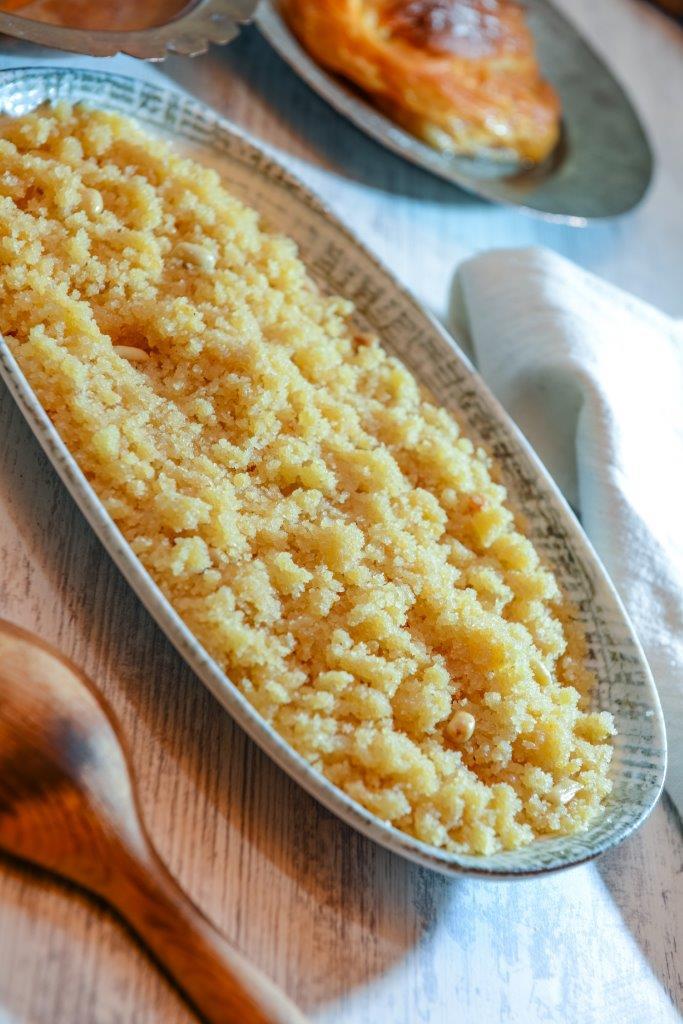
Konya İrmik Helvası is one of the traditional desserts of Konya cuisine and reflects the influences of Mevlevi culture. This halva, commonly served at weddings and special gatherings, stands out for its regional identity and historical significance. Its unique production and presentation methods are preserved through geographical indication registration. Konya İrmik Helvası was officially registered with a geographical indication on 13 September 2021 under Law No. 6769 on Industrial Property (Registration No: 890, Application No: C2020/318, Application Date: 24.09.2020).
Konya İrmik Helvası is made from roasted semolina and pine nuts, cooked with sweetened milk. After cooking, it is covered with a clean cloth or paper towel to absorb steam, then rested and stirred to achieve a grainy texture. It is always served hot. This production method and presentation define the distinctive identity of Konya İrmik Helvası.
The production, processing, and all other stages of Konya İrmik Helvası are carried out exclusively within the boundaries of Konya Province. This ensures the preservation of the product’s link to its geographical origin.
The product is monitored by a four-member oversight body composed of experts from the Directorate of Health and Social Services, the Konya Provincial Directorate of Agriculture and Forestry, the Konya Gastronomy and Tourism Association, and the Faculty of Tourism at Necmettin Erbakan University, under the coordination of the Konya Metropolitan Municipality. Inspections are conducted annually and may be repeated at any time if necessary or upon complaint. Inspection criteria include the ingredients used, the production and cooking method, and the correct use of the designation “Konya İrmik Helvası” and its geographical indication emblem.
The designation “Konya İrmik Helvası” and its geographical indication emblem appear on the product or its packaging. In cases where they cannot be placed on the product or packaging, they must be displayed in a clearly visible location within the production facility.
Turk Patent and Trademark Office. "Konya İrmik Helvası Coğrafi İşaret Detayı." Accessed August 16, 2025. https://ci.turkpatent.gov.tr/cografi-isaretler/detay/2666
Türk Patent ve Marka Kurumu. “Konya İrmik Helvası Tescil Dokümanı.” Accessed August 16, 2025. https://ci.turkpatent.gov.tr/Files/GeographicalSigns/988647b9-93f2-4a0c-b3c8-01debab36d7c.pdf

Registration Date | 13.09.2021 | ||||||||
|---|---|---|---|---|---|---|---|---|---|
Type(s) | Mahreç sign | ||||||||
Product / Product Group(s) | Semolina halva / Desserts bakery and confectionery products | ||||||||
Applicant/Registrant(s) | Konya Metropolitan Municipality | ||||||||
Geographical Boundary | Konya Province | ||||||||
Tradition | Mevlevi culture, wedding and special occasion dessert | ||||||||
Component(s) | Butter milk sugar semolina pine nuts | ||||||||
Monitoring | Under the coordination of Konya Metropolitan Municipality, at least once a year | ||||||||
No Discussion Added Yet
Start discussion for "Konya Semolina Halva" article
Product Description and Distinctive Characteristics
Production Method
Geographical Boundary and Production
Monitoring and Protection
Usage Format
Key Features