

This article was automatically translated from the original Turkish version.
+1 More
Type of Geographical İndication | Mahreç Sign | ||||||||
|---|---|---|---|---|---|---|---|---|---|
Registration Number | 910 | ||||||||
Registration Date | 01.10.2021 | ||||||||
Product / Product Group(s) | Meals and Soups | ||||||||
Province(s) | Konya | ||||||||
Applicant/Registrant(s) | Konya Metropolitan Municipality | ||||||||
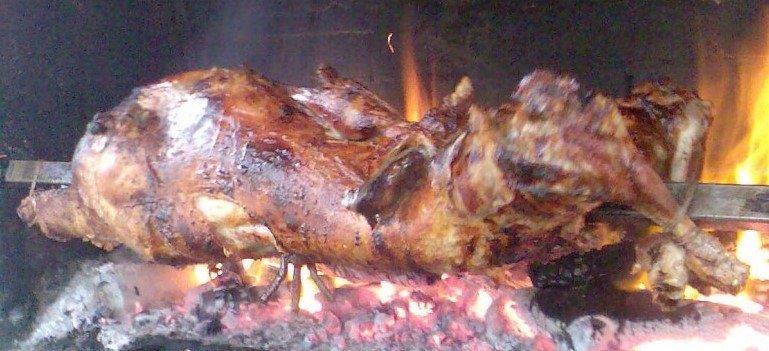
Konya Tandırda Çebiç is a geographical indication mark registered on 01.10.2021 with registration number 910 following an application submitted on 17.09.2020 by the province of Konya. The registering authority is the Konya Metropolitan Municipality. The dish is prepared by roasting the meat of a lamb under one year old (çebiç) or a young lamb in a tandır oven and serving it atop bulgur pilaf.
Konya Tandırda Çebiç is prepared using lamb meat during summer months and çebiç meat during winter months, depending on seasonality. Before cooking, the meat is coated with a mixture of strained yogurt, tomato paste, dried onion, garlic, and salt. The bulgur pilaf served alongside the dish is prepared using the fat and juices that drip from the meat into a pot during roasting, along with the offal (liver, heart, and kidney) cooked inside the animal’s abdominal cavity. Konya Tandırda Çebiç is a dish rooted in the region’s culinary tradition and is traditionally preferred on special occasions. The dish’s reputation is based on its geographically specific production method and the mastery required to execute it.
The production process of Konya Tandırda Çebiç consists of the following stages:
The production of Konya Tandırda Çebiç is tied to a geographically specific method requiring specialized skill and a reputation linked to its geographical origin. Therefore, all stages of production must be carried out within the boundaries of the province of Konya.
Monitoring is conducted by a five-member oversight body composed of one expert each from the Konya Metropolitan Municipality, the Konya Provincial Directorate of Agriculture and Forestry, the Konya Gastronomy and Tourism Association, and the Faculty of Tourism at Necmettin Erbakan University, under the coordination of the Konya Metropolitan Municipality.
Monitoring is carried out annually on a regular basis, as well as upon complaint or when deemed necessary.
The monitoring criteria are as follows:
The oversight body may obtain services from public or private institutions or qualified experts during monitoring.
Turk Patent and Trademark Office. "Konya Tandırda Çebiç Sicil Belgesi." Accessed October 24, 2025. https://ci.turkpatent.gov.tr/Files/GeographicalSigns/5aa405d7-362e-4c46-857a-612123c13ebf.pdf.
Turk Patent and Trademark Office. "Konya Tandırda Çebiç." Geographical Indications Portal. Accessed October 24, 2025. https://ci.turkpatent.gov.tr/cografi-isaretler/detay/2645.

Type of Geographical İndication | Mahreç Sign | ||||||||
|---|---|---|---|---|---|---|---|---|---|
Registration Number | 910 | ||||||||
Registration Date | 01.10.2021 | ||||||||
Product / Product Group(s) | Meals and Soups | ||||||||
Province(s) | Konya | ||||||||
Applicant/Registrant(s) | Konya Metropolitan Municipality | ||||||||
Product Characteristics
Production Method
Geographical Boundary
Monitoring