


This article was automatically translated from the original Turkish version.
+2 More
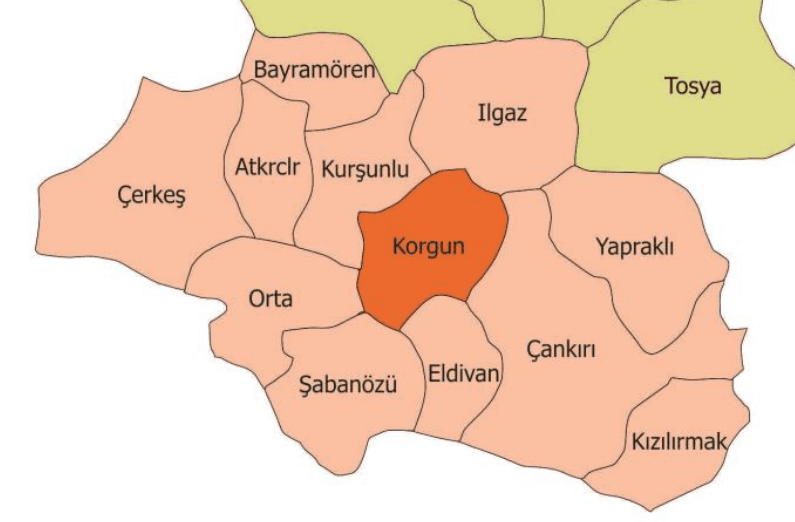
Korgun (District)
Province(s) | Çankırı | ||||||||
|---|---|---|---|---|---|---|---|---|---|
Geographical Region | Central Anatolia | ||||||||
District Governor | Ferhat GÜR | ||||||||
Mayor(s) | Hasan Hüseyin KOZAN | ||||||||
Population | 5.666 (2018) | ||||||||
Elevation(s) | 910 m | ||||||||
District Area | 557 km² | ||||||||
Korgun is a district of Çankırı in Türkiye’s Central Anatolia Region. It is one of the settlements reflecting Çankırı’s rural identity through its history, geographical location, and economic structure. Throughout its historical development, Korgun has held significance both in terms of local administrative organization and rural development policies, preserving its traditional way of life to a large extent until the present day.
Korgun’s history can be traced back to the Bronze Age based on archaeological and epigraphic studies conducted in the region. The surrounding tumuli and ancient settlement remains indicate that the area was inhabited during the Hittite, Phrygian, and later Roman and Byzantine periods. Ottoman archival documents refer to it as “Korgan” or “Kurgun.” During the Republican era, Korgun functioned as a subdistrict until it attained district status in 1990.
Aerial View of Korgun District. (Korgun Municipality)
Korgun is located in the northwestern part of Çankırı province. It is bordered by Çankırı to the east, Ilgaz to the north, Kurşunlu to the west, and Eldivan and Şabanözü districts to the south. The district’s terrain is largely rugged, mountainous, and rocky in places, leading local residents to refer to it as “Taş Yakası.” However, this rugged geography also provides favorable conditions for agriculture and animal husbandry through extensive pasturelands, fertile highland meadows, and arable land.
The Korgun River, which flows through the entire district, plays a critical role in irrigating agricultural fields especially during the summer months. In addition, several irrigation reservoirs are located in the region, the most notable of which is the Korgun Tavşankayaları Reservoir due to its large capacity. This reservoir not only supports irrigation but also positively influences the microclimate, enhancing agricultural productivity and enabling freshwater fishing.
Korgun has a typical continental climate. Summers are generally hot and dry, while winters are cold and snowy. However, the moderating influence of the Black Sea climate is occasionally felt in the northern parts of the district. This creates climatic variation across different areas of the district and directly affects agricultural production patterns.
With an average elevation of 1,050 meters, Korgun has a cooler climate than Çankırı city center. This elevation difference results in average air temperatures being 1–2 degrees Celsius lower throughout the year, an effect that influences many aspects of the region, from vegetation to animal husbandry.

Korgun District, Alpsarı Reservoir Recreation Area. (Çankırı Province KTB)
As of 2024, Korgun’s total population is 4,173. The majority of this population resides in the district center, while smaller communities live in 12 surrounding villages. The district hosts a municipal mayorship, a district governorship, and various public institutions providing services.
Korgun’s economy has traditionally been based on agriculture and animal husbandry. Cereal crops such as wheat and barley, potatoes, sunflowers, and forage plants are widely cultivated. Small-scale livestock farming is also an important source of livelihood. A small industrial site and an organized industrial zone established in the district contribute to local production and generate employment.

Aerial View of the Organized Industrial Zone. (Korgun OSB)
In Korgun district, there is one multi-program Anatolian high school, one middle school, and several primary schools under the Ministry of National Education. Additionally, a community education center operates in the district. However, there are no faculties, vocational colleges, or higher education institutions located within Korgun. Vocational colleges and faculties affiliated with Çankırı Karatekin University are situated in the provincial center and other districts. Plans are underway to establish vocational colleges in Korgun to meet the demand for trained personnel linked to the Organized Industrial Zone.
In terms of healthcare, there is no state hospital in Korgun. Basic health services are provided through a family health center and several health houses. For more advanced medical care, residents rely on hospitals in the provincial center.
Korgun possesses a rich folklore that reflects the characteristic elements of Çankırı culture. Traditional folk dances, maniles, and folk tales developed around weddings, holidays, and seasonal agricultural activities are still actively preserved. The influence of the “Çankırı Yaranı” culture is evident, with traditions such as hospitality and mutual aid through the imece system continuing to be practiced.
Although the number of historical structures in the district is limited, some villages contain mosques, fountains, and gravestones dating back to the Ottoman period. Among these, the most notable are the Korgun Central Mosque and the inscribed gravestones found in certain cemeteries.
Access to Korgun is provided by road. Daily bus and minibus services operate between Çankırı city center and the district. The roads passing through the district facilitate connections with surrounding villages and neighboring districts.
Kalkınma Bakanlığı. Çankırı İl Gelişim Raporu. Ankara: T.C. Kalkınma Bakanlığı Yayınları, 2018.
Korgun Kaymakamlığı Governorship. "Tarihçe." Accessed May 1, 2025. https://www.korgun.gov.tr
Türkiye İstatistik Kurumu (TÜİK). *Adrese Dayalı Nüfus Kayıt Sistemi Sonuçları, 2023*. Ankara: TÜİK Yayınları, 2024.
Çankırı Valiliği. _Korgun İlçesi_. Accessed May 1, 2025. https://www.cankiri.gov.tr
Çankırı İl Kültür ve Turizm Müdürlüğü. *Korgun*. Accessed May 1, 2025. https://cankiri.ktb.gov.tr/TR-242736/korgun.html
Çankırı İl Kültür ve Turizm Müdürlüğü. Çankırı Tanıtım Kitabı. Çankırı: Çankırı Valiliği Yayınları, 2020.

Korgun (District)
Province(s) | Çankırı | ||||||||
|---|---|---|---|---|---|---|---|---|---|
Geographical Region | Central Anatolia | ||||||||
District Governor | Ferhat GÜR | ||||||||
Mayor(s) | Hasan Hüseyin KOZAN | ||||||||
Population | 5.666 (2018) | ||||||||
Elevation(s) | 910 m | ||||||||
District Area | 557 km² | ||||||||
History
Geography and Climate
Population and Administrative Structure
Economy
Education and Health
Cultural Structure and Folklore
Architecture and Historical Structures
Transportation