

+1 More


Portrait of Kür Şad (Generated by Artificial Intelligence.)
Origin(s) | Göktürks | ||||||||
|---|---|---|---|---|---|---|---|---|---|
Period(s) | 7th century | ||||||||
Works Written About It | The Gray Wolves Rise Again The Death of the Gray Wolves | ||||||||
Kür Şad is a historical and mythological figure symbolizing the Göktürks’ struggle for independence against Chinese domination, particularly brought to prominence in the 20th century through Hüseyin Nihal Atsız’s novel The Death of the Grey Wolves. As the leader of the legendary raid on the Chinese court, he has become one of the symbols of heroism and independence in nationalist thought.
The name “Kür Şad” consists of two elements:
Kür: Means strong, powerful, brave.
Şad: An administrative title used in ancient Turkic state organization for high-ranking nobles.
Etimologically, the name “Kür Şad” does not appear in historical sources; it is used by Hüseyin Nihal Atsız as a Turkish adaptation of the name Chieh-she-shuai.

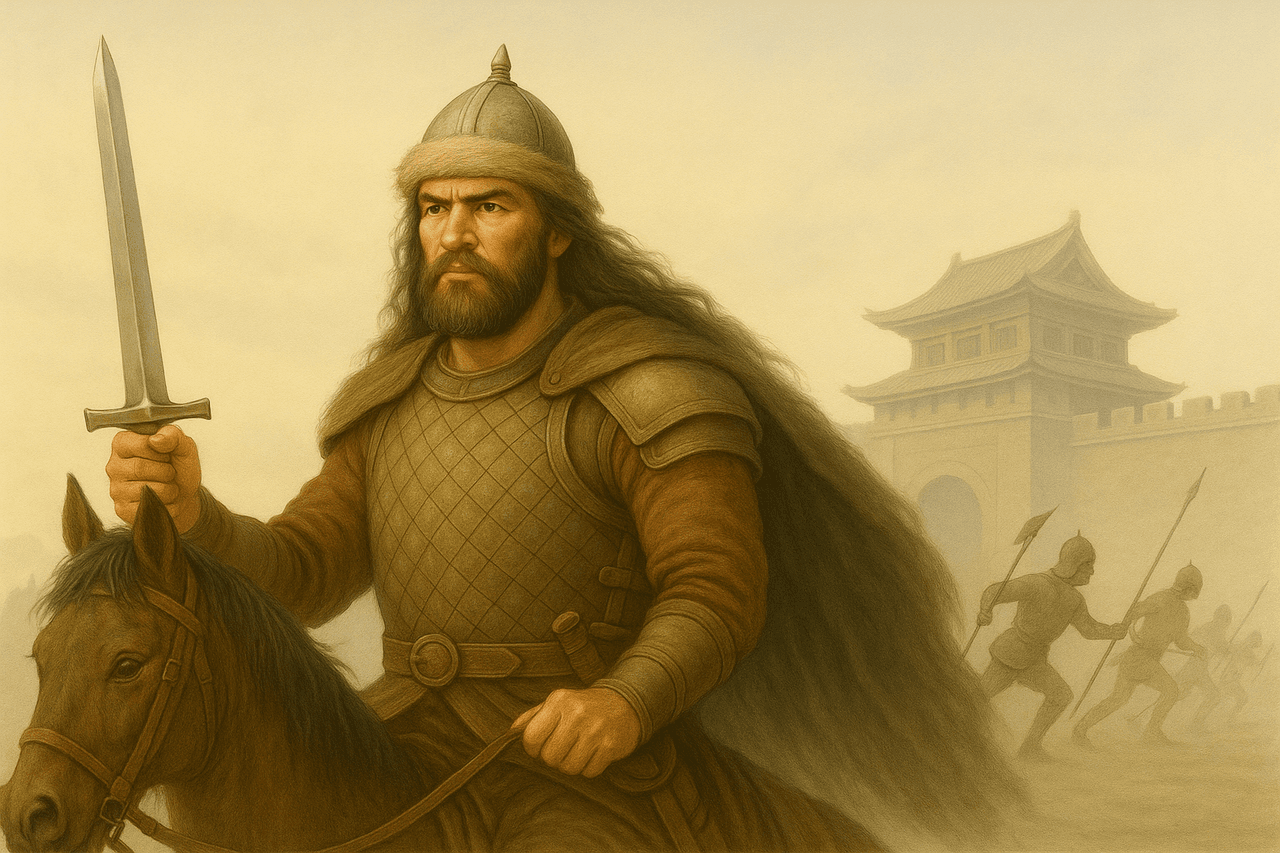
Representative Image of Kür Şad and the Forty Cheries (Generated by Artificial Intelligence)
Cultural and Social Impact
Since the mid-20th century in Türkiye, the name Kür Şad has become one of the key symbols of Turkish nationalism. It has been associated with ideals such as heroism, passion for independence, and loyalty to the state, and has been given to many male children. Additionally, the motif of “Kür Şad and the Forty Cheries” is now explored in numerous media including television series, documentaries, and novels.
The introduction of the name and character of Kür Şad into Turkish culture occurred through Hüseyin Nihal Atsız’s novel The Death of the Grey Wolves. In the novel, Kür Şad is portrayed as an idealistic leader who takes action to liberate the Turks living under Chinese captivity after the collapse of the Göktürk Khaganate. Atsız depicts Kür Şad as quiet, dignified, deeply contemplative, yet fiery and resolute when necessary. Physically strong and a master in battle, he is also a figure of profound intellectual depth. His love for his people and his yearning for freedom guide all his actions.
Hüseyin Nihal Atsız sought through the character of Kür Şad to instill in Turkish youth the values of courage, honor, love of homeland, and passion for independence. In this sense, the novel is not merely a work of fiction but also an instrument for constructing national identity.
In 630, following the destruction of the Eastern Göktürk Khaganate by China’s Tang Dynasty, the Turks lost their independence and were forced to live under Chinese domination. Turkic nobles were absorbed into the Chinese court, while the general population faced cultural suppression and assimilation policies. During this period, the Turkish people’s desire for independence was not extinguished; on the contrary, this suppressed aspiration reemerged on the historical stage through heroic figures such as Kür Şad and the Forty Cheries.
Kür Şad refused to accept the assimilation of Turkic nobles in China or the enslavement of his people. He believed that the Turks needed to reorganize as an independent political entity and devised a radical plan to achieve this. The central aim of the plan was to kidnap Emperor Taizong of the Tang Dynasty, create chaos within the Chinese court, and use this opportunity to inspire the Turks to reunite and rise up for independence.
In pursuit of this goal, in 639, Kür Şad decided to launch a raid on the palace accompanied by forty armed companions. Despite being outnumbered and strategically disadvantaged, this act is regarded as a symbolic uprising representing the Turkish people’s will to resist enslavement. However, a violent storm on the night of the planned operation prevented the emperor from leaving the palace, leading to the failure of the mission.
Kür Şad and his companions refused to retreat and continued their resistance, ultimately dying in battle near the Wei River. Although the operation achieved no political success, the event was recorded in Chinese official chronicles as a source of concern and prompted the Tang administration to reconsider its approach toward Turkic elements. Historically, this endeavor holds great significance as an early and powerful expression of the Turkish people’s will for independence and their ideal of sovereignty.
Atsız, Hüseyin Nihal. Bozkurtların Ölümü. İstanbul: Orkun Yayınları, 1946.
Kapusuzoğlu, Gökçen. “Tarihî Bir Kişilik Olarak Kür Şad ve 639 Yılı.” *Gazi Türkiyat* 21 (Fall 2017): 121–136. https://dergipark.org.tr/en/pub/gaziturkiyat/issue/67881/1070911
Sertkaya, Osman Fikri. “Kür Şad Adının Etimolojisi veya Türk Tarihinde Kür Şad Adlı Bir Kişi Var Mıdır?” *Gazi Türkiyat* 14 (Spring 2014): 1–10. https://dergipark.org.tr/en/pub/gaziturkiyat/issue/6727/90440

Portrait of Kür Şad (Generated by Artificial Intelligence.)
Origin(s) | Göktürks | ||||||||
|---|---|---|---|---|---|---|---|---|---|
Period(s) | 7th century | ||||||||
Works Written About It | The Gray Wolves Rise Again The Death of the Gray Wolves | ||||||||
Etimology
Literary Fiction and Ideological Influence
Historical Background
The Raid on the Chinese Court: A Manifesto of Resistance