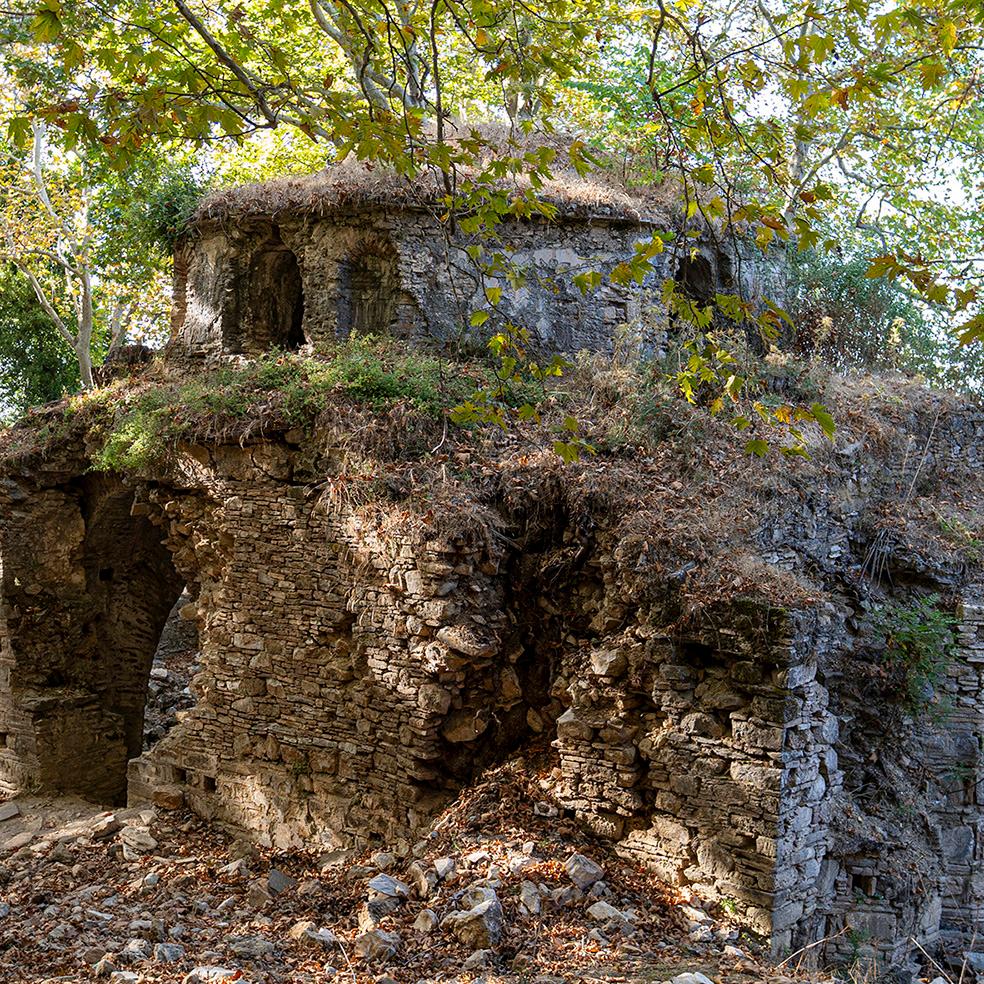
This article was automatically translated from the original Turkish version.
+1 More
Province(s) | Aydın | ||||||||
|---|---|---|---|---|---|---|---|---|---|
Period(s) | 11th century (Byzantine) 13th century (Laskarid period additions) | ||||||||
Current Status | Included in restoration and conservation projects | ||||||||
Architectural Type | Closed Greek Cross plan, centrally domed chapel and monastery complex | ||||||||
Sections | Chapel, Refectory (trapeza), Monks' rooms, Pantry, Kitchen, Necropolis and walls | ||||||||
District | Kuşadası | ||||||||
Kurşunlu Manastırı is a historical Byzantine complex located within the boundaries of Davutlar Neighborhood in the Kuşadası district of Aydın Province, on the northern slopes of the Dilek Peninsula–Big Menderes Delta National Park. Situated at an elevation of approximately 690 meters above sea level on the Samson Mountains (ancient Mykale), this religious structure is regarded as one of the examples of Byzantine cultural heritage in the region.
Dedicated to the Virgin Mary and known among the Greeks as "Panagia Kursunniatissa", the monastery’s name derives from the lead cladding that once covered its structures. It is known that this complex, dated to the 11th century, remained functional until the 19th century.

Kurşunlu Manastırı (Kuşadası Belediyesi)
The origins of the monastery trace back to the 8th century, when intense Christian migrations to the region and the efforts of pagan clergy to escape persecution led to the creation of hidden places of worship in secure, elevated areas. The building’s current architectural features, particularly in wall construction techniques, parallel those of the 13th-century Laskarid period (Empire of Nicaea).
Due to its elevated position, the structure was built to dominate the Kuşadası Bay and key ancient settlements in the region. When visited by archaeologist Theodore Wiegand in the late 1800s, it was recorded that several monks were still residing and performing duties there.
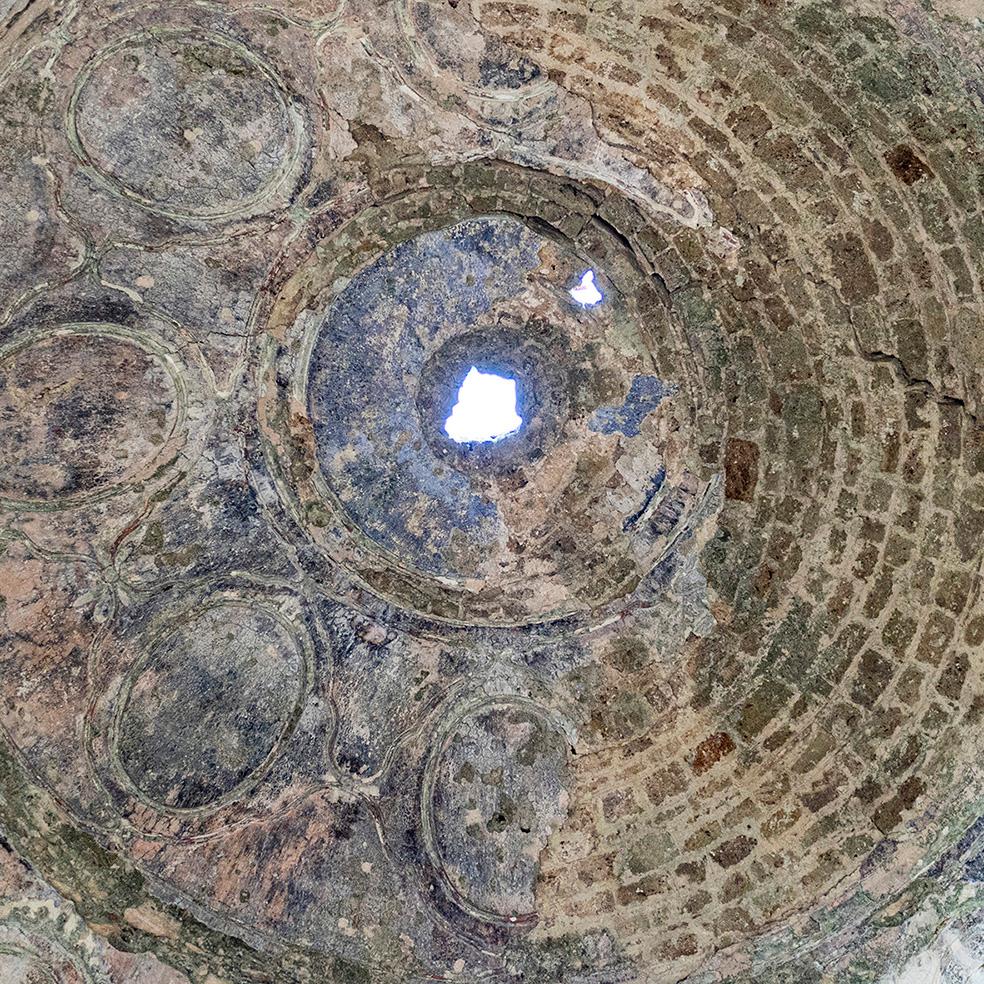
Kurşunlu Manastırı Tavan Görünümü (Kuşadası Belediyesi)
Kurşunlu Manastırı is a comprehensive settlement comprising a refectory, storerooms, kitchen, monks’ cells, infirmary, chapel (small church), cemetery (necropolis), defensive walls, and a powder magazine. The chapel at the center of the complex features a “cross-in-square with dome” architectural type. Local rubble stone, marble fragments, and bricks were used in its construction.
The frescoes on the chapel’s ceiling and walls hold critical importance in the history of Byzantine art. These decorations can be divided into two main periods according to their developmental phases.
During this period, when the depiction of religious figures was prohibited, frescoes employed symbolic imagery such as fish, roosters, and grapes, alongside geometric and vegetal motifs. This represents an era of expression through symbolism rather than direct representation.

Kurşunlu Manastırı (Kuşadası Belediyesi)
From the second half of the 9th century onward, following the end of Iconoclasm and the restoration of Christian worship, scenes from religious events and the Bible became the primary themes of the frescoes. These depictions were executed using pigments dissolved in lime water applied onto wet plaster.
Today, Kurşunlu Manastırı faces severe risks of collapse due to prolonged neglect, structural damage caused by natural vegetation, and illegal excavations. The deterioration of key load-bearing elements, such as pillars, and the intrusion of tree roots growing on the dome have disrupted the building’s structural equilibrium.
Although vegetation on the site was partially cleared during cleaning efforts in 2005, a comprehensive restoration has yet to be carried out. The area is currently visited as part of cultural routes and trekking trails.
Akmeşe, Kadriye Alev. "Kuşadası." *Türkiye Turizm Ansiklopedisi*. 2021. Accessed January 24, 2026. https://turkiyeturizmansiklopedisi.com/kusadasi.
Aydın İl Kültür ve Turizm Müdürlüğü. "Kurşunlu Manastırı." Accessed January 24, 2026. https://aydin.ktb.gov.tr/TR-64460/kursunlu-manastiri.html.
Ekosistemi Koruma ve Doğa Sevenler Derneği (EKODOSD). "Kurşunlu Manastırı Bir Gün Çökebilir." Accessed January 24, 2026. https://ekodosd.org/index.php?view=article&id=985:kursunlu-manastiri-bir-guen-coekebilir&catid=25.
Gündüz, Serkan. "Bursa’nın Antik Deniz Limanları." *U.U. International Journal of Social Inquiry / U.Ü. Sosyal Bilimler Enstitüsü Dergisi* 8, no. 1 (2015): 105-146. Accessed January 24, 2026. https://www.academia.edu/34957823/BURSANIN_ANT%C4%B0K_DEN%C4%B0Z_L%C4%B0MANLARI
Kuşadası Belediyesi. "Kurşunlu Manastırı." Accessed January 24, 2026. https://kusadasi.bel.tr/tr/kursunlu-manastiri-pv16.
Mercangöz, Zeynep. "Kuşadası’nın Kültür Mirasında ki İki Bizans Kalıntısı: Kurşunlu Manastırı ve Kadıkalesi." *Geçmişten Geleceğe Kuşadası Sempozyumu (23-26 Şubat 2000)*, pp. 165-180. Kuşadası: Kuşadası Belediyesi Yayınları, 2000. https://www.academia.edu/35940456/Ku%C5%9Fadas%C4%B1n%C4%B1n_K%C3%BClt%C3%BCr_Miras%C4%B1nda_ki_%C4%B0ki_Bizans_Kal%C4%B1nt%C4%B1s%C4%B1_Kur%C5%9Funlu_Manast%C4%B1r%C4%B1_ve_Kad%C4%B1kalesi

Province(s) | Aydın | ||||||||
|---|---|---|---|---|---|---|---|---|---|
Period(s) | 11th century (Byzantine) 13th century (Laskarid period additions) | ||||||||
Current Status | Included in restoration and conservation projects | ||||||||
Architectural Type | Closed Greek Cross plan, centrally domed chapel and monastery complex | ||||||||
Sections | Chapel, Refectory (trapeza), Monks' rooms, Pantry, Kitchen, Necropolis and walls | ||||||||
District | Kuşadası | ||||||||
History and Location
Architectural Features
Frescoes and Decorations
Iconoclastic Period
Post-Iconoclastic Period
Current Condition and Threats