

This article was automatically translated from the original Turkish version.
+1 More
Name(s) | Kuwait Grand Mosque (Al-Masjid al-Kabir) | ||||||||
|---|---|---|---|---|---|---|---|---|---|
Location | Arab Gulf Street Kuwait Kuwait City | ||||||||
Coordinate(s) | 29°22′45.93″ N 47°58′29.65″ E | ||||||||
Construction Start | 1979 | ||||||||
Completion Date | 1986 | ||||||||
Opening | 1987 | ||||||||
Patron | Emir Sheikh Jaber al-Ahmed al-Jaber al-Sabah | ||||||||
Architect(s) | Muhammad al-Makki | ||||||||
Construction Cost | Approximately 14 million Kuwaiti dinars | ||||||||
Total Area | 45,000 m² | ||||||||
Indoor Area (Worship and Structure) | 20,000 m² | ||||||||
Garden Area | 6,500 m² | ||||||||
Dome Height | 43 m | ||||||||
Dome Diameter | 26 m | ||||||||
Minaret Height | 72 m | ||||||||
Number of Doors | 22 (made from saj trees) | ||||||||
Number of Windows | 144 | ||||||||
Parking Capacity | 500 vehicles (5 stories, also usable as prayer space) | ||||||||
Main Worship Area (Men) | 10,000 people | ||||||||
Women’s Section | 1,000 people | ||||||||
Total Capacity (Ramadan/Qadr Night) | Approximately 150,000 people | ||||||||
Indoor Spaces | Seminar and Conference Halls Library Emir Hall Women's Hall Main Worship Hall | ||||||||
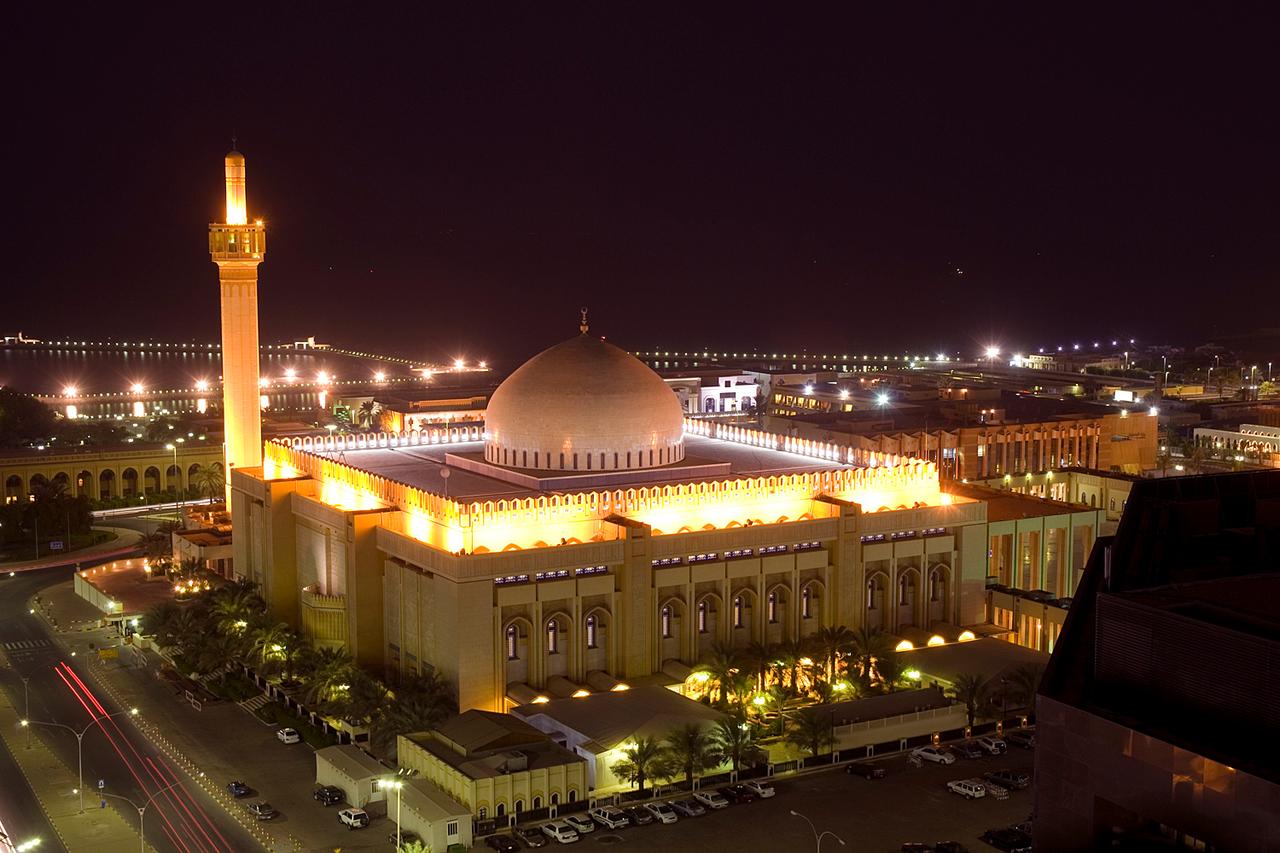
Kuwait Grand Mosque (Arabic: Al-Masjid al-Kabir) is the largest and official mosque of Kuwait, located in the heart of Kuwait City, along Arab Gulf Street. Covering an area of 45,000 square meters, the structure holds a special place in Kuwait’s religious life and architectural heritage, with a prayer hall spanning 20,000 square meters. Construction began in 1979, was completed in 1986, and it was officially opened for worship in 1987. The construction cost approximately 14 million Kuwaiti dinars.
Kuwait Grand Mosque (m_elnur1975)
The construction of the Kuwait Grand Mosque was initiated by order of the then Emir Sheikh Jaber al-Ahmad al-Jaber al-Sabah. The foundation was laid in 1979, and after the efforts of 50 engineers and over 400 workers, the mosque was completed in 1987. The construction process reflected Kuwait’s desire to preserve its cultural heritage alongside its modernization policies.
During the 1980s, as regional oil wealth increased, Kuwait aimed to build an architectural masterpiece comparable to major religious structures in the Islamic world. The Grand Mosque project was realized in pursuit of this goal.
The Kuwait Grand Mosque combines classical elements of Islamic architecture with modern construction techniques. Built on reinforced concrete foundations, the mosque is adorned on its exterior with natural stone and various tonal claddings. The total area of the structure is 45,000 square meters, with a prayer hall covering 20,000 square meters. Adjacent gardens occupy an additional 6,500 square meters.
The main prayer hall is square in plan, with sides measuring 72 meters in length. The central dome rises 43 meters high and has a diameter of 26 meters. It is decorated with the 99 names of Allah (Asma al-Husna), inscribed in Kufic calligraphy. The inscriptions on the dome were executed by Hamid Haddad, one of the leading calligraphers of the Middle East.
The architectural layout features a central dome, pointed arches, open-air passageways formed by columned arches, and Andalusian-style ceramic tilework. The dome rests on four massive pillars and is illuminated by natural light filtering through 144 windows. This lighting is complemented by four large chandeliers, each containing over 100 bulbs.
The interior space is distinguished by gold-leaf decorations, blue-toned calligraphic details, and hand-carved plasterwork. Andalusian-style geometric patterns are extensively used in wall tiles and around the mihrab. The area surrounding the mihrab features Moroccan-style zellij (mosaic) craftsmanship. The mosque’s 22 doors are made from saj wood imported from India.
The section designated for women is located above the main prayer hall and has a capacity of approximately 1,000 worshippers. Additionally, a smaller prayer hall is provided for daily prayers. Beneath the eastern courtyard lies a five-level parking facility, which also serves as an extended prayer area during Ramadan.
The architecture of the Kuwait Grand Mosque integrates influences from Andalusian, Iranian, and Arab architectural traditions. The overall plan follows the Iranian model, with a large central dome and pointed arches. The minaret, situated in the northwestern corner, exhibits an Andalusian appearance.
The architect of the mosque is widely recognized as Muhammad Mekki, a renowned architect of the Arab world. Mekki harmonized classical forms of Islamic art with a modern aesthetic sensibility.
The Kuwait Grand Mosque is not merely a place of worship but also a center for intellectual, cultural, and social activities. The mosque houses an extensive library of Islamic works, as well as seminar and conference halls, where researchers access sources on Islamic history and art.
During Ramadan, particularly on Laylat al-Qadr, the gardens, courtyards, and parking areas surrounding the mosque are converted into additional prayer spaces, accommodating up to 150,000 worshippers. The state television network broadcasts live the Tarawih and Isha prayers held in the mosque during these nights.
A special section known as the Emir’s Hall is used twice a year by the Emir to host guests. This hall, with its symmetrical plaster ceilings and intricate decorations, is considered the most important part of the building.
The Kuwait Grand Mosque is one of the most visited religious sites in the country by tourists. The mosque is open to visitors daily with guided tours. Guides provide information on the mosque’s architecture, Islamic art, and worship traditions. Headscarves and abayas are provided for female visitors, and appropriate dress is required during visits.
Visiting hours are typically from 08:30 to 10:45 and 16:45 to 18:45, Sunday through Thursday. The mosque is located opposite the Al-Seif Palace and the Kuwait Stock Exchange. The parking facility has a capacity of 500 vehicles.
AA (Anadolu Ajansı). “Kuveyt’te Farklı Mimarilerin Kesiştiği Ulu Camisi.” Anadolu Ajansı Foto Galeri. Accessed October 12, 2025. https://www.aa.com.tr/tr/pg/foto-galeri/kuveytte-farkli-mimarilerin-kesistigi-ulu-camisi/0
Flickr. "Grand Mosque of Kuwait." Photograph: cajie. Accessed October 12, 2025. https://www.flickr.com/photos/cajie/2049982237/in/photolist-489Gik-BsKAJk-BsCFoq-BrfJ9A-fAP5EQ-ChRpGt-BRCGme-BsKqZk-BRCs8z-CfyUaY-BsCj1W-3eqETQ-CnQu77-ChR7T8-Cq8Qxv-BRCxde-6FSEwK-CfyQ4m-59Bmg2-BsKtmV-Cfz2YJ-7NnimX-BsKpHn-BsKUge-Cq8WMp-BsCecC-ChRika-fAxMyB-27uCBt4-CEkUqu-Cq8GYx-BsKSNV-Cq9jun-7VZKyh-3jhHdk-2oj6amx-2pk3JnE-48egPN-Cq9fUX-BsKDYr-BsLJBH-CnQ81E-CqfEks-BY1Fg9-BRCALr-4w5pgg-53bDXr-Cq962F-3nRRRM-5ssYr5
GZT. “Körfez’in Üçüncü Büyük Camisi: Kuveyt Mescid-i Kebir Camii.” GZT Mecra Foto Galeri. Accessed October 12, 2025. https://www.gzt.com/foto-galeri/mecra/korfezin-ucuncu-buyuk-camisi-kuveyt-mescid-i-kebir-camii-2032894/1
Hilite Homes. "Grand Mosque Kuwait." Hilite Homes Real Estate Blog. Accessed October 12, 2025. https://www.hilitehomes.com/real-estate-blog-in-kuwait/grand-mosque-kuwait
Islamic Architectural Heritage. "The Grand Mosque of Kuwait." Accessed October 12, 2025. https://www.islamicarchitecturalheritage.com/listings/the-grand-mosque-of-kuwait
Kuveyt.tr. "Kuveyt Büyük Camii: İslam Mimarisi ve Kuveyt’teki Önemi." Accessed October 12, 2025. https://kuveyt.tr/kuveyt-buyuk-camii-islam-mimarisi-ve-kuveytteki-onemi/
Kuwait News Agency (KUNA). “Grand Mosque of Kuwait.” KUNA English Edition. Accessed October 12, 2025. https://www.kuna.net.kw/ArticleDetails.aspx?id=3137546&language=en
TRT Haber. "Kuveyt’te Farklı Mimarilerin Kesiştiği Ulu Camisi." TRT Haber Foto Galeri. Accessed October 12, 2025. https://www.trthaber.com/foto-galeri/kuveytte-farkli-mimarilerin-kesistigi-ulu-camisi/50819/sayfa-1.html
m_elnur1975. “Grand Mosque of Kuwait.” YouTube video. Accessed October 12, 2025. https://www.youtube.com/watch?v=hrzKnOakXwI

Name(s) | Kuwait Grand Mosque (Al-Masjid al-Kabir) | ||||||||
|---|---|---|---|---|---|---|---|---|---|
Location | Arab Gulf Street Kuwait Kuwait City | ||||||||
Coordinate(s) | 29°22′45.93″ N 47°58′29.65″ E | ||||||||
Construction Start | 1979 | ||||||||
Completion Date | 1986 | ||||||||
Opening | 1987 | ||||||||
Patron | Emir Sheikh Jaber al-Ahmed al-Jaber al-Sabah | ||||||||
Architect(s) | Muhammad al-Makki | ||||||||
Construction Cost | Approximately 14 million Kuwaiti dinars | ||||||||
Total Area | 45,000 m² | ||||||||
Indoor Area (Worship and Structure) | 20,000 m² | ||||||||
Garden Area | 6,500 m² | ||||||||
Dome Height | 43 m | ||||||||
Dome Diameter | 26 m | ||||||||
Minaret Height | 72 m | ||||||||
Number of Doors | 22 (made from saj trees) | ||||||||
Number of Windows | 144 | ||||||||
Parking Capacity | 500 vehicles (5 stories, also usable as prayer space) | ||||||||
Main Worship Area (Men) | 10,000 people | ||||||||
Women’s Section | 1,000 people | ||||||||
Total Capacity (Ramadan/Qadr Night) | Approximately 150,000 people | ||||||||
Indoor Spaces | Seminar and Conference Halls Library Emir Hall Women's Hall Main Worship Hall | ||||||||
No Discussion Added Yet
Start discussion for "Kuwait Grand Mosque" article
Historical Development
Architectural Features
General Structure and Layout
Interior Space and Decorations
Architectural Influences and Style
Cultural and Religious Function
Tourism and Visitation Arrangements