


This article was automatically translated from the original Turkish version.
+1 More
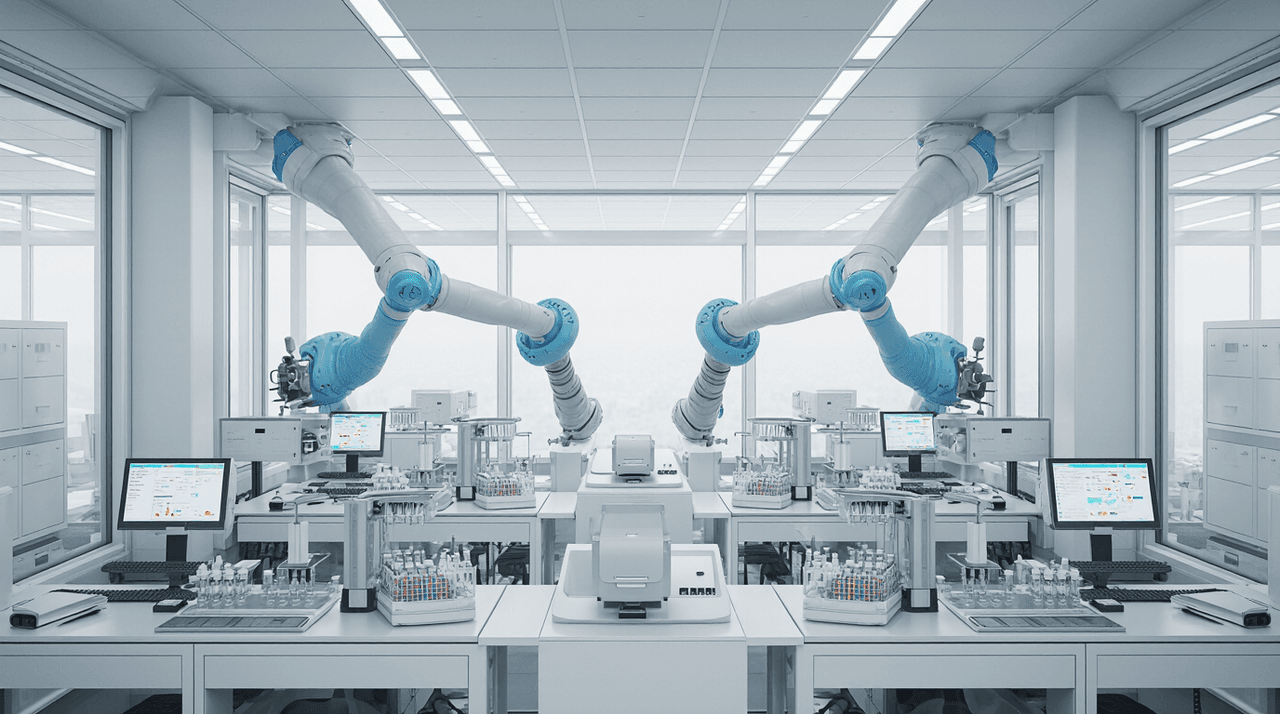
Laboratory Automation (Generated with Artificial Intelligence)
Related Concept(s) | Laboratory 4.0 (Digitalization and Intelligent Automation) | ||||||||
|---|---|---|---|---|---|---|---|---|---|
Application Area(s) | Clinical Diagnosis Food and Environmental Analysis R&D Drug Development | ||||||||
Main Component(s) | Robotics Systems Barcode Systems Conveyor Systems Automated Analyzers LIS/LBYS Software | ||||||||
Basic Objectives | Increased Efficiency, Reduced Error Rate, Standardization, Cost Savings, Traceability | ||||||||
Laboratory automation is a comprehensive technological infrastructure that enables all processes in clinical and industrial laboratories—from sample acceptance through analysis, data management, to result reporting—to be carried out via robotic systems, automated analyzers, and integrated software. This structure enhances the speed, accuracy, and consistency of operations by minimizing human intervention.
The widespread adoption of these systems in modern laboratories is primarily driven by increasing test volumes, the need for rapid results, cost reduction, and the prevention of human errors. Laboratory automation strengthens operational continuity by standardizing workflows, simplifying sample tracking, and enabling more systematic quality control procedures.
This technological infrastructure is not merely an innovation that boosts productivity; it is also a critical element for patient safety, data integrity, and quality management. Particularly in healthcare services, it directly contributes to clinical decision-making by enhancing the capacity to produce accurate and timely results. Therefore, laboratory automation has become a strategic necessity in today’s biomedical and industrial analysis environments.
Laboratory automation systems are integrated technological structures composed of hardware and software components that operate in seamless coordination. These systems are designed to cover all stages of laboratory processes: pre-analytical (pre-analysis), analytical (analysis), and post-analytical (post-analysis). The goal is to ensure that the entire workflow proceeds continuously, traceably, and in a standardized manner.
The physical infrastructure of laboratory automation consists of hardware components that ensure mechanical precision and repeatability at every stage, from sample collection to result generation. These components include:
In addition, fully automated analyzers and staining units specific to different analytical fields such as hematology, biochemistry, immunology, and microbiology form the core of laboratory automation. Companies such as Yaskawa and OMRON develop high-precision robotic systems in this field, while manufacturers like Schneeberger specialize in the precision linear guides and mechanical motion components used within these systems.
The administrative and computational aspects of laboratory automation are managed by software, which functions as the system’s “brain.” The Laboratory Information Management System (LIMS) sits at the center of the entire process. This system integrates with the Hospital Information Management System (HIMS) to receive patient information and test requests, assigns unique barcodes to samples, automatically collects results from analyzers, evaluates them against reference ranges, and transmits approved results to relevant physicians. Advanced LIMS platforms do more than transfer data; they also integrate functions such as:
In Türkiye and globally, systems such as Meddata, LabosNET and AY Otomasyon support the digital transformation of laboratory processes by providing these advanced functionalities.
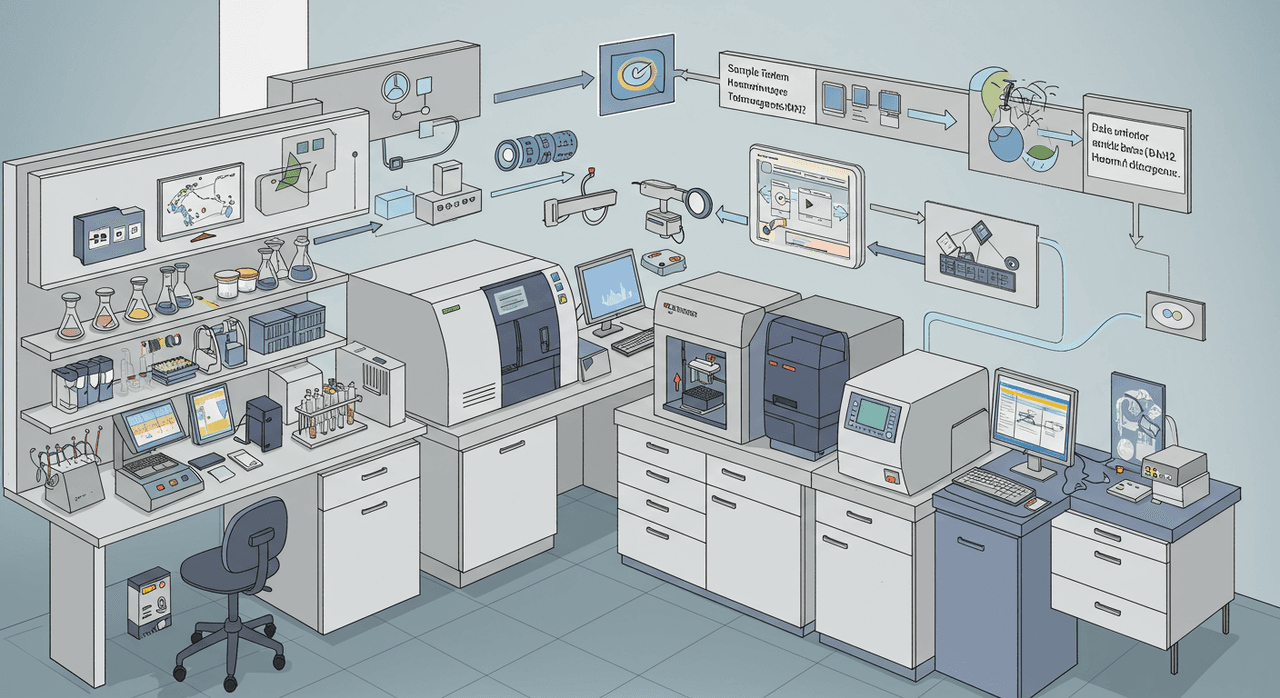
Laboratory Automation (Generated by Artificial Intelligence.)
The implementation of laboratory automation systems provides institutions not only with technological transformation but also with comprehensive strategic advantages in operational, clinical, and administrative terms. These advantages directly impact the laboratory’s overall performance, patient care quality, and compliance with quality management standards.
Automation systems offer a 24/7 operational infrastructure without requiring human intervention. The elimination of manual procedures enables faster test execution and minimizes time loss throughout the entire analysis process. As a result, significantly more samples can be processed using the same resources, reducing the turnaround time for test results and accelerating clinical decision-making.
Automated systems ensure that every sample is processed under identical conditions and according to the same protocols, reducing human-induced variability. This enhances the reproducibility, accuracy, and reliability of laboratory results. Furthermore, the traceability and documentation of processes facilitate compliance with international quality management systems such as ISO 15189 (standard for quality and competence in medical laboratories) and ISO 17025 (standard for quality in testing and calibration laboratories).
Transferring repetitive and time-consuming tasks to machines enables laboratory personnel to focus on higher-value responsibilities. Expert staff can therefore concentrate on result interpretation, quality control, method validation, and development of new tests. In the long term, this approach increases workforce efficiency while reducing costs associated with human errors and operational delays.
Thanks to barcode-based identification and digital tracking systems, every step from sample receipt to archiving is recorded. This process is managed cohesively through the Laboratory Information Management System (LIMS). Centralized storage of all analytical data provides significant advantages in terms of rapid access to historical results, statistical performance analysis, trend monitoring, and transparency in audit processes.
Automation reduces critical risks such as sample mix-ups, misidentification, or handling errors. Since samples are processed within closed systems, the likelihood of laboratory staff coming into direct contact with potentially infectious, toxic, or biohazardous materials is significantly reduced. This enhances both occupational health and safety and the reliability of patient results.
Laboratory automation is widely used in virtually all disciplines requiring large-scale testing volumes and high standardization. These systems are adapted to the unique requirements of different analytical fields, accelerating processes, reducing errors, and strengthening data integrity.
The most intensive and comprehensive application of automation occurs in clinical diagnostic laboratories. Here, numerous processes—from sample acceptance to reporting—are fully automated. Major manufacturers such as Siemens Healthineers, Roche Diagnostics, Beckman Coulter and Abbott offer integrated automation solutions for sub-disciplines including hematology, clinical chemistry, immunology, serology, coagulation and urinalysis. These systems can perform multiple test types simultaneously on a single line, prioritize samples, and automatically manage quality control steps, ensuring a balance of speed and reliability even under high test volumes.
In microbiology laboratories, automation provides significant advantages in sample inoculation, incubation, and organism identification. Automated culture inoculation systems reduce contamination risks, while incubation units continuously monitor environmental conditions to optimize growth. Additionally, advanced identification systems such as MALDI-TOF MS can determine microbial species within seconds with high accuracy. In molecular diagnostics laboratories, high-precision liquid handling systems such as Tecan Fluent, Hamilton Microlab STAR or Qiagen QIAcube perform procedures requiring high precision, including PCR preparation, DNA/RNA isolation, and sequencing. These systems greatly enhance standardization and data reliability in genomic and proteomic research.
In pathology, automation is intensively used in both tissue preparation and imaging processes. Automated tissue tracking devices, sectioning systems, and staining modules (e.g., devices such as Lieva Stainer) ensure consistent sample preparation. Subsequent digital pathology systems convert microscopic slides into digital formats using high-resolution scanners, enabling remote examination, artificial intelligence-assisted analysis, and archiving.
Pharmaceutical R&D and biotechnology laboratories rely on automation as the core of high-throughput screening and compound management processes. These systems accelerate the early evaluation of new drug candidates by enabling the rapid analysis of thousands of samples. Automated liquid dispensing systems, microplate-based test setups, and storage robots support data reproducibility and experimental accuracy throughout drug discovery.
Quality control laboratories in the food, environmental, cosmetic, chemical, and materials sectors also extensively utilize automation systems. Sample tracking, analysis planning, data recording, and reporting processes in these laboratories are managed through software solutions.
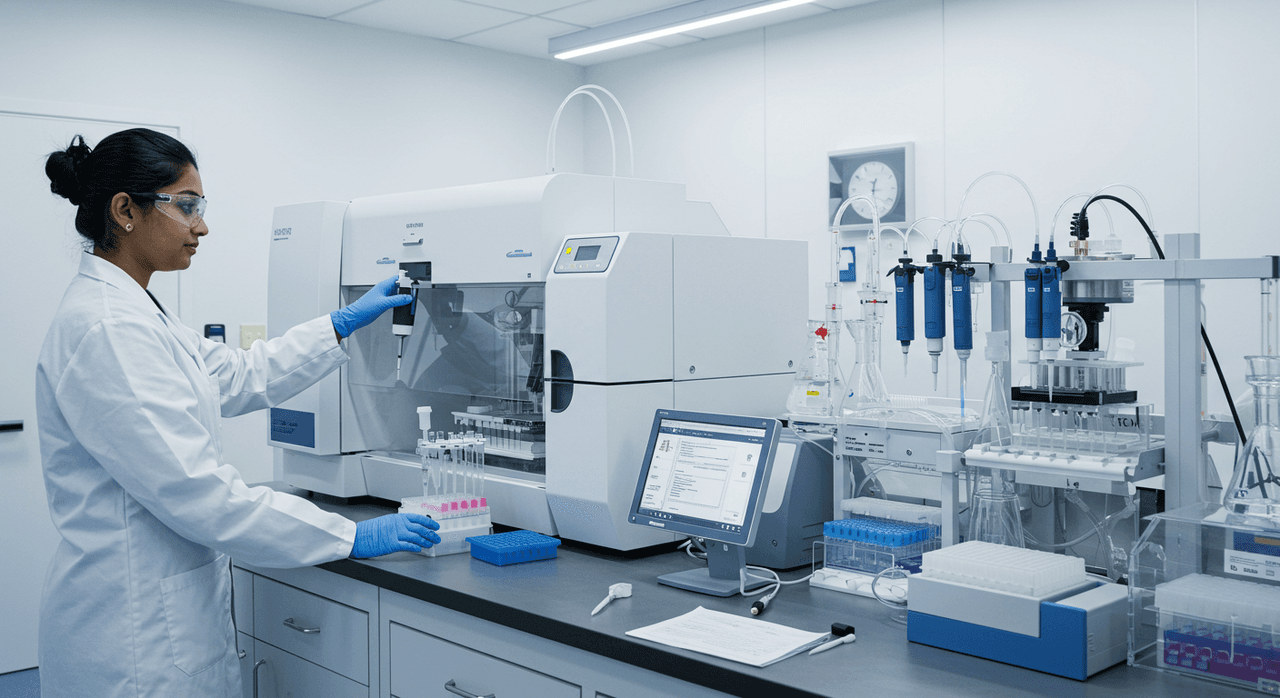
Laboratory Automation (Generated by Artificial Intelligence.)
Laboratory automation does not offer a single rigid structure but provides flexible solutions adaptable to each laboratory’s workload, physical infrastructure, budget, and operational goals. Thanks to scalable modules, these systems can be incrementally integrated into laboratories of varying sizes. Institutions can therefore transition gradually from limited automation to fully integrated systems over time.
This approach allows laboratories to adopt automation incrementally. Initially, only one pre-analytical module—such as a sample aliquoter, barcode reader, or cap opener—can be integrated. As the laboratory’s test volume or requirements increase, additional modules—such as analyzers, storage units, or post-analytical archiving systems—can be added to the same infrastructure. The key advantage of modular automation is its scalability and flexibility, enabling laboratories to expand their systems in line with their needs and technological advancements without exceeding existing budgets.
This model focuses on automating specific tasks or process stages. For example:
are optimized using task-targeted systems. Such devices are often preferred in medium-sized laboratories to eliminate specific bottlenecks and improve workforce efficiency.
The most advanced automation model, TLA, integrates the entire laboratory workflow—including pre-analytical, analytical, and post-analytical stages—onto a single continuous line. In these systems, sample tubes are automatically transported via conveyor belts from the moment they enter the laboratory, and the following tasks are performed without human intervention:
TLA systems are preferred in high-volume central laboratories and university hospitals. These infrastructures provide minimum error rates, maximum speed, and continuous quality control by ensuring complete process traceability.
Laboratory 4.0 is the adaptation of the Industry 4.0 approach to healthcare and scientific research, representing the next stage in the evolution of laboratory automation. This approach aims not only to automate mechanical processes but to transform laboratories into fully digital, interconnected, and data-driven ecosystems.
Laboratory 4.0 creates intelligent laboratory environments by integrating sensors, robotic systems, cloud-based data infrastructures, and artificial intelligence algorithms. In these systems, every device functions as a data-generating component, enabling real-time data exchange between analyzers, storage systems, and information management platforms. This architecture allows devices to autonomously assess their status, predict maintenance needs, and reduce error risks without human intervention.
In future laboratories, clinical data from diverse disciplines—hematology, biochemistry, molecular diagnostics, pathology, and microbiology—will be integrated into a single platform. These unified data pools will be analyzed by artificial intelligence (AI) and machine learning (ML) algorithms to generate comprehensive patient-specific clinical profiles. These analyses will enable:
The Laboratory 4.0 vision aims to free researchers and laboratory professionals from routine, repetitive tasks so they can focus more on scientific analysis, problem-solving, and innovation. This transformation shifts laboratories from mere analytical centers to intelligent systems that generate knowledge and guide clinical decision-making.
Laboratory 4.0 necessitates the development of new standards in data security, interoperability, quality assurance, and sustainability. This paradigm represents a fundamental shift shaping the future of medicine by forming the foundation for digital hospital infrastructures, AI-supported clinical decision systems, and big data analytics in healthcare.
Al Naam, Y. A., S. Elsafi, M. H. Al Jahdali, R. S. Al Shaman, B. H. Al-Qurouni, and E. M. Al Zahrani. “The Impact of Total Automation on the Clinical Laboratory Workforce: A Case Study.” *Journal of Healthcare Leadership* 14 (May 9, 2022): 55–62. Accessed October 18, 2025. https://doi.org/10.2147/JHL.S362614
Alexander, Tobias, and Adam Wahab. “Autonomous ‘Self-Driving’ Laboratories: A Review of Technology and Policy Implications.” *Royal Society Open Science* 12, no. 7 (2025): 250646. Accessed October 18, 2025. https://doi.org/10.1098/rsos.250646
Armbruster, David A., Douglas R. Overcash, and Jaime Reyes. “Clinical Chemistry Laboratory Automation in the 21st Century—Amat Victoria Curam (Victory Loves Careful Preparation).” Clinical Biochemistry Reviews 35, no. 3 (August 2014): 143–153. Accessed October 18, 2025. https://pubmed.ncbi.nlm.nih.gov/25336760
Mencacci, Antonella, G. V. De Socio, E. Pirelli, P. Bondi, and E. Cenci. “Laboratory Automation, Informatics, and Artificial Intelligence: Current and Future Perspectives in Clinical Microbiology.” *Frontiers in Cellular and Infection Microbiology* 13 (June 27, 2023): 1188684. Accessed October 18, 2025. https://doi.org/10.3389/fcimb.2023.1188684
Munir, Tahir, Muhammad Soomair Akbar, Sadia Ahmed, Azza Sarfraz, Zouina Sarfraz, Muzna Sarfraz, Miguel Felix, and Ivan Cherrez-Ojeda. “A Systematic Review of Internet of Things in Clinical Laboratories: Opportunities, Advantages and Challenges.” *Sensors* 22 (209) (2022): 8051. Accessed October 18, 2025. https://doi.org/10.3390/s22208051
Rupp, N., R. Ries, R. Wienbruch, and T. Zuchner. “Can I Benefit from Laboratory Automation? A Decision Aid for the Successful Introduction of Laboratory Automation.” *Analytical and Bioanalytical Chemistry* 416 (November 2024): 5–19. Accessed October 18, 2025. https://doi.org/10.1007/s00216-023-05038-2

Laboratory Automation (Generated with Artificial Intelligence)
Related Concept(s) | Laboratory 4.0 (Digitalization and Intelligent Automation) | ||||||||
|---|---|---|---|---|---|---|---|---|---|
Application Area(s) | Clinical Diagnosis Food and Environmental Analysis R&D Drug Development | ||||||||
Main Component(s) | Robotics Systems Barcode Systems Conveyor Systems Automated Analyzers LIS/LBYS Software | ||||||||
Basic Objectives | Increased Efficiency, Reduced Error Rate, Standardization, Cost Savings, Traceability | ||||||||
No Discussion Added Yet
Start discussion for "Laboratory Automation" article
Scope and Components of Laboratory Automation
Hardware Components
Software Components
Objectives and Benefits of Laboratory Automation
Increased Efficiency and Speed
Standardization and Quality Assurance
Cost and Workforce Optimization
Advanced Data Management and Traceability
Patient and Staff Safety
Application Areas
Clinical Diagnostic Laboratories
Microbiology and Molecular Diagnostics
Pathology and Digital Pathology Applications
Pharmaceutical Research and Biotechnology
Industrial Laboratories
Types and Flexibility of Automation Systems
Modular Automation
Task-Targeted Automation
Total Laboratory Automation (TLA)
Future Perspective: Laboratory 4.0
Smart and Digitized Laboratory Vision
Interdisciplinary Data Integration and Analytical Intelligence
Data-Driven Scientific Productivity
Strategic Importance