
This article was automatically translated from the original Turkish version.
+2 More
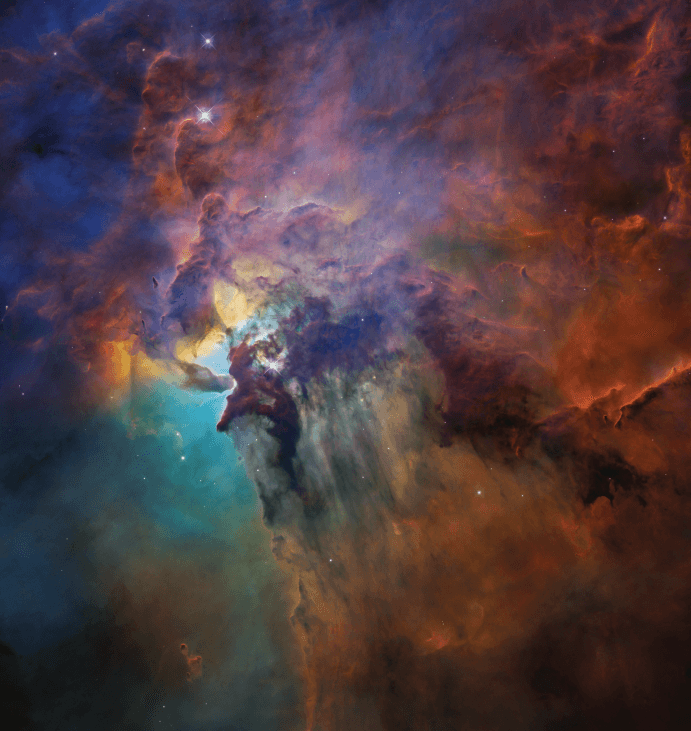
Lagoon Nebula (Messier 8) is a massive star-forming region located in the direction of the Sagittarius constellation. This nebula is one of the few that can be observed with the naked eye from Earth. Approximately 4,100 light-years away, the Lagoon Nebula contains a vast cloud of hydrogen gas and numerous young stars currently forming within it.
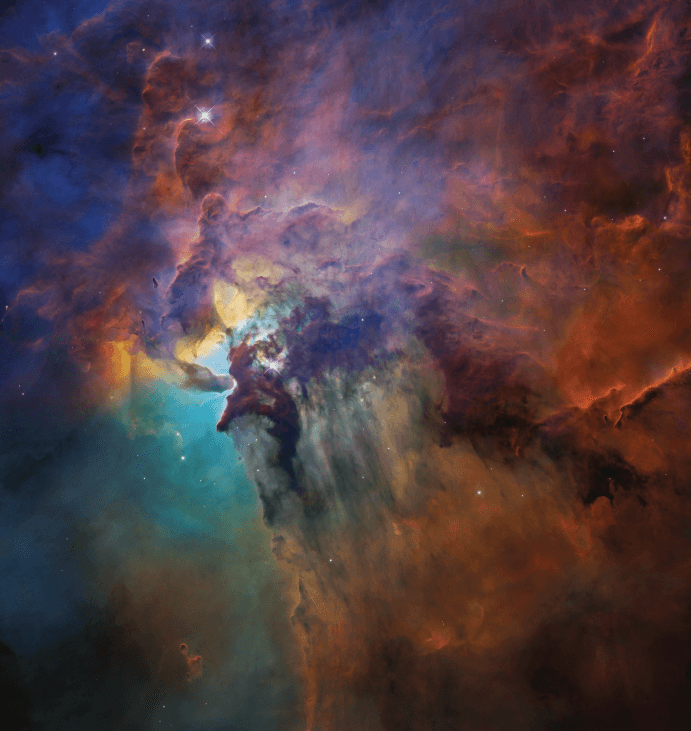
Lagoon Nebula (NASA)
The Lagoon Nebula is classified as an emission nebula. Such nebulae consist of ionized gas illuminated by intense ultraviolet radiation from nearby young and hot stars. The Lagoon Nebula contains regions known as H II regions, composed of ionized hydrogen atoms. This ionized hydrogen gas emits a characteristic reddish glow.
Within the nebula are also dense dust clouds, dark nebula structures, and numerous star clusters. The most prominent dark structure is a broad band known as the "Dark Lagoon"; this feature runs through the center of the nebula and blocks the passage of visible light.
The Lagoon Nebula is an active star-forming region. One of its most notable features is NGC 6530, a young open star cluster located in the central region of the nebula. This cluster contains hot, young stars whose ionizing radiation causes the surrounding gas to glow.
The internal regions of the nebula provide favorable conditions for star formation due to high densities of gas and dust. Observations made by the Hubble Space Telescope and ESO telescopes have revealed active star-forming regions accompanied by dense clumps of dust and gas known as "Bok globules".
The Lagoon Nebula is prominently observed through its strong H-alpha emission lines, resulting from its extensive hydrogen gas structure. Its emission spectrum shows clear signatures of ionized hydrogen (H II), oxygen ([O III]), and sulfur ([S II]). These spectral lines provide valuable information about the nebula’s physical conditions.

Location of M8 (NASA)
Radio, infrared, and X-ray observations have revealed young stars and protostars hidden behind the obscuring dust. The Spitzer Space Telescope detected early stages of star formation and gas outflows using infrared imaging.
The Lagoon Nebula was first discovered in 1654 by Italian astronomer Giovanni Battista Hodierna. It was more thoroughly observed by John Flamsteed in 1747 and later included in Charles Messier’s catalog in 1764 as M8. It is also listed in the New General Catalogue as NGC 6523 and in the Sharpless Catalogue as Sh 2-25.
The Lagoon Nebula is regarded as an important laboratory for studying star formation processes. Due to its large structure and active star-forming regions, it is frequently studied by both amateur and professional astronomers. In particular, the early stages of stellar evolution and the dynamic processes within and around the nebula are subjects of ongoing research.
The Lagoon Nebula is located in the Sagittarius constellation in the southern sky during summer months. In northern hemisphere countries such as Türkiye, it is visible low on the horizon. Although it appears as a faint glow to the naked eye, finer details become visible through binoculars or small telescopes.
Images of the Lagoon Nebula have been captured in high resolution by the Hubble Space Telescope, ESO’s Very Large Telescope (VLT), and numerous amateur astrophotographers. The images typically display dominant red and pink hues, resulting from the H-alpha emission of ionized hydrogen gas.
The Lagoon Nebula (M8) is one of the most notable emission nebulae in astronomy due to its structural complexity, role as a site of active star formation, and high visibility. Its proximity and large size make it an important target for both amateur observers and scientific research. The star-forming regions, protostars, and young stellar clusters within its structure provide critical data for understanding stellar evolution.

No Discussion Added Yet
Start discussion for "Lagoon Nebula (Messier 8)" article
Classification and Structure
Physical Characteristics
Star Formation and Internal Structures
Observations and Spectral Properties
Discovery and Catalog Information
Astrophysical Significance and Observability
Photographic Observations