

This article was automatically translated from the original Turkish version.
+1 More
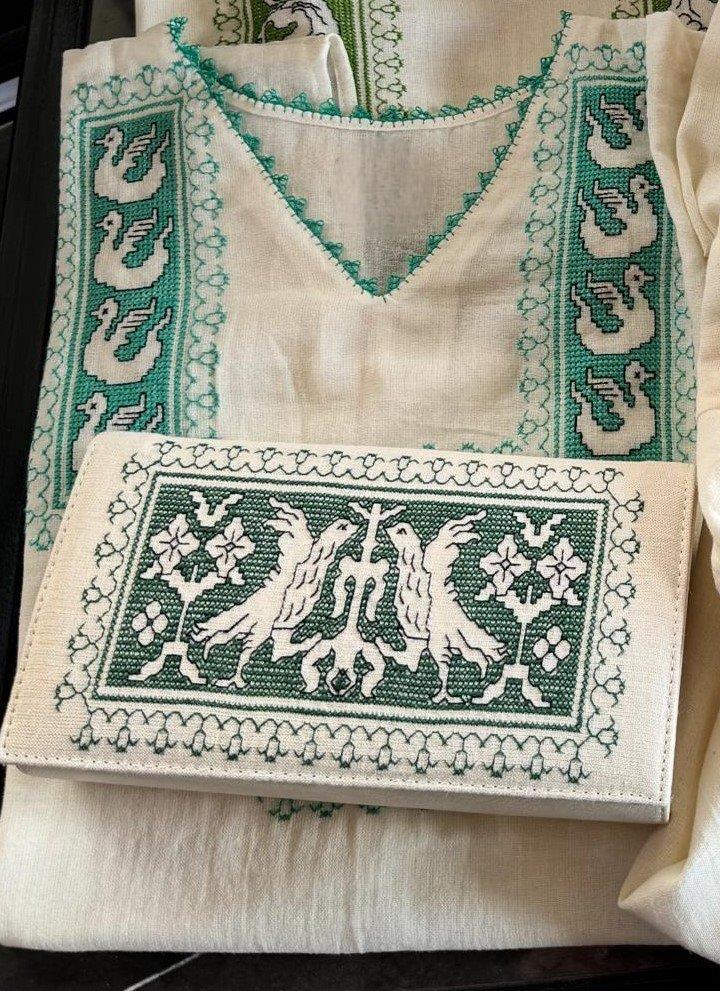
Lapta Hesap İşi is a type of embroidery executed with colored threads on countable woven fabrics, traditionally produced in Turkish Republic of Northern Cyprus. It is regarded as an original example of Turkish Cypriot folk culture in terms of its production technique, motif repertoire, historical development, and areas of use. Due to its history extending to the late 19th century and its strong association with the Lapta region, it was officially registered as a geographical indication on 11 November 2025.

Lapta Hesap İşi (Anadolu Agency)
The existence of Lapta Hesap İşi can be traced back to the early 1900s. The embroidery technique was taught to girls at Lapta Primary School in the 1930s by Lefkosia teacher Fikriye Hussein Ahmet, and was quickly adopted by women in the region. Initially prevalent in Lapta, the craft spread to other villages such as Ozanköy, Göçeri, Dağyolu, Yılmazköy and Denya through young women who moved there after marriage. This process led to the technique becoming identified with Lapta and acquiring the name “Lapta İşi” or “Lapta Hesap İşi”.
Among traditional Turkish Cypriot embroidery styles, Lapta Hesap İşi holds a significant place. Throughout the 20th century, it was used for the production of household textiles and clothing, and today it continues to exist as a decorative and cultural heritage craft.
Lapta Hesap İşi is applied on woven fabrics with countable warp and weft threads. The fabrics used include high-quality weaves such as idare, bürümcük, silk and linen. A fundamental requirement is that the fabric threads are of equal thickness and clearly countable.
Muliné embroidery thread is predominantly used. Traditional colors include shades of burgundy, red, pink, blue and green. Black or brown thread is typically preferred for outlining motifs. Depending on the motif and fabric, the thread may consist of two, three or more strands.
Motifs are drawn on graph paper and counted before being transferred to the fabric. The central points of the motif and the fabric are marked with white thread.
The outer contours of the motif are embroidered using black or brown muliné thread with the hand machine stitch technique. This stage is called “outlining” and defines the motif’s frame. During this process, work is typically done over two threads.
The interior or surrounding area of the motif is filled using the cross stitch technique, counting two or three threads. Two different cross stitch methods may be employed. No knots are made in the color filling; the reverse side must remain clean and smooth.
After the motif is completed, an edge decoration called “su” is added around it. This involves a combination of straight stitch, cross stitch and hand machine stitch techniques. At the end of the process, the edges may be trimmed with oya if desired. The finished product is then ironed.
Motifs in Lapta Hesap İşi are generally grouped by theme. Common examples include:
Due to the counted-thread technique, motifs have a clear and symmetrical appearance. While different applications on various products give rise to new compositions, this variation is accepted as long as the fundamental technique remains unchanged.
Traditionally, Lapta Hesap İşi was used on:

Motifs (Anadolu Agency)
In Turkish Cypriot folk culture, embroidery is an important indicator of social life, traditions and manual skill. Lapta Hesap İşi, passed down with mastery primarily among women, holds value in terms of identity and cultural memory. Among Turkish Cypriot handcrafts, Lapta work is mentioned alongside Lefkara work, Koza work and needle lace as one of the fundamental examples of cultural diversity.
Lapta Hesap İşi is a traditional handcraft produced using traditional methods within the geographical boundaries of the Turkish Republic of Northern Cyprus. As required by its geographical indication status, all production stages must be carried out within this boundary. Inspections are conducted by relevant local institutions under the coordination of the Turkish Cypriot Women Entrepreneurs Association.
Turkish Cypriot handcrafts reflect the diversity created by different cultures on the island throughout history. Among embroidery types, Lapta work occupies a distinctive position due to its vibrant compositions, animal and plant motifs, and its counted-thread technique. In this regard, it holds significant representational value within the island’s folk culture, identity elements and social practices.
Anadolu Ajansı (AA). “Kadınların asırlardır matematiksel zekayla yaptığı işleme tekniği: Hesap işi.” Accessed July 5, 2025. https://www.aa.com.tr/tr/yasam/kadinlarin-asirlardir-matematiksel-zekayla-yaptigi-isleme-teknigi-hesap-isi/2074474
Miralay, F. "Türk Halk Kültüründe El Sanatlarının Önemi: Kıbrıs Örneği". Journal of History Culture and Art Research, 7(5), 495-509. (2018). https://www.researchgate.net/publication/330146369_Turk_Halk_Kulturunde_El_Sanatlarinin_Onemi_Kibris_Ornegi_The_Importance_of_Handicrafts_in_Turkish_Folk_Culture_The_Case_of_Cyprus
Turk Patent and Trademark Office. "Lapta Hesap İşi." *Coğrafi İşaretler Portalı*. Accessed November 28, 2025. https://ci.turkpatent.gov.tr/cografi-isaretler/detay/11762
Turkish Patent and Trademark Office. *Lapta Hesap İşi — Coğrafi İşaret Sicil Belgesi*. PDF. File No: C2024/000235, Registration No: 1789, Registration Date: November 11, 2025. https://ci.turkpatent.gov.tr/Files/GeographicalSigns/74edc730-3470-4bb0-81d4-43b39b3b8d34.pdf


No Discussion Added Yet
Start discussion for "Lapta Accounting Practice" article
History
Technical Features
Fabric
Thread
Tools and Equipment
Production Stages
1. Determining the pattern and center
2. Outlining (Hand Machine Stitch)
3. Coloring (Cross Stitch)
4. Edge Finishing (Water)
Motifs
Applications
Cultural Significance
Geographical Indication and Production Area
Ethnographic Context