


This article was automatically translated from the original Turkish version.
King’s Law is a concept introduced by British economist Alexander King, highlighting the relationship between economic growth and environmental degradation. Also known as the Paradox of Plenty, King’s Law is an economic principle asserting that changes in the supply of agricultural goods—with inelastic demand—lead to disproportionate and inverse effects on their prices.
King observed that a 10% increase in wheat supply could reduce prices by 50%, while a 10% decrease in supply could raise prices by 30%. This observation revealed that producers’ income depends not only on production volume but also on demand structure and price movements.
For King’s Law to hold, certain fundamental assumptions must be met. These are:
Low Demand Elasticity: The good in question—typically agricultural products—must have inelastic demand, meaning consumption remains largely unchanged regardless of price fluctuations.
Production Dependent on Natural Conditions: Production must be largely determined by natural factors such as weather and drought, rather than human intervention. Agricultural products are a prime example.
Closed Market: The market must be closed to international trade, meaning supply or demand shocks cannot be offset by external inflows or outflows.
Short Time Horizon: The period under analysis must be short enough to exclude structural influences such as population growth.
When these conditions are simultaneously satisfied, King’s Law applies, and small shifts in supply-demand equilibrium are expected to cause large price fluctuations.
According to King’s Law:
Thus, during periods of abundance, producers may earn less despite higher output due to low prices, whereas during periods of scarcity—such as droughts—they may earn more despite producing less.
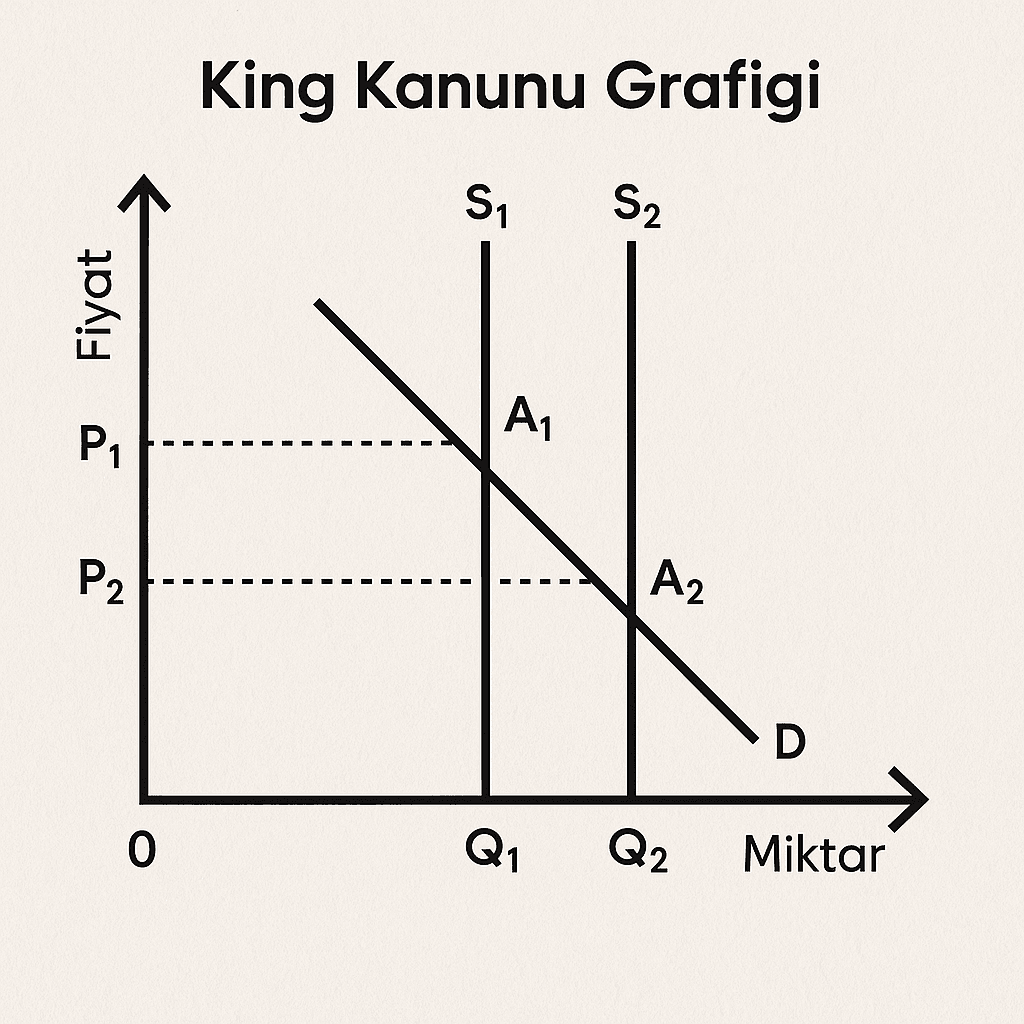
Graphical Representation (Generated by Artificial Intelligence)
Horizontal axis: Quantity (Q),
Vertical axis: Price (P),
D: Demand curve (negatively sloped)
S₁ and S₂: Supply curves (S₂ shifted to the right)
Intersection points: S₁ ∩ D → P₁, Q₁ and S₂ ∩ D → P₂, Q₂
As supply increases (S₁ → S₂), price falls (P₁ → P₂) and quantity rises (Q₁ → Q₂).
Although King’s Law is rooted in agricultural economics, its principles are now interpreted in the fields of consumer behavior, psychology, and marketing. In particular, Barry Schwartz’s work The Paradox of Choice explains how an increase in options negatively impacts individual decision-making. According to this view:
This phenomenon is recognized as a significant challenge in modern consumer societies, prompting the development of solutions such as simplification and filtering strategies.
King’s Law presents an exception to the classical supply-demand relationship. In goods with inelastic demand, small changes in supply generate large price fluctuations, directly affecting producer income. Today, the effects of this law are observed not only in agricultural economics but also in consumer behavior and decision theory. In this regard, King’s Law provides an important analytical framework for both historical and contemporary economic studies.
Ankara Sosyal Bilimler Vakfı. "King Kanunu." Accessed May 29, 2025. https://www.sosyalbilimlervakfi.org/tr/sozluk/king-kanunu/
Economics Dictionary. "What Is King's Law?" Accessed May 29, 2025. https://www.iktisatsozlugu.com/tr/king-kanunu/nedir/2756
Yıldız, Haldun. "Bolluk Paradoksu Nedir? King Yasası." HaldunYildiz.com. Accessed May 29, 2025. https://www.haldunyildiz.com/bolluk-paradoksu-nedir-king-yasasi/

No Discussion Added Yet
Start discussion for "Law of the King (Paradox of Plenty)" article
Assumptions
Mechanism
Application Examples
Modern Approaches and Expanded Interpretation