


This article was automatically translated from the original Turkish version.
Lawn mowers are mechanical tools that play a significant role in landscape management and green space maintenance. Over time, technological advancements have led to the development of diverse models tailored to different applications. This article examines the history, types, technological evolution, usage areas, environmental impacts, and sustainability assessments of lawn mowers.
The history of lawn mowers begins in 1830 with the invention of the first cylinder-type model by Edwin Budding in England. This innovation provided an alternative to manual grass cutting and enabled regular maintenance of parks and sports fields. Throughout the 20th century, gasoline-powered and later electric models were developed. Today, robotic lawn mowers offer modern solutions equipped with remote control and sensor technologies.
The primary function of lawn mowers is to cut grass to a desired height. Technically, they are classified by the following features:
Recent studies have demonstrated that the frequency of lawn mowing significantly affects biological diversity. According to a study by the University of New Hampshire, insect populations increase in areas where grass is mowed less frequently, positively influencing local ecosystems. Similarly, a study published by MDPI reveals that the carbon footprint of lawn mowers varies substantially depending on the type of energy used and the mowing frequency. The study notes that energy-efficient and robotic systems can reduce environmental impacts over the long term. A Life Cycle Assessment (LCA) conducted by the University of Illinois provides a detailed analysis of the environmental effects of lawn mowers across their production, use, and disposal phases, highlighting the importance of eco-friendly engineering designs.
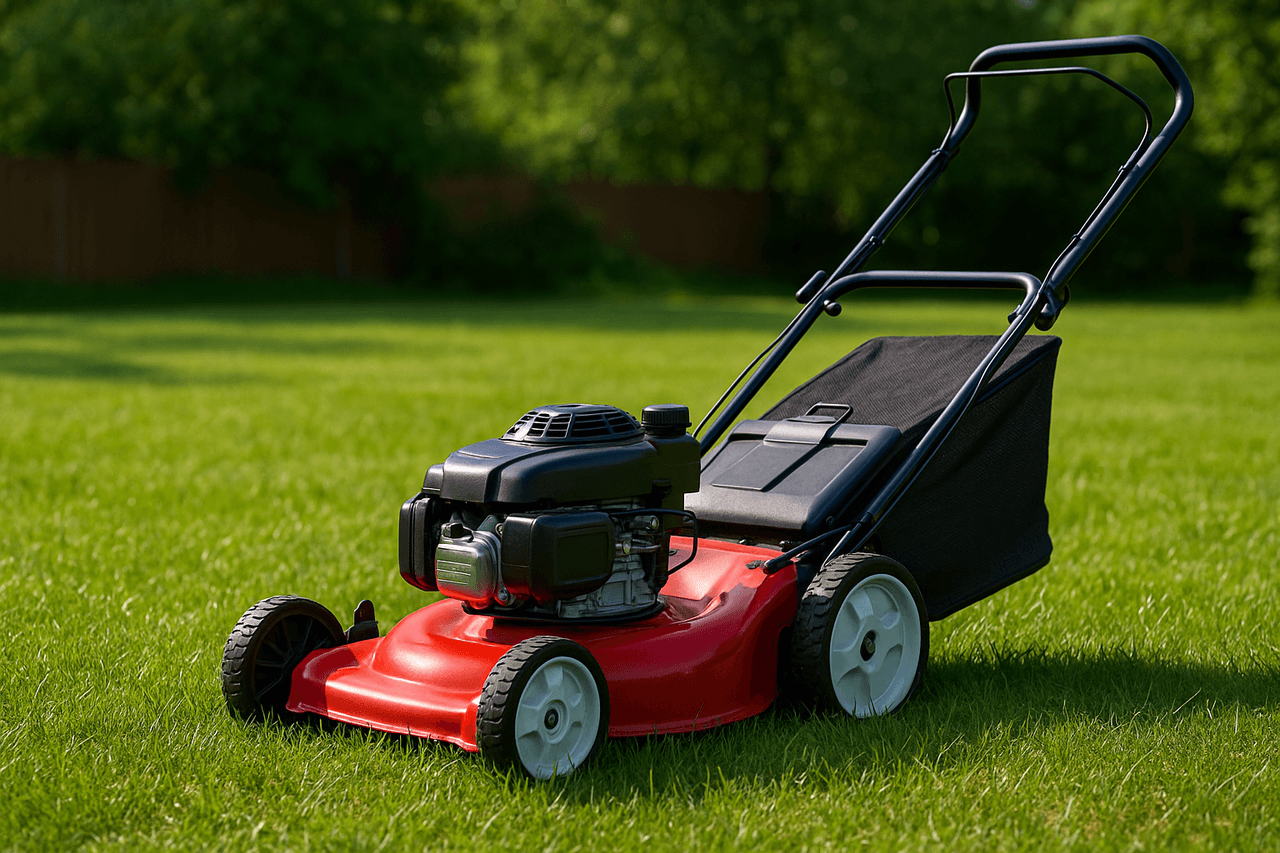
Lawn Mower (Generated by Artificial Intelligence)
Lawn mowers are not limited to individual use; they are regularly employed by municipalities, parks, university campuses, and sports complexes. At the same time, reduced mowing practices offer economic benefits by lowering maintenance costs and energy consumption while also contributing to the preservation of local biodiversity.
Next-generation lawn mowers are being developed with designs that prioritize environmental sustainability. Smart sensors, IoT integration, and AI-powered robotic mowers ensure that grass is cut only when necessary and in the most efficient manner, thereby minimizing both energy consumption and environmental impact.
"Assessment of the Effects of Autonomous Mowers on Plant Biodiversity." MDPI. Accessed May 24, 2025. https://www.mdpi.com/2311-7524/10/4/355
"Lazy Lawn Mowers Rejoice, Mowing Less May Be a Good Thing." University of New Hampshire. Accessed May 24, 2025. https://www.unh.edu/unhtoday/news/release/2025/05/14/lazy-lawn-mowers-rejoice-mowing-less-may-be-good-thing
"Quantification of the Environmental and Economic Benefits of the Electrification of Lawn Mowers." *ESOL*. Accessed May 24, 2025. https://esol.ise.illinois.edu/static2/pdf/IJLCA2021.pdf

Historical Development
Function and Technical Features
Ecological and Biological Impacts
Social and Economic Aspects
Future Perspective