


This article was automatically translated from the original Turkish version.
+2 More
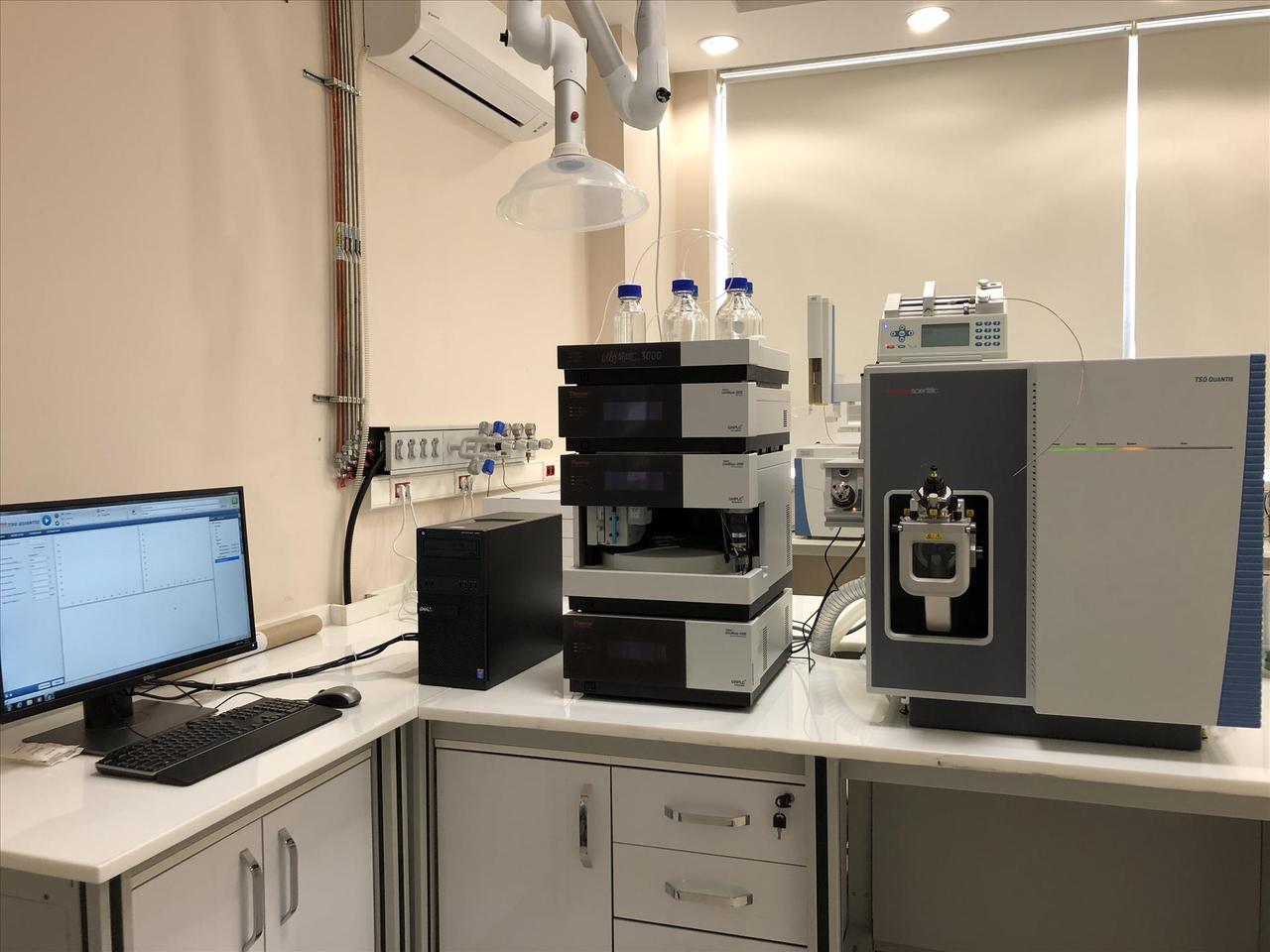
https://arum.ogu.edu.tr/Sayfa/Index/72/sivi-kromatografi-kutle-spektrometresi-lc-msms
LC-MS/MS
Definition(s) | It is a combination of liquid chromatography with tandem mass spectrometry. | ||||||||
|---|---|---|---|---|---|---|---|---|---|
Technical Structure | LC, ESI/APCI ionization, Triple Quadrupole (QqQ), CID fragmentation. | ||||||||
Detection Threshold | 1 fg/mL | ||||||||
Ionization Efficiency | 80% (ESI) | ||||||||
Fragmentation Energy | 10–50 eV | ||||||||
Applications | Pharmaceutical (ibuprofen in plasma), toxicology (ASÜBTAM), food (GRÜMLAB), environment (SUBİTAM) | ||||||||
Advantage(s) | 95% specificity rapid analysis multiple analytes | ||||||||
Limitations | High cost, matrix effect, requires expertise | ||||||||
LC-MS/MS (Liquid Chromatography–Tandem Mass Spectrometry) is a highly sensitive technique used in modern analytical chemistry for molecular-level identification and quantitative analysis. Globally, it is employed in approximately 70% of pharmaceutical analyses and with 95% accuracy in doping control tests. In Türkiye, it is effectively utilized in centers such as DAYTAM, ASÜBTAM, and GRÜMLAB for the analysis of pesticides, toxic substances, and food additives.
The LC-MS/MS system integrates liquid chromatography (LC) with a tandem mass spectrometry (MS/MS) unit. LC separates the compounds in the sample, while MS/MS ionizes and fragments these compounds to identify and quantify them. This configuration enables detection limits as low as 1 fg/mL in complex biological and environmental samples.
Separation (LC Unit):
The sample is separated on a reversed-phase column such as a C18 column. The mobile phase typically consists of a water/acetonitrile mixture.
Ionization:
Mass Spectrometry (MS/MS):
Detection and Analysis:
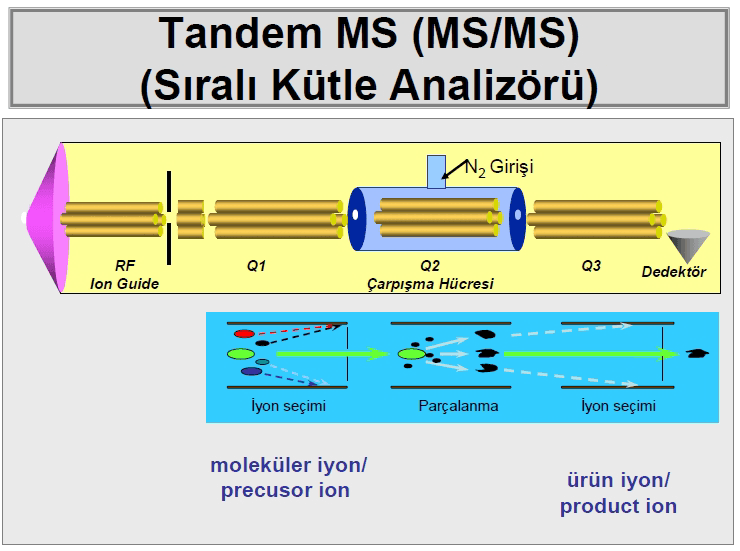
LC-MS/MS Working Principle (AIÇÜ)
ASÜBTAM. "Sıvı Kromatografisi-Kütle Spektrometresi (LC-MS/MS)." Accessed July 7, 2025. https://asubtam.aksaray.edu.tr/sivi-kromatografisi-kutle-spektrometresi-lc-ms-ms.
Anadolu Üniversitesi ARUM. "Sıvı Kromatografi-Kütle Spektrometresi (LC-MS/MS)." Accessed July 7, 2025. https://arum.ogu.edu.tr/Sayfa/Index/72/sivi-kromatografi-kutle-spektrometresi-lc-msms.
Ağrı İbrahimÇeçen Üniversitesi. "LC-MS/MS." Accessed July 7, 2025. https://www.agri.edu.tr/detail.aspx?id=327&bid=262&tid=6&dil=tr-TR.
DAYTAM. “Sıvı Kromatografi – Kütle Spektrometresi Laboratuvarı.” Accessed July 7, 2025. https://daytam.atauni.edu.tr/altyapi/kimya-bilimi-ve-teknolojileri/kutle-sistemleri-laboratuvari/sivi-kromatografi-ku%CC%88tle-spektrometresi-lc-ms-ms/.
Giresun Üniversitesi GRÜMLAB. "LC-MS & GC-MS Laboratuvarı." Accessed July 7, 2025.
Halpern, Malka, and Ido Izhaki. “Fish as Hosts of Vibrio cholerae.” Frontiers in Microbiology 8 (2017): 282. Accessed July 7, 2025.
Harran Üniversitesi HUBTAM. “LC-MS/MS.” Accessed July 7, 2025. http://hubtam.harran.edu.tr/hubtam/tr/cihazlar/lc-msms/.
Ho, C. S., M. L. Lam, R. Chan, C. Y. Cheung, L. C. Law, and K. W. Ng. “Electrospray Ionisation Mass Spectrometry: Principles and Clinical Applications.” *Clinical Biochemistry* 36, no. 1 (2003): 3–17. Accessed July 7, 2025.
Karabük Üniversitesi. "LC-MS/MS Sertifikası." Accessed July 7, 2025. https://sertifika.karabuk.edu.tr/lc-msms-sivi-kromatografisikutle-spektrometresi-sertifikasi-blog.
Ondokuz Mayıs Üniversitesi KITAM. "LC-MS/MS." Accessed July 7, 2025.
Pamukkale Üniversitesi İLTAM. "LC-MS." Accessed July 7, 2025. http://iltam.pau.edu.tr/cihazlar/lc-ms.html.
Sinop Üniversitesi SUBİTAM. "LC-MS/MS Laboratuvarı." Accessed July 7, 2025.
Vanden Broeck, D., C. Horvath, and M. J. De Wolf. “Vibrio cholerae: Cholera Toxin.” The International Journal of Biochemistry & Cell Biology 39, no. 10 (2007): 1771–1775. Accessed July 7, 2025.
Vezzulli, Luigi, Carla Pruzzo, Anwar Huq, and Rita R. Colwell. “Environmental Reservoirs of Vibrio cholerae and Their Role in Cholera.” Environmental Microbiology Reports 2, no. 1 (2010): 27–33. Accessed July 7, 2025. https://onlinelibrary.wiley.com/doi/abs/10.1111/j.1758-2229.2009.00128.x
Want, Elizabeth J., Brendan Wilson, Hyun Min Gika, Robert T. Theodoridis, Jason Plumb, Elaine Shockcor, Ian D. Holmes, Elizabeth F. Fiehn, and Jeremy K. Nicholson. “Global Metabolic Profiling of Animal and Human Tissues via UPLC-MS.” *Nature Protocols* 5, no. 6 (2010): 1005–1018. Accessed July 7, 2025.

https://arum.ogu.edu.tr/Sayfa/Index/72/sivi-kromatografi-kutle-spektrometresi-lc-msms
LC-MS/MS
Definition(s) | It is a combination of liquid chromatography with tandem mass spectrometry. | ||||||||
|---|---|---|---|---|---|---|---|---|---|
Technical Structure | LC, ESI/APCI ionization, Triple Quadrupole (QqQ), CID fragmentation. | ||||||||
Detection Threshold | 1 fg/mL | ||||||||
Ionization Efficiency | 80% (ESI) | ||||||||
Fragmentation Energy | 10–50 eV | ||||||||
Applications | Pharmaceutical (ibuprofen in plasma), toxicology (ASÜBTAM), food (GRÜMLAB), environment (SUBİTAM) | ||||||||
Advantage(s) | 95% specificity rapid analysis multiple analytes | ||||||||
Limitations | High cost, matrix effect, requires expertise | ||||||||
No Discussion Added Yet
Start discussion for "LC-MS/MS (Liquid Chromatography – Tandem Mass Spectrometry)" article
Definition and Technological Structure
Working Mechanism
Applications
Advantages
Limits
Technical Specifications and Components
Application Examples