


This article was automatically translated from the original Turkish version.
+1 More
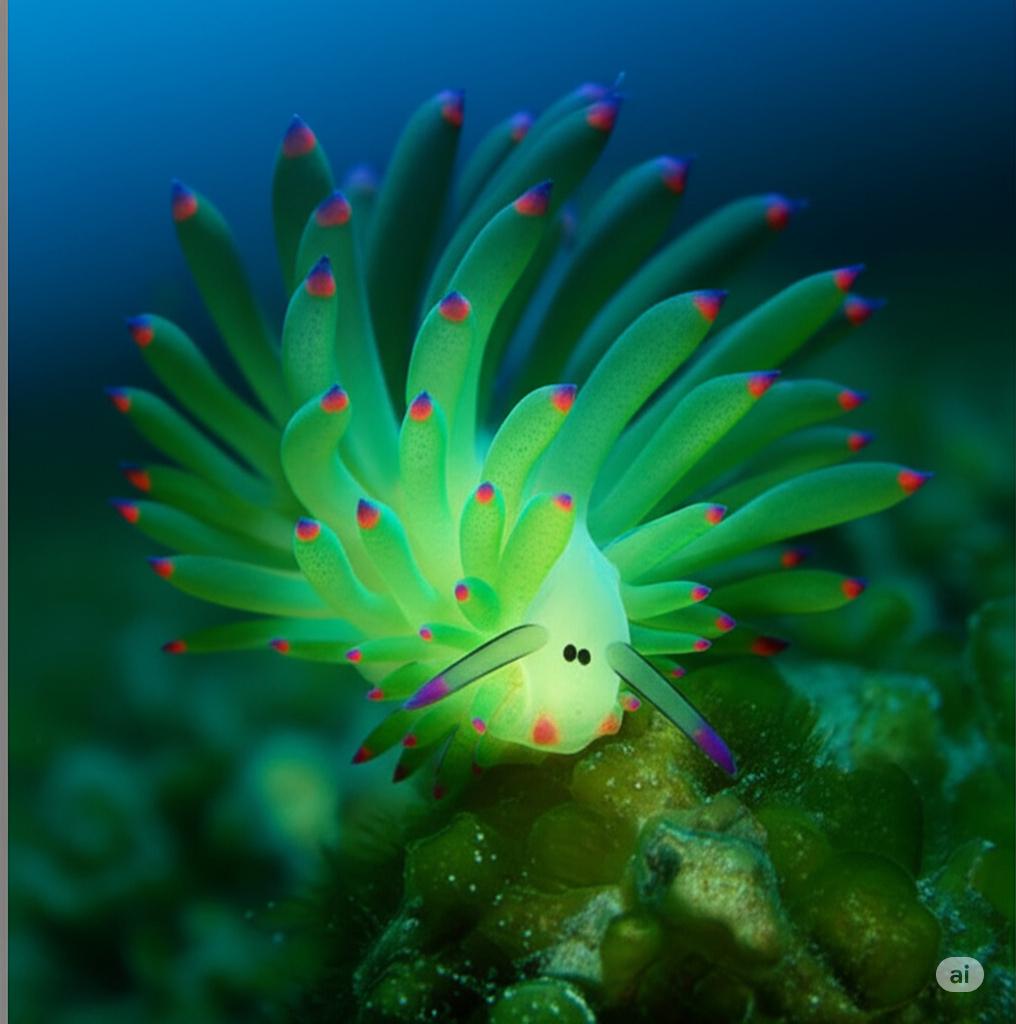
Leaf Sheep (Generated by Artificial Intelligence)
Size(s) | approximately 5 mm | ||||||||
|---|---|---|---|---|---|---|---|---|---|
Regions Observed | Southeast Asia Japan Philippines | ||||||||
Habitat | Tropical Seas | ||||||||
Feeding Behavior | green algae of the genus Avrainvillea | ||||||||
Costasiella kuroshimae is a small marine animal belonging to the order Sacoglossa, commonly known as the "leaf sheep." It measures approximately 5 mm in length. The species was first described in 1993 off the coast of Kuroshima Island in Japan. It belongs to the group of mollusks known as sea slugs.

Leaf Sheep (Unsplash)
Costasiella kuroshimae possesses green-colored cerata (outgrowths) on its back. These structures serve to store chloroplasts acquired from its food. The head features two sensory organs called rhinophores, which detect chemical signals. Its eyes are small and provide limited visual perception.
This species feeds on green algae of the genus Avrainvillea. During feeding, it ingests the algae’s chloroplasts and retains them within its own cells. This biological process is known as kleptoplasty. The chloroplasts are preserved in the cerata on the animal’s back, where they can continue to perform photosynthesis. The duration of photosynthetic activity can range from several days to several weeks.
Costasiella kuroshimae inhabits tropical waters. It has been observed in shallow, sunlit areas along the coasts of Japan, the Philippines, and Southeast Asia. It is typically found on surfaces covered with algae. Its physical appearance is well adapted to its environment, and its small size facilitates movement among algal mats.
Costasiella kuroshimae is one of the few documented animal species capable of photosynthesis. This unique trait is studied in scientific research to better understand the mechanisms of kleptoplasty.
The shallow marine habitats where this species lives are vulnerable to environmental degradation, pollution, and climate change. These factors can lead to the decline or loss of the algae upon which it depends for food. Indirectly, such threats may disrupt the leaf sheep’s life cycle.
Macphee, Annabell. “Munching on the Sun.” *theGIST*, January 22, 2022. Accessed June 18, 2025. https://the-gist.org/2022/01/munching-on-the-sun/.
Oceana. "Yaprak Koyunu." Accessed June 18, 2025. https://oceana.org/marine-life/leaf-sheep/.
Unsplash. “A Close-Up of a Green Leaf with Drops of Water on It.” Photograph: shb52OAV_6w. Accessed June 18, 2025. https://unsplash.com/photos/a-close-up-of-a-green-leaf-with-drops-of-water-on-it-shb52OAV_6w.

Leaf Sheep (Generated by Artificial Intelligence)
Size(s) | approximately 5 mm | ||||||||
|---|---|---|---|---|---|---|---|---|---|
Regions Observed | Southeast Asia Japan Philippines | ||||||||
Habitat | Tropical Seas | ||||||||
Feeding Behavior | green algae of the genus Avrainvillea | ||||||||
No Discussion Added Yet
Start discussion for "Leaf Sheep (Costasiella kuroshimae)" article
Appearance and Morphology
Feeding and Kleptoplasty
Habitat and Behavior
Evolutive Feature and Subject of Research
Environmental Impacts and Threats