

This article was automatically translated from the original Turkish version.
Classification(s) | Among the mimetic muscles in the group of muscles that elevate the corners of the mouth | ||||||||
|---|---|---|---|---|---|---|---|---|---|
Nerve | Buccal branches of the facial nerve | ||||||||
Artery | Facial artery and its branches | ||||||||
Function(s) | Elevates the corner of the mouth upward and medially | ||||||||
The levator anguli oris is a facial muscle located in the oral region that contributes to the formation of smiling and similar facial expressions. It originates from a specific depression on the anterior surface of the maxilla and extends to the corner of the mouth, where it blends with other facial muscles.
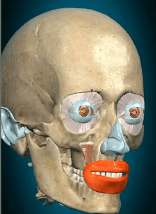
The muscle originates from the canine fossa of the maxilla. This origin point is located immediately below the infraorbital foramen. Its fibers run downward and laterally to attach at the corner of the mouth. Anatomically, it lies in the superficial layer of the upper lip and cheek region.
The levator anguli oris consists of short but strong muscle fibers. Its origin is the canine fossa of the maxilla, and its insertion is at the corner of the mouth. Here, its fibers intermingle with those of the zygomaticus major, depressor anguli oris (triangularis), and orbicularis oris muscles, contributing to the muscular network around the mouth.
The muscle develops from the mesoderm of the second pharyngeal arch and is classified among the facial muscles. Anatomically, it is grouped among the muscles that elevate the corner of the mouth.
The levator anguli oris is innervated by the buccal branches of the facial nerve (nervus facialis, VII). Its blood supply is typically provided by the facial artery and its branches, which originate from the external carotid artery.
The primary function of the muscle is to elevate and retract the corner of the mouth. This movement plays a key role in the formation of smiling and expressions of happiness. In cases of facial nerve damage, the muscle’s function may be reduced or lost, leading to asymmetrical facial expressions.
IMAIOS e-Anatomy. "Levator Anguli Oris." 2025. Accessed August 16, 2025. https://www.imaios.com/en/e-anatomy/anatomical-structures/levator-anguli-oris-1541081732?utm_source.
Munakomi, S., and M. Varacallo. “Anatomy, Levator Anguli Oris.” StatPearls/NCBI Bookshelf, 2020–2023. Accessed August 16, 2025. https://www.ncbi.nlm.nih.gov/books/NBK547688/?utm_source.
Radiopaedia. “Levator Anguli Oris Muscle: Radiology Reference.” 2021. Accessed August 16, 2025. https://radiopaedia.org/articles/levator-anguli-oris-muscle?lang=us&utm_source.
YouTube. "Levator Anguli Oris Muscle Anatomy." Video, 2:05. January 12, 2020. Accessed August 16, 2025. https://www.youtube.com/watch?v=X0sENYLooGg&pp=ygUabGV2YXRvciBhbmd1bGkgb3JpcyBtdXNjbGU%3D.

Classification(s) | Among the mimetic muscles in the group of muscles that elevate the corners of the mouth | ||||||||
|---|---|---|---|---|---|---|---|---|---|
Nerve | Buccal branches of the facial nerve | ||||||||
Artery | Facial artery and its branches | ||||||||
Function(s) | Elevates the corner of the mouth upward and medially | ||||||||
No Discussion Added Yet
Start discussion for "Levator anguli oris" article
Anatomical Structure
Morphology and Attachment Points
Embryological Origin and Classification
Innervation and Vascular Supply
Function and Clinical Relevance