

This article was automatically translated from the original Turkish version.
Nerve | Innervated by the facial nerve (cranial nerve VII) | ||||||||
|---|---|---|---|---|---|---|---|---|---|
Artery | Supplied by the facial artery | ||||||||
Function(s) | Pulls the corners of the mouth downward to form a expression of sadness | ||||||||
Classification(s) | One of the facial mimic muscles located below the corner of the mouth | ||||||||
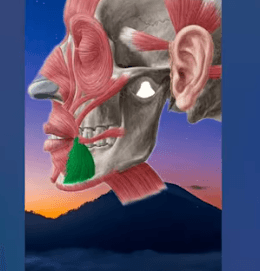
Depressor Anguli Oris is a facial muscle that plays a significant role in facial expressions. It originates from the lateral surface of the mandible (lower jaw) and inserts into the angle of the mouth (modiolus). It contributes to the formation of expressions such as frowning and sadness.
The depressor anguli oris is a flat, triangular, superficial muscle that arises along the oblique line of the mandible, just below the mental foramen. Its fibers run upward and laterally to insert via a narrow fascicle into the modiolus, a fibrous structure at the corner of the mouth. At its origin, it exhibits structural continuity with the platysma muscle and forms anatomical connections with the orbicularis oris and risorius muscles in its upper portions. Some fibers of the depressor anguli oris cross the midline of the jaw to interdigitate with the corresponding depressor anguli oris muscle on the opposite side, forming a small transverse muscle bundle known as the transversus menti. These connections enable the depressor anguli oris to function in coordination with both local and contralateral facial muscles, establishing it as a central structure among the muscles of the lower face.
The depressor anguli oris muscle is embryologically derived from the second pharyngeal arch and is classified among the muscles of facial expression. Like most facial muscles, it develops under the innervation of the facial nerve and is one of the primary muscles responsible for pulling the corner of the mouth downward. Functionally, it belongs to the depressor group of facial muscles. It acts antagonistically to the levator anguli oris and synergistically with the depressor labii inferioris, helping to balance positive and negative elements of facial expression. This antagonist-synergist relationship enables coherent emotional mimicry.
The depressor anguli oris receives its motor innervation from the marginal mandibular branch of the facial nerve. This branch travels along the margin of the mandible to reach the superficial aspect of the muscle. The vascular supply of the depressor anguli oris is provided by the facial artery (a. facialis) and its branches. These superficial nerve and vascular structures render the anatomical region of the depressor anguli oris a delicate area during surgical interventions and aesthetic procedures. Incorrect incisions or injections may result in loss of function of this muscle.
The depressor anguli oris pulls the corner of the mouth downward and slightly laterally, contributing to facial expressions of sadness, dissatisfaction, and disappointment. Consequently, it is one of the most prominent muscles in the lower face for conveying negative emotional expressions. While it functions antagonistically to the levator anguli oris, it works synergistically with the depressor labii inferioris to ensure controlled and balanced movement of the lower lip and perioral region. Coordinated activity of the depressor anguli oris is essential for functions such as speech, crying, and facial mimicry. In cases of facial nerve palsy, damage to the marginal mandibular branch of the facial nerve may cause weakness or paralysis of the depressor anguli oris. This results in drooping of the mouth corner on the affected side and marked facial asymmetry. This appearance, particularly noticeable during smiling, can lead to aesthetic and psychosocial issues in the patient. Treatment options include partial resection of the depressor labii inferioris muscle on the contralateral side to restore balance. Congenital anomalies may present as hypoplasia or aplasia of the depressor anguli oris muscle. This condition is often associated with congenital facial asymmetry and may be linked to certain syndromes. Early detection is crucial for timely aesthetic and functional intervention. Botulinum toxin injections can be used aesthetically to temporarily suppress the function of the depressor anguli oris. This method is preferred for treating the wrinkles extending downward from the corners of the mouth, known as “marionette lines.” However, during injection, the relationship of the depressor anguli oris with adjacent structures must be carefully considered. Excessive dosage or incorrect localization may disrupt perioral mimicry and cause functional impairment.
Jern, Sanna, and Martin Halle. “The Social and Emotional Consequences of Facial Muscle Paralysis.” Master's thesis, Stockholm University, 2023. Accessed July 29, 2025. https://www.diva-portal.org/smash/get/diva2:1806794/FULLTEXT01.pdf.
Kim, Nam-Ho, Ji-Hyun Lee, and Sung Bin Youn. “Anatomical Considerations Regarding the Location and Boundary of the Depressor Anguli Oris Muscle with Reference to Botulinum Toxin Injection.” Surgical and Radiologic Anatomy 37, no. 7 (2015): 835–840. Accessed July 29, 2025. https://www.researchgate.net/publication/267730124.
Yoshimura, Koichi, Hiroshi Nakajima, and Masaru Ishii. “Congenital Hypoplasia of Depressor Anguli Oris Muscle: 3 Cases Report.” Annals of Plastic Surgery 39, no. 4 (1997): 434–436. Accessed July 29, 2025. https://www.researchgate.net/publication/315960024.
Çavuşoğlu, Meryem, and Ayşe Yavuz. “Botulinum Toksin Enjeksiyonunda Depressor Anguli Oris Kasının Anatomik Özelliklerinin Değerlendirilmesi.” International Anatomy and Surgery 21, no. 4 (2023): 149–154. Accessed July 29, 2025. https://jag.journalagent.com/ias/pdfs/IAS_21_4_149_154.pdf.
Özdemir, Erdal, and Hasan Bahadır. “Depressor Anguli Oris Kasının Anatomik Özellikleri.” Anatomy 17, no. 2 (2010): 13–16. Accessed July 29, 2025. https://www.bibliomed.org/mnsfulltext/134/2010_17_2_13.pdf?1753816686.

Nerve | Innervated by the facial nerve (cranial nerve VII) | ||||||||
|---|---|---|---|---|---|---|---|---|---|
Artery | Supplied by the facial artery | ||||||||
Function(s) | Pulls the corners of the mouth downward to form a expression of sadness | ||||||||
Classification(s) | One of the facial mimic muscles located below the corner of the mouth | ||||||||
No Discussion Added Yet
Start discussion for "Depressor Anguli Oris Muscle" article
Anatomical Structure
Morphology and Attachment Points
Embryological Origin and Classification
Innervation and Vascular Supply
Function and Clinical Relevance