

This article was automatically translated from the original Turkish version.
Nerve | Innervated by the facial nerve (cranial nerve VII). | ||||||||
|---|---|---|---|---|---|---|---|---|---|
Artery | Supplied by the facial artery. | ||||||||
Function(s) | Pulls down the lower jaw and the corner of the mouth to tense the face and stretches the skin of the neck. | ||||||||
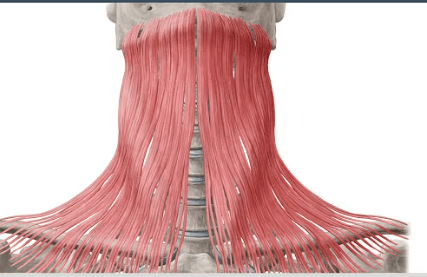
Platysma muscle is a thin, broad muscle located in the superficial layer of the neck. It plays a role in facial expressions, mandibular movements, and tensioning of the neck skin. It is innervated by the facial nerve (CN VII) and is an important structure in aesthetic surgery.
The platysma muscle is a thin, broad superficial muscle that originates from the fascia overlying the pectoralis major and deltoid muscles and extends upward to the upper part of the clavicle. Muscle fibers blend with the muscles at the lower border of the mandible, the muscles around the corner of the mouth (such as the depressor anguli oris), and the skin of the neck and face. It lies at the subcutaneous level in the anterior and lateral regions of the neck. The muscle arises from the fascia over the pectoralis major and deltoid muscles and spreads toward the mandible and the muscles at the corner of the mouth. Its fibers also intermingle with the skin of the neck and face, providing support to the mimetic muscles. These connections enable the platysma to contribute to both tensioning of the neck skin and movements of the mandible and lips.
The platysma muscle develops embryologically from mesodermal fascial tissue and is classified as a superficial muscle of fascial origin. Functionally, it is associated with the facial mimetic muscles and is innervated by the cervical branch of the facial nerve (CN VII). It is also classified based on its location in the transition zone between the face and the neck.
The muscle is innervated by the cervical branch of the facial nerve (cranial nerve VII). Its blood supply is provided by branches of the submental artery and the suprascapular artery. This neural and vascular architecture is important for the functional efficiency and healing capacity of the muscle.
When the platysma muscle contracts, it produces transverse lines on the neck skin resembling a “bowstring” and tenses the neck skin. Together with the depressor labii inferioris and depressor anguli oris muscles, it pulls the lower lip downward, playing an active role in facial expressions such as fear, anger, or disgust. Clinically, perforation of the platysma in penetrating neck injuries indicates damage to deeper structures, and the extent of injury is assessed using CT angiography. In aesthetic surgery, the “turkey neck” appearance associated with aging results from weakening of the platysma bands; treatment options include botulinum toxin injection, platysmaplasty, and liposuction. Additionally, during neck surgeries such as thyroidectomy or lymph node dissection, the platysma is incised, and careful suturing techniques are employed to minimize scar formation.
Accessed November 26, 2025.
DeCarlo, M., and L. M. Siddiqui. Anatomy, Head and Neck, Platysma Muscle. StatPearls [Internet]. Treasure Island, FL: StatPearls Publishing, 2023. Accessed July 3, 2025.
Hwang, Seoung Joo, et al. “Understanding Platysma Muscle Contraction Pattern and Its Relationship to Platysmal Banding - A Real-Time Ultrasound Study.” ResearchGate, 2023. Accessed July 22, 2025. https://www.researchgate.net/publication/374619188_Commentary_on_Understanding_Platysma_Muscle_Contraction_Pattern_and_Its_Relationship_to_Platysmal_Banding_-_A_Real-Time_Ultrasound_Study.
Lieb, Frank J., and Michael J. Perry. “The Anatomy and Electrical Activity of the Platysma Muscle.” ResearchGate, 2001. Accessed July 22, 2025. https://www.researchgate.net/publication/19305247_The_anatomy_and_electrical_activity_of_the_platysma_muscle.
Pallure, V., et al. “Anatomy and Clinical Considerations of the Platysma Muscle.” *European Journal of Plastic Surgery*, 2021. Accessed July 22, 2025. https://pure.eur.nl/ws/portalfiles/portal/137684003/sjad216.pdf.

Nerve | Innervated by the facial nerve (cranial nerve VII). | ||||||||
|---|---|---|---|---|---|---|---|---|---|
Artery | Supplied by the facial artery. | ||||||||
Function(s) | Pulls down the lower jaw and the corner of the mouth to tense the face and stretches the skin of the neck. | ||||||||
Anatomical Structure
Morphology and Attachment Points
Embryological Origin and Classification
Innervation and Vascular Supply
Function and Clinical Relevance