
This article was automatically translated from the original Turkish version.
Classification(s) | It is one of the facial mimic muscles located in the cheek region. | ||||||||
|---|---|---|---|---|---|---|---|---|---|
Nerve | It is innervated by the facial nerve (cranial nerve VII). | ||||||||
Artery | It is supplied by the facial artery. | ||||||||
Function(s) | It produces a smiling expression by pulling the corners of the mouth laterally. | ||||||||
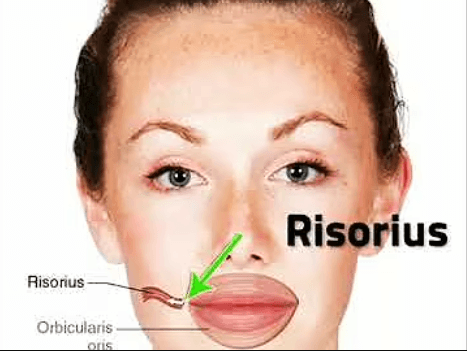
Risorius muscle is a highly variable facial muscle involved in facial expressions. It attaches to the modiolus at the corner of the mouth and contributes to the formation of expressions such as smiling, grinning, and laughing. It is innervated by the buccal branch of the facial nerve (CN VII) and may be asymmetric or absent in some individuals.
The risorius muscle is a thin, superficial muscle exhibiting significant anatomical variation. Its structure differs between individuals, ranging from a narrow band of muscle to a broad, fan-shaped form. It lies superficial to the masseter muscle and is partially covered by it. The origin of the muscle is variable and may arise from the parotid fascia, masseteric fascia, the modiolar portion of the platysma muscle, the mastoid bone, or the zygomatic arch. Its insertion is at the modiolus, a critical junction where multiple mimetic muscles converge and coordinate their actions.
The risorius muscle is embryologically derived from the second pharyngeal arch and belongs to the group of mimetic muscles. It is one of the muscles responsible for facial expressions. Classically classified within the mimetic muscle group, it works in coordination with other facial muscles to produce various emotional expressions. Its structural and functional variability is attributed to its potential development from multiple embryological sources.
The motor innervation of the risorius muscle is provided by the buccal branch of the facial nerve (cranial nerve VII). This nerve branch precisely controls the muscle’s movements. Its blood supply is primarily derived from the superior labial artery. The distribution of its neural and vascular structures is essential for the continuity of its mimetic functions. Additionally, due to the superficial course of its innervating nerves, caution is required during surgical and cosmetic procedures.
The risorius muscle actively contributes to various facial expressions by pulling the corner of the mouth laterally. It is particularly functional in social and emotional expressions such as smiling, grinning, and laughing. These movements enhance the liveliness and expressiveness of the face. The risorius holds an important role in mimetic muscles for aesthetic and psychological communication. Anatomical variations of the risorius muscle have clinical significance: in some individuals, it may be unilateral or entirely absent. The number and distribution of muscle fibers vary between individuals. During botulinum toxin (Botox) injections into the masseter muscle, the risorius may be inadvertently affected, leading to asymmetric facial expressions. Therefore, the location and function of the risorius must be considered during Botox applications. The functional integrity of the muscle is crucial for facial aesthetics and the prevention of mimetic disorders.
"A Different Pattern of Arrangement of the Risorius Muscle Fibers: A Case Report." ResearchGate. Accessed July 3, 2025. https://www.researchgate.net/publication/359075409_A_Different_Pattern_of_Arrangement_of_the_Risorius_Muscle_Fibers_A_Case_Report.
"Transversus Nuchae Muscle Fused with Risorius Muscle: A Case Report." ResearchGate. Accessed July 3, 2025. https://www.researchgate.net/publication/343450403_Transversus_Nuchae_Muscle_Fused_with_Risorius_Muscle_A_Case_Report.
Accessed November 26, 2025.
Goyal, L., and B. M. Kohn. "Anatomy, Head and Neck, Risorius Muscle." In StatPearls [Internet]. Treasure Island (FL): StatPearls Publishing, 2023. Accessed July 3, 2025.

Classification(s) | It is one of the facial mimic muscles located in the cheek region. | ||||||||
|---|---|---|---|---|---|---|---|---|---|
Nerve | It is innervated by the facial nerve (cranial nerve VII). | ||||||||
Artery | It is supplied by the facial artery. | ||||||||
Function(s) | It produces a smiling expression by pulling the corners of the mouth laterally. | ||||||||
Anatomical Structure
Morphology and Attachment Points
Embryological Origin and Classification
Innervation and Vascular Supply
Function and Clinical Relevance