


This article was automatically translated from the original Turkish version.
Subject(s) | Forest interior landscape | ||||||||
|---|---|---|---|---|---|---|---|---|---|
Type(s) | Landscape | ||||||||
Period(s) | Ottoman painting of the 19th century | ||||||||
Current Location | It is part of the TBMM National Palaces Painting Collection | ||||||||
Art Movement / Trend | Academic landscape painting | ||||||||
Surface | Canvas | ||||||||
Technique | Oil paint | ||||||||
Year of Production | 1887 | ||||||||
Artist | Şeker Ahmed Paşa | ||||||||
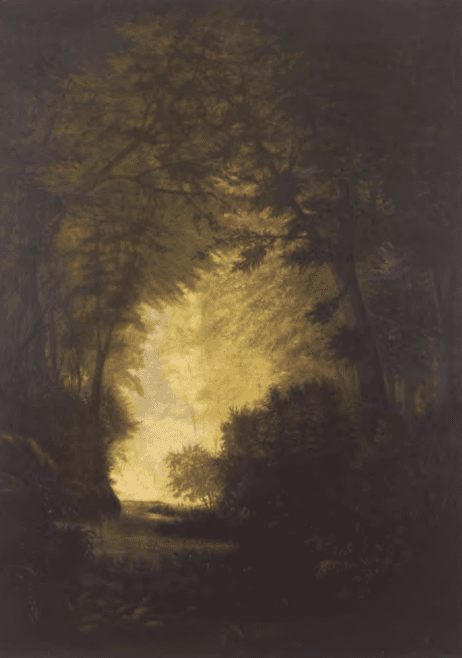
The Light of the Forest is a painting completed in 1887 by the artist Şeker Ahmed Paşa on the subject of landscape. The work is regarded as one of the artist’s paintings focused on natural scenery and is particularly noted for its exploration of the relationship between light and depth in a forest interior. It is considered one of the most distinguished examples reflecting Şeker Ahmed Paşa’s technical and aesthetic approach to landscape painting【1】.
Şeker Ahmed Paşa is among the most influential artists in the development of Western-style landscape painting in nineteenth-century Ottoman art. His academic art training in Europe shaped his approach to painting based on direct observation of nature. The painting The Light of the Forest is classified among the artist’s mature works, during which he continued his practice of depicting nature through direct observation【2】.
The painting depicts the interior space of a wooded area, with tree trunks, branches, and the play of light on the forest floor forming the central compositional elements. The composition employs a perspective that guides the viewer into the depths of the forest. The treatment of the natural environment independently of human figures aligns the work with a landscape tradition that treats nature as a subject in its own right【3】.
In The Light of the Forest, light functions as one of the defining elements of the composition. The subtle filtering of natural light through leaves and trunks onto the ground is rendered with meticulous detail. This arrangement of light is said to create a powerful sense of spatial depth. Şeker Ahmed Paşa treated light not as a dramatic effect but as an intrinsic part of nature’s internal order【4】.
The work is executed in oil on canvas. The brushwork demonstrates a controlled and detailed approach, particularly evident in the depiction of vegetation through small, careful strokes. The color palette is dominated by shades of green, brown, and yellow, which are balanced through the effects of light.
The painting is regarded as one of the strongest examples in Ottoman art of landscape as an independent subject. Its significance lies in its treatment of nature within an academic framework. Şeker Ahmed Paşa is said to have synthesized the European landscape tradition with local observations of nature and his own distinctive style in this work【5】.
Şeker Ahmed Paşa’s landscape paintings are described as portraying nature not as a static backdrop but as a subject governed by its own internal structure and light relationships【6】. The Light of the Forest is one of the clearest expressions of this approach. The painting is noted for demonstrating the artist’s technical mastery and his observation-based methodology in landscape painting.
According to current inventories and catalog records, the painting The Light of the Forest is held in the National Palaces Painting Collection of the Grand National Assembly of Türkiye. Dated 1887, it is an oil on canvas measuring 98 × 134 cm. Its registration in the National Palaces Collection indicates that the work has been formally preserved and documented at an institutional level.
A significant portion of Şeker Ahmed Paşa’s landscape paintings was incorporated into public collections after his death. The National Palaces Painting Collection, in particular, has become one of the primary institutions gathering his mature works on nature and landscape themes. The Light of the Forest is regarded as one of the key works within this collection representing the artist’s approach to forest landscapes.
The inclusion of this work in the collection is significant as it highlights Şeker Ahmed Paşa’s position within nineteenth-century Ottoman art and illustrates the institutionalization of landscape painting through public collections.
The Light of the Forest (1887) is recognized as one of the most important works in which Şeker Ahmed Paşa unified his observations of light, space, and nature in landscape painting. The work is examined within the context of the academic landscape tradition that developed in Ottoman art during the second half of the nineteenth century.
Baytar, İlona. “Şeker Ahmed Paşa’nın Sıra Dışı Bir Portresi.” *Art-Sanat* 10 (2018): 1–12. Accessed January 16, 2026. https://dergipark.org.tr/tr/download/article-file/515704
Demir, Deniz. “Modernleşme Sürecinde Türk Resmi: Şeker Ahmed Paşa Örneği.” *Akademik Sanat* 9, no. 17 (2024): 20–35. Accessed January 16, 2026. https://dergipark.org.tr/tr/download/article-file/4556661
Kaya, Gülsen Sevinç, and Ümit Kılınç. “Batılılaşma Dönemi Türk Resminde Şeker Ahmed Paşa’nın Yeri ve Önemi.” *Journal of Universal History Studies* 6, no. 1 (2023): 112–128. Accessed January 16, 2026. https://dergipark.org.tr/en/download/article-file/3124342
Kılıç, Erol. “Şeker Ahmed Paşa ve Türk Resminde Doğa Algısı.” *Yedi: Sanat, Tasarım ve Bilim Dergisi* 12 (2014): 45–56. Accessed January 16, 2026. https://dergipark.org.tr/en/download/article-file/28454
Müftüoğlu, Mustafa Orkun. “Şeker Ahmed Paşa’nın ‘Otoportre’si Üzerine Bir Değerlendirme.” *Sanat Tarihi Yıllığı* 24 (2015): 1–17. Accessed January 16, 2026. https://dergipark.org.tr/tr/download/article-file/28977
Serin, Muhittin. “Şeker Ahmed Paşa.” *TDV İslâm Ansiklopedisi*. Accessed January 16, 2026. https://islamansiklopedisi.org.tr/seker-ahmed-pasa
Türkiye Büyük Millet Meclisi Başkanlığı. *Millî Saraylar Resim Koleksiyonu Kataloğu*. Ankara: TBMM Yayınları, 20XX. TBMM Açık Accessed Sistemi. Accessed January 16, 2026. https://acikerisim.tbmm.gov.tr/bitstreams/d60fa673-0bbc-45de-8f37-687b2da076e0/download
[1]
Gülsen Sevinç Kaya ve Ümit Kılınç, “Batılılaşma Dönemi Türk Resminde Şeker Ahmed Paşa’nın Yeri ve Önemi,” Journal of Universal History Studies 6, sy. 1 (2023): 112–128, erişim tarihi 16 Ocak 2026, https://dergipark.org.tr/en/download/article-file/3124342
[2]
Muhittin Serin, “Şeker Ahmed Paşa,” TDV İslâm Ansiklopedisi, erişim tarihi 16 Ocak 2026, https://islamansiklopedisi.org.tr/seker-ahmed-pasa
Deniz Demir, “Modernleşme Sürecinde Türk Resmi: Şeker Ahmed Paşa Örneği,” Akademik Sanat 9, sy. 17 (2024): 20–35, erişim tarihi 16 Ocak 2026, https://dergipark.org.tr/tr/download/article-file/455666
[3]
Erol Kılıç, “Şeker Ahmed Paşa ve Türk Resminde Doğa Algısı,” Yedi: Sanat, Tasarım ve Bilim Dergisi 12 (2014): 45–56, erişim tarihi 16 Ocak 2026, https://dergipark.org.tr/en/download/article-file/28454
[4]
Erol Kılıç, “Şeker Ahmed Paşa ve Türk Resminde Doğa Algısı,” Yedi: Sanat, Tasarım ve Bilim Dergisi 12 (2014): 45–56, erişim tarihi 16 Ocak 2026, https://dergipark.org.tr/en/download/article-file/28454
[5]
Kaya, Gülsen Sevinç ve Ümit Kılınç. “Batılılaşma Dönemi Türk Resminde Şeker Ahmed Paşa’nın Yeri ve Önemi.” Journal of Universal History Studies 6, sy. 1 (2023): 112–128. Erişim tarihi 16 Ocak 2026. https://dergipark.org.tr/en/download/article-file/3124342
[6]
Kılıç, Erol. “Şeker Ahmed Paşa ve Türk Resminde Doğa Algısı.” Yedi: Sanat, Tasarım ve Bilim Dergisi 12 (2014): 45–56. Erişim tarihi: 16 Ocak 2026. https://dergipark.org.tr/en/download/article-file/28454

Subject(s) | Forest interior landscape | ||||||||
|---|---|---|---|---|---|---|---|---|---|
Type(s) | Landscape | ||||||||
Period(s) | Ottoman painting of the 19th century | ||||||||
Current Location | It is part of the TBMM National Palaces Painting Collection | ||||||||
Art Movement / Trend | Academic landscape painting | ||||||||
Surface | Canvas | ||||||||
Technique | Oil paint | ||||||||
Year of Production | 1887 | ||||||||
Artist | Şeker Ahmed Paşa | ||||||||
No Discussion Added Yet
Start discussion for "Light of the Forest (Painting)" article
Artist and Historical Context
Subject and Composition
Use of Light and Depiction of Nature
Technical Features
Evaluation in Art Historical Context
Place Within Şeker Ahmed Paşa’s Landscape Vision
Current Location and Collection Status