


This article was automatically translated from the original Turkish version.
+2 More

Purpose(s) | Unifying Quantum Mechanics and General Relativity (Theory of Everything) | ||||||||
|---|---|---|---|---|---|---|---|---|---|
Origin(s) | University of Southern California (Strings '95 Conference) | ||||||||
Theories Included | Five Superstring Theories, 11-Dimensional Supergravity | ||||||||
Date of Proposal | 1995 | ||||||||
Pioneer Name | Edward Witten | ||||||||
Discipline | Theoretical Physics, Quantum Gravity, Cosmology | ||||||||
In physics, M-theory is an eleven-dimensional physical theory that unifies all fundamental forces and forms of matter within a single mathematical framework, reconciling quantum mechanics with general theory of relativity. This theory defines the most basic building blocks of the universe not as point-like particles but as vibrating one-dimensional strings and multidimensional objects known as membranes or branes. It has been regarded as the strongest candidate for a "Theory of Everything" in modern physics. Although a complete mathematical formulation of the theory has not yet been achieved, it has been found to coincide with the laws of eleven-dimensional supergravity in low-energy limits.
The foundations of M-theory extend back to the early 20th century, when physicists attempted to unify gravity with electromagnetism. In 1919, Theodor Kaluza and in 1926, Oskar Klein proposed that the universe might have five dimensions rather than four (Kaluza-Klein Theory). This extra dimension was assumed to be curled up into a circle too small to be observed.
By the 1980s, research on string theory gained momentum, leading to what became known as the "First Superstring Revolution." During this period, physicists developed five mathematically consistent string theories capable of describing nature: Type I, Type IIA, Type IIB, Heterotic-O, and Heterotic-E. However, the existence of five distinct "Theories of Everything" for a single universe was seen as a conceptual inconsistency among physicists.
The turning point came in 1995 at a string theory conference held at the University of Southern California. Theoretical physicist Edward Witten proposed that these five different theories were not independent but rather different manifestations of a single, more fundamental theory under varying physical conditions or limits. Witten’s proposal initiated the "Second Superstring Revolution" and gave rise to the name M-theory for this unifying structure. Witten’s work demonstrated that the five string theories and the eleven-dimensional supergravity theory are interconnected through mathematical relationships known as "dualities."
M-theory extends the ten-dimensional models predicted by earlier string theories by adding one additional spatial dimension, bringing the total number of dimensions to eleven. This eleventh dimension is required for the theory’s consistency and reveals that strings are in fact cross-sections of higher-dimensional objects.
The most distinctive feature of the theory is that its fundamental constituents are not only one-dimensional strings but also multidimensional objects called p-branes. Here, the value of "p" represents the number of spatial dimensions of the object:
1-brane: String
2-brane: Membrane
3-brane: A three-dimensional volume
These structures are described as energy forms that move and vibrate within the eleven-dimensional space-time (bulk). It is hypothesized that our perceived four-dimensional universe is actually a three-dimensional brane (3-brane) suspended within this higher-dimensional space.
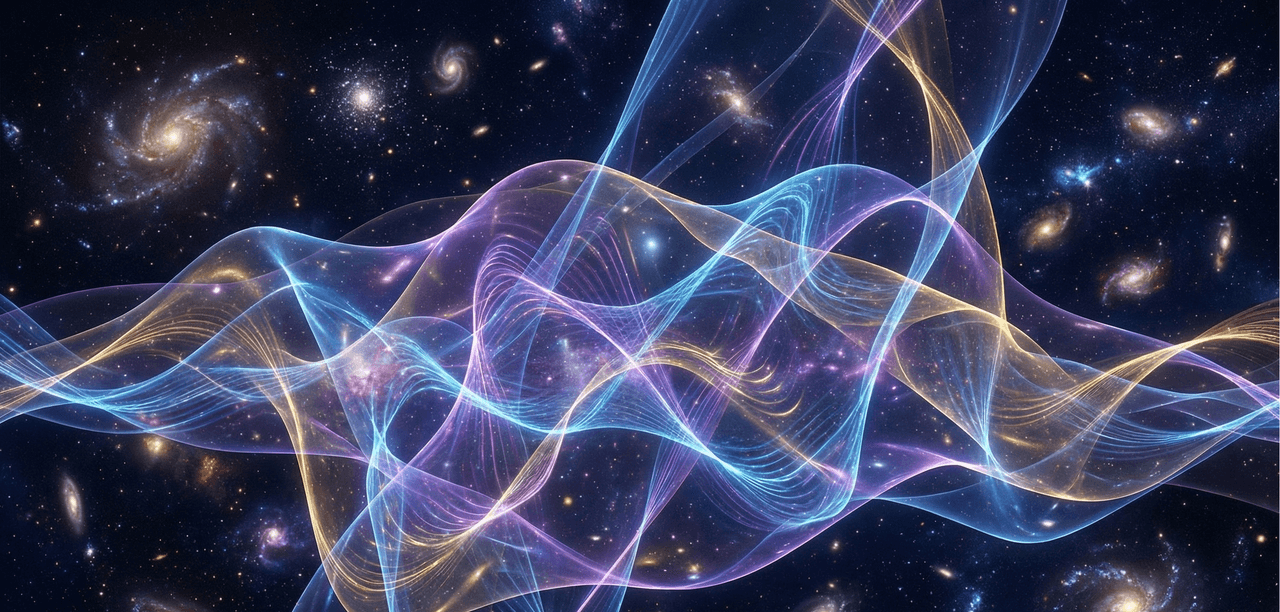
Illustration representing M-theory and the structure of a multidimensional universe. (Generated by artificial intelligence)
The unification of different string theories under the M-theory framework is made possible by symmetry principles known as "dualities." These principles show that seemingly distinct physical systems are in fact descriptions of the same underlying phenomenon:
This demonstrates that a situation in which particles interact strongly in one theory is mathematically equivalent to a situation in which particles interact weakly in another theory.
This relates to the geometry of extra dimensions. A dimension with radius R is physically indistinguishable from one with radius 1/R; thus, a string tightly wound around a very small dimension produces the same physics as a string stretched across a very large dimension.
Edward Witten, who named the theory, deliberately avoided giving a definitive interpretation of the letter "M." It has been interpreted contextually as "Membrane," "Magic," "Mystery," or "Matrix." Witten has indicated that the true meaning of the letter will become clear once a more fundamental formulation of the theory is discovered.
M theory: what does it stand for? - Parallel Universes - BBC Science (YouTube)
Accessed November 26, 2025.
Accessed November 26, 2025.
Centre for Theoretical Cosmology. “Quantum Cosmology.” University of Cambridge. Accessed January 17, 2026. https://www.ctc.cam.ac.uk/outreach/origins/quantum_cosmology_four.php
Mkaku. "M-Theory: The Mother of All Superstrings." mkaku.org. Accessed January 17, 2026.
Quanta Magazine. "Why Is M-Theory the Leading Candidate for Theory of Everything?" Quanta Magazine. Accessed January 17, 2026. https://www.quantamagazine.org/why-is-m-theory-the-leading-candidate-for-theory-of-everything-20171218/
ThoughtCo. "M-Theory." ThoughtCo. Accessed January 17, 2026.
YouTube. "M Theory: What Does It Stand For? – Parallel Universes – BBC Science." BBC Studios. Accessed January 17, 2026. https://www.youtube.com/watch?v=-wUh_eMtnFg
nLab. "M-Theory." nLab. Accessed January 17, 2026.

Purpose(s) | Unifying Quantum Mechanics and General Relativity (Theory of Everything) | ||||||||
|---|---|---|---|---|---|---|---|---|---|
Origin(s) | University of Southern California (Strings '95 Conference) | ||||||||
Theories Included | Five Superstring Theories, 11-Dimensional Supergravity | ||||||||
Date of Proposal | 1995 | ||||||||
Pioneer Name | Edward Witten | ||||||||
Discipline | Theoretical Physics, Quantum Gravity, Cosmology | ||||||||
Historical Development and Emergence
Theoretical Properties and Dimensions
Duality Symmetries
S-Duality
T-Duality
Terminology and the Meaning of the Letter "M"