This article was automatically translated from the original Turkish version.
+2 More
Location | Andes Mountains Cusco Region Peru | ||||||||
|---|---|---|---|---|---|---|---|---|---|
Elevation(s) | 430 m 2 | ||||||||
Establishment | 15th century (approximately 1450–1470) | ||||||||
Founder(s) | Pachacutec Inca Yupanqui | ||||||||
Area(s) | 32 592 hectares (Historical Conservation Area) | ||||||||
Population (Historical) | 500–750 people | ||||||||
Discovery(ies) | 1911 | ||||||||
Discoverer(s) | Hiram Bingham | ||||||||
World Heritage | UNESCO, 1983 | ||||||||
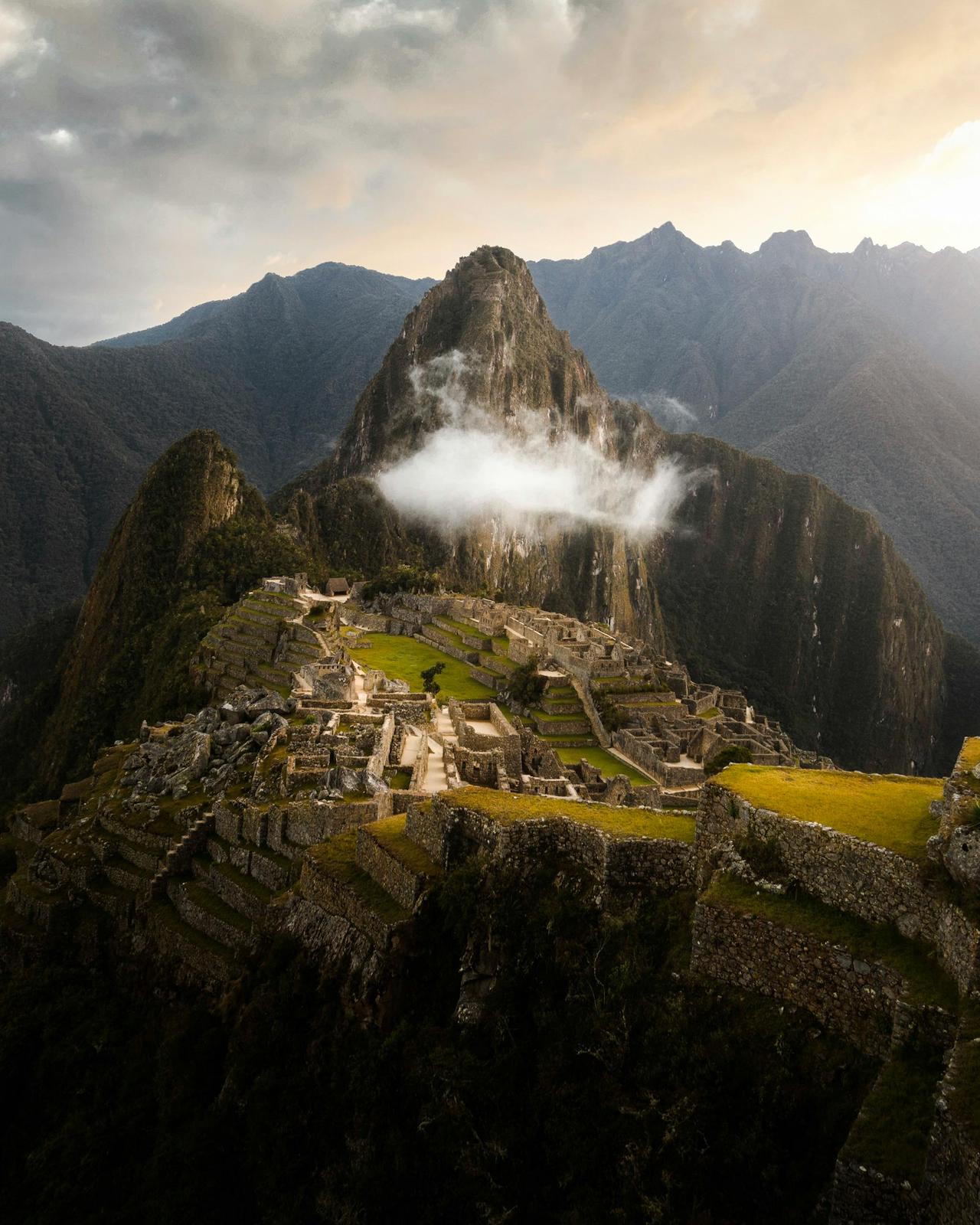
Machu Picchu is an Inca settlement located in the Cusco Region of Peru, on the eastern slopes of the Andes Mountains. This archaeological site, situated at an elevation of approximately 2,430 meters above sea level, was constructed during the 15th century under the Inca Empire and is one of South America’s most significant historical and cultural heritage sites.

Machu Picchu (Flickr)
Machu Picchu is an Inca settlement situated in the Machupicchu District of Urubamba Province within the Cusco Region of southern Peru, along the eastern range of the Andes Mountains. The site occupies a narrow ridge between two peaks—Machu Picchu and Huayna Picchu—at an altitude of approximately 2,430 meters, overlooking the Upper Sacred Valley and extending along the deep canyon of the Urubamba River.
The site is part of a larger protected area of 325.92 km², declared a Historical Conservation Area by Peru in 1981, encompassing the biodiversity of the Peruvian Yungas and the wet puna ecological zones of the Central Andes.
The settlement is generally accepted to have been constructed in the mid-15th century (approximately 1450–1470) during the reigns of Pachacutec Inca Yupanqui and Túpac Inca Yupanqui. Some radiocarbon (AMS) evidence suggests occupation may have extended between approximately 1420 and 1530. The settlement was abandoned during the 16th century following the onset of Spanish conquest.
Machu Picchu Ancient City (gdh date)
Although known to local populations, the site gained international visibility through the work of Hiram Bingham in 1911. Bingham initially believed the site he discovered to be Vilcabamba, the last city of the Incas; in 1964, Gene Savoy demonstrated that Vilcabamba was in fact located at Espiritu Pampa. International interest increased significantly following Bingham’s expeditions in 1912 and 1915.
Machu Picchu consists of approximately 200 structures divided into areas with distinct functions. The settlement is composed of buildings, plazas and platforms, organized into sections connected by narrow passages. One section is separated by walls, ditches and a possible defensive trench; this arrangement is interpreted not as military fortification but as “ritual isolation with defined boundaries.”
The spatial organization emphasizes the Andean concept of upper (hanan) and lower (hurin) divisions, separated by a central plaza. Natural ridges were transformed into terraced plateaus, and slopes were stabilized with stone retaining walls. Windows and doorways were deliberately oriented to frame views of surrounding mountains.
Among the structures built using the classic Inca dry-stone masonry technique (without mortar), the Temple of the Sun (Torreón), the Temple of the Three Windows and the Intihuatana stone are prominent in the literature. The alignment of the Temple of the Sun’s window with the Pleiades star cluster and a stone projection that marks the June solstice sunrise supports interpretations of its astronomical function. Large administrative halls (kallanka) were constructed with finely cut stone masonry.
A water supply system has been identified, comprising 16 carved stone channels that draw water from 14 natural springs. Stone staircases extending toward Huayna Picchu form part of the local circulation network.
Stone blocks were placed without mortar in tightly fitted joints; this technique is considered a key factor in discussions of structural stability and seismic resistance. Terraces were designed for both agricultural use and erosion and drainage control; the transformation of ridges into plateaus and the use of stone-retained slopes are defining features of the overall layout.

Machu Picchu (Flickr)
Geological studies have shown that the region contains a network of large and small faults forming an “X” pattern, with the main intersection located beneath Machu Picchu. The settlement’s layout and terraces are aligned parallel to major fault lines. These faults are believed to have facilitated the local sourcing and shaping of building stones, as fractured blocks could be more easily worked.
During its period of use, the settlement is estimated to have housed approximately 750 people, the majority of whom were servants and specialized laborers; the population declined during winter months. Skeletal analyses reveal chemical and osteological indicators of individuals originating from different regions and regional dietary variations. Most burials belong to lower-ranking administrative personnel, and the scarcity of high-value grave goods has drawn attention.
The most well-known historical route to Machu Picchu is the Inca Trail, which leads to Inti Punku (the Sun Gate). This route extends up to approximately 42.5 km from its starting point and includes passes reaching 4,200 meters in elevation; due to limited permits, advance reservations are required.
In 1981, the Peruvian government declared Machu Picchu a National Historical Conservation Area, and UNESCO added it to the World Heritage List in 1983. The inscription describes the site as a masterpiece of Inca civilization in the fields of art, urban planning, architecture and engineering, encompassing both the archaeological complex and its surrounding landscape. UNESCO highlights its outstanding universal value (criteria i, iii, vii, ix) and the region’s microclimatic diversity and endemism at the transition between the Andes and the Amazon. Integrity and authenticity have been preserved due to isolation after abandonment, and post-1911 interventions have been conducted in accordance with international standards.
The “Historical Conservation Area Management Unit” (UGM), established in 1999, is a governing structure representing ministries, the Cusco Regional Government and local municipalities. Continuous planning is emphasized to address the impacts of increasing visitor numbers, waste management and infrastructure development.

Machu Picchu (Anadolu Agency)
The site was named one of the “New Seven Wonders of the World” in 2007. The rising number of visitors and its management remain central concerns in conservation policy. Outside the protected area, the town of Aguas Calientes along the Urubamba River provides tourist service infrastructure.
The protected area supports numerous mammal and bird species, as well as over 550 tree species belonging to 74 families. UNESCO criteria specifically emphasize the high level of endemism and microclimatic diversity.
Machu Picchu is a mixed (cultural-natural) heritage site, designated a national Historical Conservation Area in 1981 and inscribed on the UNESCO World Heritage List in 1983. Visitor pressure, transportation and infrastructure projects, waste management and ecosystem governance are reported as key issues requiring monitoring and regulation in relevant management plans.
Machu Picchu is an Inca settlement constructed in the 15th century during the reign of Pachacutec, abandoned in the 16th century and introduced to the international community by Hiram Bingham in 1911. Located strategically and symbolically on the eastern slopes of the Andes, it is distinguished by its dry-stone masonry, terraced systems and advanced water and drainage infrastructure. Structures such as the Temple of the Sun, the Temple of the Three Windows and the Intihuatana indicate astronomical and ceremonial functions. With an estimated population of 500 to 750 individuals drawn from diverse regions and agricultural production extending beyond local terraces, Machu Picchu was declared a historical conservation area by Peru in 1981 and inscribed on the UNESCO World Heritage List in 1983. Today, it is a mixed heritage site requiring sustainable management in the face of tourism pressure and ecosystem conservation challenges.
Adams, Mark. “Discover 10 secrets of Machu Picchu.” *National Geographic*. Accessed September 25, 2025. https://www.nationalgeographic.com/travel/article/machu-picchu-secrets
Anadolu Ajansı. “O Kadar Yüksek Ki Ücretsiz Oksijen Servisi Yapılıyor.” Accessed September 25, 2025. https://www.aa.com.tr/tr/yasam/o-kadar-yuksek-ki-ucretsiz-oksijen-servisi-yapiliyor/40627
Anadolu Ajansı. “Peru’daki Antik İnka Şehri Machu Picchu.” Anadolu Ajansı. Accessed September 25, 2025. https://www.aa.com.tr/tr/pg/foto-galeri/perudaki-antik-inka-sehri-machu-picchu/146
Anadolu Ajansı. “Peru’nun Machu Picchu Antik Kentinde Yeni Yapılar Bulundu.” Accessed September 25, 2025. https://www.aa.com.tr/tr/kultur-sanat/perunun-machu-picchu-antik-kentinde-yeni-yapilar-bulundu/2484079
Bilim Genç. "Machu Picchu Fayların Üzerine Kurulmuş." TÜBİTAK Bilim Genç. Accessed September 25, 2025. https://bilimgenc.tubitak.gov.tr/makale/machu-picchu-faylarin-uzerine-kurulmus
Cartwright, Mark. “Machu Picchu.” World History Encyclopedia. Accessed September 25, 2025. https://www.worldhistory.org/trans/tr/1-11930/machu-picchu/
GZT Jurnalist. "Dünyanın Yeni Yedi Harikasından Biri: Machu Picchu Antik Kenti." GZT Jurnalist. Accessed September 25, 2025. https://www.gzt.com/video/jurnalist/dunyanin-yeni-yedi-harikasindan-biri-machu-picchu-antik-kenti-2157171
Hearn, Kelly and Jason Golomb. “Machu Picchu Mystery.” National Geographic. Accessed September 25, 2025. https://www.nationalgeographic.com/history/article/machu-picchu-mystery
Hudson, Trace. “Machu Picchu’nun Peru’daki Hava Fotoğrafı.” Pexels. Accessed September 25, 2025. https://www.pexels.com/tr-tr/fotograf/machu-picchu-nun-peru-daki-hava-fotografi-2516418/
Szekely, Pedro. “Machu Picchu Image by World Travel and Tourism Council.” Flickr. Accessed September 25, 2025. https://www.flickr.com/photos/43355249@N00/2355232262
Szekely, Pedro. “Machu Picchu Photo by pedrosz.” Flickr. Accessed September 25, 2025. https://www.flickr.com/photos/pedrosz/2115782565
UNESCO. “Historic Sanctuary of Machu Picchu.” *UNESCO World Heritage Centre*. Accessed September 25, 2025. https://whc.unesco.org/en/list/274/
gdh tarih. "Machu Picchu: 2450 Metre Yükseklikte Bir Antik Şehir." YouTube. Accessed September 25, 2025. https://www.youtube.com/watch?v=KZ3yVNV7hEI


Location | Andes Mountains Cusco Region Peru | ||||||||
|---|---|---|---|---|---|---|---|---|---|
Elevation(s) | 430 m 2 | ||||||||
Establishment | 15th century (approximately 1450–1470) | ||||||||
Founder(s) | Pachacutec Inca Yupanqui | ||||||||
Area(s) | 32 592 hectares (Historical Conservation Area) | ||||||||
Population (Historical) | 500–750 people | ||||||||
Discovery(ies) | 1911 | ||||||||
Discoverer(s) | Hiram Bingham | ||||||||
World Heritage | UNESCO, 1983 | ||||||||
Location, Topography and Natural Environment
Foundation, Period of Use and Abandonment
Discovery, Misattributions and Research History
Urban Plan and Spatial Organization
Notable Structures
Construction Techniques, Water and Drainage
Geology and Seismic Activity
Population, Origins and Daily Life
Access and Routes
Legal Status, Management and Conservation
Tourism and Visitor Management
Biodiversity