

 Recently Added:
This article was automatically translated from the original Turkish version.
On 10 June 2025, the Maghreb Resistance Convoy, a multinational civilian land convoy composed of thousands of participants from Algeria, Morocco, Libya, Mauritania and Tunisia, departed from Tunisia with the aim of lifting the blockade on Gaza, delivering humanitarian aid and demonstrating international solidarity. After being denied passage into eastern Libya, it decided on 18 June to return to Tunisia.

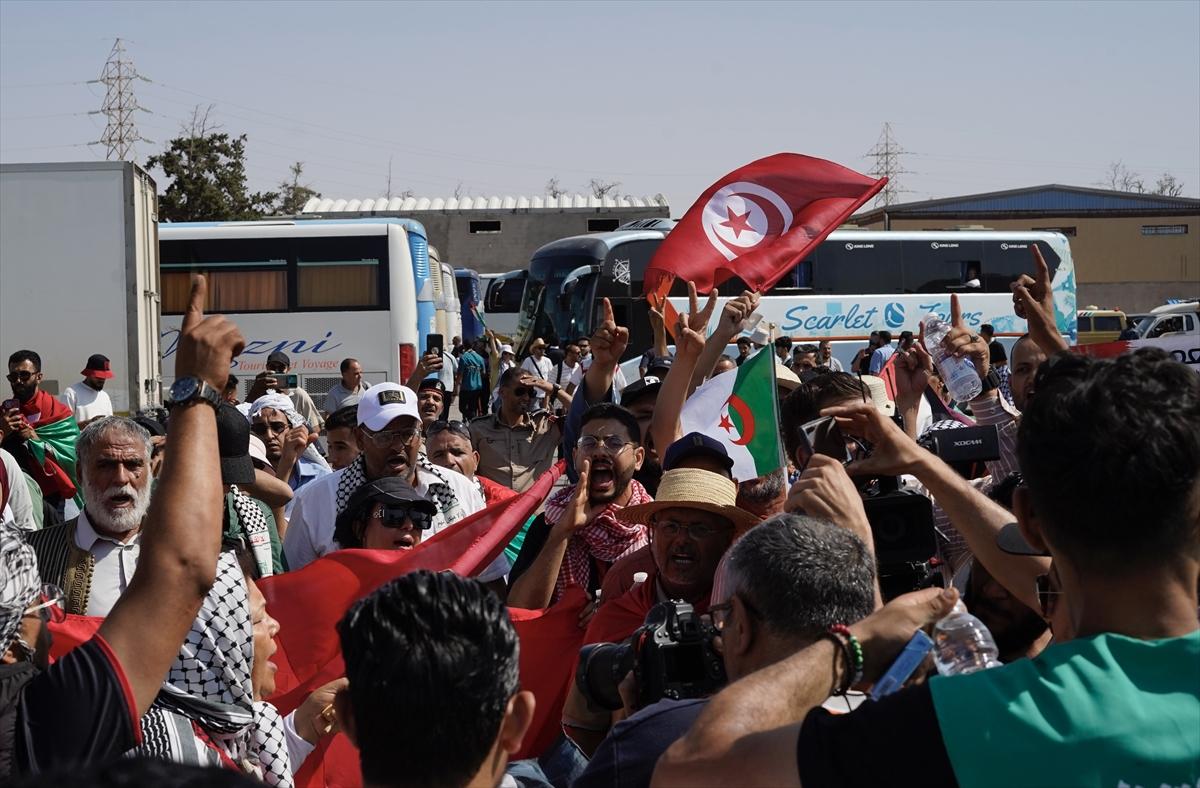
Maghreb Resistance Convoy, 9 June 2025 – (Anadolu Agency)
The Maghreb Resistance Convoy is a multinational civilian initiative launched from Tunisia in June 2025 with the goal of reaching Gaza by land route. Organized by the Solidarity Coordination for Independent Palestine based in Tunisia, the convoy included participants primarily from Tunisia but also from Algeria, Morocco, Mauritania and Libya. The planned route began in Tunisia, passed through Libya into Egypt, and was intended to conclude at the Rafah Border Crossing.
Maghreb Resistance Convoy route – (Anadolu Agency)
The convoy’s objectives include protesting Israel’s blockade of Gaza, delivering humanitarian supplies and drawing international public attention to the humanitarian crisis in the region. Participants are attempting to reach Gaza by land while coordinating their efforts with parallel initiatives organized by sea and air.
The convoy is being carried out as part of a movement supported not only regionally but also globally. Groups from Europe, South America and Southeast Asia have been reported to have organized similar actions with comparable goals. In this context, the Maghreb Resistance Convoy is operating in coordination with other initiatives such as the Global Gaza March, the Freedom Fleet and the Gaza March.
As of 11 June 2025, this land convoy has gained widespread visibility through social media platforms and international media, symbolizing the Maghreb peoples’ call for solidarity under the hashtag #قافلة_الصمود.
The organization of the Maghreb Resistance Convoy is led by the Solidarity Coordination for Independent Palestine based in Tunisia. The organizational structure includes various civil society organizations such as trade unions, professional associations, youth groups and health institutions. Institutions supporting the initiative include the Tunisian General Labour Union, the Tunisian Journalists’ Union, the National Bar Association, the Tunisian Union for the Defense of Human Rights, the Tunisian Forum for Economic and Social Rights, the Tunisian Medical Association and the Association of Young Doctors.

Maghreb Resistance Convoy, 9 June 2025 – (Anadolu Agency)
Participation has been shaped by volunteer applications from diverse segments of the Maghreb countries. A core group of approximately 1,000 individuals formed the initial contingent, with total registrations reaching 7,000. Delegations from Algeria, Tunisia, Libya, Morocco and Mauritania have joined the convoy. Participants include trade unionists, lawyers, doctors, journalists, youth organizations and political figures.
During the preparation phase, participants were planned to join the convoy from various cities. In addition to Tunisia’s capital, participation was organized from cities such as Sousse, Sfax and Gabès. Each country conducted its own logistical preparations, with participants mobilized via buses and private vehicles.
The convoy that departed from Tunisia initially included 12 buses and approximately 100 vehicles. Dr. Muhammad Emin Bennur, spokesperson for the convoy, stated that the number of participants is expected to grow along the route and that activists arriving from different countries via land and air routes into Egypt are anticipated to integrate into the convoy.
Structurally, the convoy has established units for health coordination, media coordination, and logistical support. Health services are carried out by volunteer doctors.
The ultimate objective of the convoy is to reach the Rafah Border Crossing and create a symbolic presence in solidarity with the people of Gaza. A peaceful demonstration is planned for June 15 at the Egyptian side of the Rafah Border Crossing. Activist groups aim to undertake a 50-kilometer march lasting three days from the city of Arish to Rafah.
The land journey of the Maghreb Resistance Convoy began on the morning of June 10, 2025, at 5th Muhammad Street in the capital city of Tunis, Tunisia. By 04:00, hundreds of people gathered for registration and logistical preparations, and the convoy departed at 08:30. Participants converged from various cities across Tunisia. Additional groups from Sousse, Sfax, and Gabès also joined in support of the convoy.

Maghreb Resistance Convoy, June 10, 2025 – (Anadolu Agency)
At the moment of departure, the convoy was farewelled by civilian participation. Participants carried Palestinian and Tunisian flags, creating a visual display of unity. It was announced that the leading group consisted of 12 buses and approximately 100 private vehicles. Vehicles participating in the convoy moved in accordance with pre-determined order and security protocols.
Participation in the main group departing from Tunis was expanded by individual and organized activists arriving from Algeria, Morocco, and Mauritania. Vehicles made scheduled stops along internal routes to pick up additional groups from other cities, resulting in a gradual increase in participation throughout the journey.
During the convoy’s advance, the main route headed south through Tunisia, reaching the Ras Jedir border crossing with Libya via the Ben Gardane region. Throughout the Tunisian stage, various informational briefings were held for participants, detailing the route, border crossing procedures, security measures, and logistical rules. The organizing committee provided written and verbal instructions regarding in-vehicle guidance and coordination protocols to be followed during the crossing.
After reaching Tunisia’s southern border, the convoy completed its preparations for entry into Libya and crossed into Libya through the Ras Jedir border crossing during nighttime hours. It was reported that Tunisian authorities applied all necessary procedures and facilitated the convoy’s passage. With this crossing, the convoy entered the Libyan stage.
Anadolu Ajansı. “Dünyanın Dört Bir Yanından Binlerce Aktivist Küresel Gazze Yürüyüşü İçin Kahire’de Bir Araya Gelecek.” Accessed June 11, 2025. https://www.aa.com.tr/tr/dunya/dunyanin-dort-bir-yanindan-binlerce-aktivist-kuresel-gazze-yuruyusu-icin-kahirede-bir-araya-gelecek/3591978
Anadolu Ajansı. “Gazze’ye Doğru Yola Çıkan Mağrip Direniş Konvoyu Libya’daki İlk Durağı Olan Zaviye Kentine Ulaştı.” Accessed June 11, 2025. https://www.aa.com.tr/tr/dunya/gazze-ye-dogru-yola-cikan-magrib-direnis-konvoyu-libya-daki-ilk-duragi-olan-zaviye-kentine-ulasti/3592821
Anadolu Ajansı. “Tunus’tan Gazze’ye Gitmeyi Planlayan Mağrip Direniş Konvoyu Yola Çıktı.” Accessed June 11, 2025. https://www.aa.com.tr/tr/dunya/tunus-tan-gazze-ye-gitmeyi-planlayan-magrip-direnis-konvoyu-yola-cikti/3592192
Sinar Daily. "Thousands Join Maghreb Resilience Convoy to Gaza, Demanding End to Israeli's Genocide." Accessed June 11, 2025. https://www.sinardaily.my/article/727926/focus/world/thousands-join-maghreb-resilience-convoy-to-gaza-demanding-end-to-israelis-genocide
Watanserb. “Human Flood: Maghreb Solidarity Convoy Sweeps Through Tunisia Toward Gaza.” Watanserb. Accessed June 11, 2025. https://www.watanserb.com/en/2025/06/10/human-flood-maghreb-solidarity-convoy-sweeps-through-tunisia-toward-gaza/
The Maghreb Resistance Convoy arrived at Zawiya, its first stop in Libya, during the evening hours of 10 June 2025. Several Libyan activists joined the convoy at this stop, which consisted of approximately 120 vehicles and 12 buses. After spending a night in Zawiya, the convoy departed early on the morning of 11 June heading toward the capital, Tripoli.

The Maghreb Resistance Convoy departing from Zliten, Libya, toward Misrata, 12 June 2025 – (Anadolu Agency)
Upon news spreading that the convoy would pass through Tripoli, numerous Libyans gathered at Martyrs’ Square to welcome it with Libyan and Palestinian flags. Following this reception, the convoy proceeded toward the town of Tachura, east of Tripoli. Upon arrival in Tachura, the convoy was again welcomed by locals who provided participants with water, fruit juice and lunch. Local residents and activists organized a demonstration following the welcome, expressing solidarity against the Gaza blockade.

The Maghreb Resistance Convoy welcomed with roses in Misrata, Libya, 12 June 2025 – (Anadolu Agency)
On 12 June 2025, the convoy reached its next destination, the city of Misrata. In Misrata, it was greeted in front of the Misrata International Fair Center. During the reception, Libyan and Palestinian flags were carried, roses were presented to some participants, and rose petals were scattered over the convoy vehicles. Banners reading “Welcome to the City of Resistance” and “The People of Misrata Salute the Resistance Convoy” were hung at key locations in the city. Local scout groups carried slogans such as “Freedom for Palestine” and “Stand with Gaza for Justice”.
On the evening of 12 June 2025, the convoy was halted at a checkpoint near the entrance to Sirte. Forces controlling eastern Libya refused to allow the convoy to pass through Sirte. Internet access was completely restricted across an area of approximately 50 kilometers around Sirte, and no food or logistical supplies were permitted to enter.
In a statement issued on 13 June 2025, Maghreb Resistance Convoy spokesperson Wael al-Nawwar stated that the convoy had been stranded near Sirte since the previous night and had received no response regarding passage into eastern Libya. The security forces had confiscated the passports and identity lists of convoy participants. Nawwar emphasized that the convoy would not turn back until it reached Gaza.
Calls have been made for the security cordon around the convoy’s camp to be lifted and for humanitarian needs to be addressed. As of 14 June, the convoy remains stalled at the entrance to Sirte, with negotiations ongoing regarding passage to the east.
Planning for the Maghreb Resistance Convoy’s transit into Egypt proceeded simultaneously while the convoy remained within Libya. The organizing committee began following official procedures to secure land passage into Egypt and coordinated with other groups expected to arrive in Cairo by air. The convoy is planned to proceed toward the Rafah Border Crossing upon reaching the Egyptian border.
In a written statement issued by Egypt’s Ministry of Foreign Affairs on 11 June 2025, it was stated that all visits to the areas near the Gaza border, including Arish and Rafah, would require prior official authorization. The statement emphasized strict compliance with existing administrative regulations and procedures.
Positive statements regarding the convoy were issued by two separate Libyan governments: the Tripoli-based administration of Abdulhamid Dbeibeh and the Benghazi-based government of Usama Hammad. The Dbeibeh administration expressed satisfaction at the warm reception the convoy received from the Libyan people. The Hammad government described the convoy as a “courageous popular initiative” and stressed that the organizers must adhere to the rules set by Egyptian authorities.
As of 14 June 2025, the Maghreb Resistance Convoy continues to wait near the city of Sirte in Libya. Negotiations are ongoing between convoy spokespersons and local authorities in eastern Libya to secure passage eastward. The convoy’s entry into Egypt and advance toward Rafah will depend on the outcome of these negotiations.
Anadolu Ajansı. “Gazzeye İlerleyen Mağrib Direniş Konvoyunun Libya’nın Doğusuna Geçişine İzin Verilmiyor.” Accessed June 14, 2025. https://www.aa.com.tr/tr/dunya/gazzeye-ilerleyen-magrib-direnis-konvoyunun-libyanin-dogusuna-gecisine-izin-verilmiyor/3596845#
Anadolu Ajansı. “Gazze’ye Doğru Yola Çıkan Mağrib Direniş Konvoyu Libya’daki İlk Durağı Olan Zaviye Kentine Ulaştı.” Accessed June 14, 2025. https://www.aa.com.tr/tr/dunya/gazze-ye-dogru-yola-cikan-magrib-direnis-konvoyu-libya-daki-ilk-duragi-olan-zaviye-kentine-ulasti/3592821#
Anadolu Ajansı. “Gazze’ye İlerleyen Mağrib Direniş Konvoyu Libya’nın Misrata Kentinde Güllerle Karşılandı.” Accessed June 14, 2025.
Anadolu Ajansı. “Gazze’ye İlerleyen Mağrib Direniş Konvoyu Libya’nın Tacura Kentine Ulaştı.” Accessed June 14, 2025. https://www.aa.com.tr/tr/dunya/gazze-ye-ilerleyen-magrib-direnis-konvoyu-libyanin-tacura-kentine-ulasti/3594047#
Anadolu Ajansı. “Gazze’ye İlerleyen Mağrib Direniş Konvoyu’nun 2 Gündür Libya’nın Doğusuna Girişine İzin Verilmiyor.” Accessed June 14, 2025. https://www.aa.com.tr/tr/dunya/gazze-ye-ilerleyen-magrib-direnis-konvoyu-nun-2-gundur-libya-nin-dogusuna-girisine-izin-verilmiyor/3597903
On 18 June 2025, the Maghreb Resistance Convoy decided to return to Tunisia after being denied passage into eastern Libya. The decision was announced via the social media account of the "Joint Action Coordination for Palestine." The statement indicated that the convoy departed from the city of Zliten at 08:00 on the morning of 18 June and planned to reach the Ras Jedir Border Crossing via the Tachura and Tripoli route.
The convoy was halted on 12 June at the entrance to the city of Sirte by forces controlling eastern Libya. At this point, access to water, food, and medical supplies was denied, and internet connectivity was restricted. On 15 June, the convoy returned to Misrata and declared that it would not leave Libyan territory until the 15 individuals detained at the Sirte checkpoint were released. It was later reported that the detained individuals had been released.
Anadolu Ajansı. "Libya’nın Doğusuna Girişine İzin Verilmeyen Mağrib Direniş Konvoyu Tunus’a Dönüyor." Accessed June 19, 2025. https://www.aa.com.tr/tr/dunya/libyanin-dogusuna-girisine-izin-verilmeyen-magrib-direnis-konvoyu-tunusa-donuyor/3603157#

The Maghreb Resistance Convoy departed from Tunisia on 10 June 2025 to lift the blockade on Gaza deliver humanitarian aid and demonstrate regional solidarity. The convoy was formed with the participation of thousands of individuals from Algeria Morocco Libya Mauritania and Tunisia. Initially advancing toward southern Tunisia the convoy crossed into Libya through the Ras Jdir border crossing and reached the entrance of the city of Sirte. Due to being denied passage into eastern Libya a decision was made on 18 June to return to Tunisia.
No Discussion Added Yet
Start discussion for "Maghreb Resistance Convoy (2025)" article
June 11, 2025
Definition and Scope
June 11, 2025
Organization and Participation Structure
June 11, 2025
Departure Preparations and Tunisia Stage
June 14, 2025
Libya Stage
June 14, 2025
Security Restrictions at the Entrance to Sirte
June 14, 2025
Preparations for Crossing the Egyptian Border and Official Statements
June 19, 2025
Decision to Return to Tunisia and the Post-Sirte Process