This article was automatically translated from the original Turkish version.
+2 More
Origin(s) | Ottoman State | ||||||||
|---|---|---|---|---|---|---|---|---|---|
Etymology(s) | Persian: mâhiye Arabic: mahyâ | ||||||||
Classic Texts | Welcome Sultan of the Eleven Months, There is no god but Allah, Goodbye | ||||||||
Common Motifs | Rose, Maiden's Tower, Boat, Steamship, Crescent and star | ||||||||
Important Figures | Hattat Hafız Ahmed Kefevî, Abdüllatif Efendi (Süleymaniye), Ali Ceyhan | ||||||||
Modern Material | Electric bulbs, LED lighting | ||||||||
Traditional Material | Olive oil lamps, wicks made from reed fibers, pulley rope systems | ||||||||
First Application | Recorded in 1578 (Schweigger), officially in 1614 (Sultanahmet Camii, Hattat Hafız Ahmed Kefevî) | ||||||||
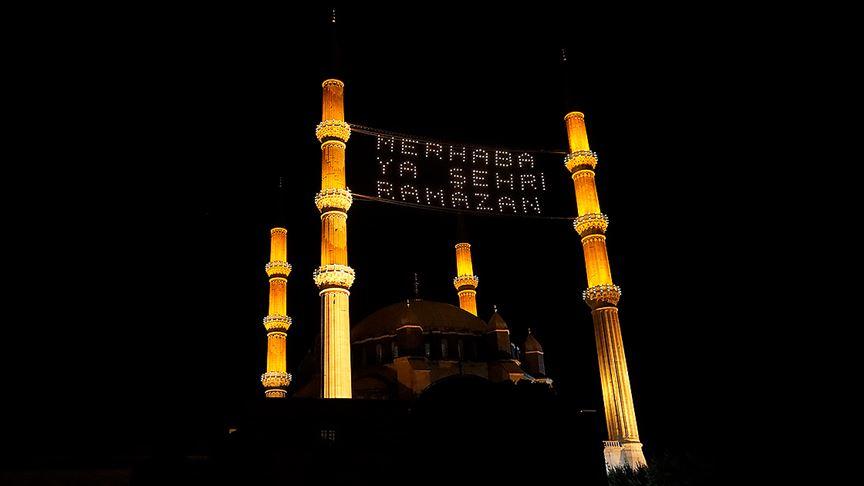
Mahya is a decorative art form consisting of illuminated texts and figures suspended on ropes stretched between two minarets of mosques with multiple minarets, particularly during the month of Ramadan and sacred nights. Traditionally lit by oil lamps, today these displays use electric bulbs. Etymologically derived from the Persian word "mâhiye," meaning "monthly" or "specific to the moon," this art serves as a traditional medium of communication, publicly expressing the collective joy, sorrow, and messages of the community through light.
The tradition of illuminating mosques with oil lamps during sacred nights and days extends back to the early centuries of Islam, with practices documented in the Masjid al-Haram. Although the historian Fâkihî recorded in the 9th century that lamps in Mecca were hung from ropes stretched between poles, it was the Ottomans who elevated this practice into an artistic dimension by placing them between minarets. The earliest known references to mahya in Istanbul appear in the records of the German traveler Schweigger, who visited in 1578.【1】 Its formal adoption dates to an order issued by Sultan Murad III in 1588, instructing the decoration of minarets during the Mevlid Kandili. According to one account, the design of a two-minaret mahya by calligrapher Hafız Ahmed Kefevî was highly admired by Sultan Ahmed I, and its installation on the Sultanahmet Camii in 1614 granted the tradition official recognition. In 1722, under the orders of Nevşehirli Damat İbrahim Paşa, this art was widely extended to all imperial mosques, even prompting the special elevation of minarets of structures like the Eyüp Camii, which originally had short minarets.
Mahya (TRT Arşiv)
There are two main theories regarding the origin of the word "mahya." The first holds that it derives from the Persian word "mâh" (moon) combined with the Arabic suffix "-iyye," forming the Ottoman Turkish "mâhiyye," meaning "monthly" or "specific to the moon," reflecting the practice’s exclusive association with the month of Ramadan. The second theory suggests the term originates from the Arabic word "mahyâ," used for gatherings where blessings and prayers were offered upon the Prophet. The custom of illuminating mosques with lamps during sacred nights known as "leyletü’l-mahyâ" contributed to the word’s association with this specific meaning.【2】
The installation of mahya is the product of an elaborate process requiring a full year of preparation. Preparations begin with the arrival of the three holy months, during which the text and patterns to be displayed are decided. The mahya master would draw a small-scale model of the intended design on green or red satin using pearls sent from the palace and submit it for approval. During implementation, a scaled model was drawn on squared paper, representing the rope stretched between the two minarets, with precise millimeter measurements calculated for the placement of lamps and the length of vertical ropes.
In the classical period, preparing lamps and wicks involved great effort. Approximately 10,000 wicks were needed for a single Ramadan, crafted from the fibers of reeds growing along riverbanks. With a maximum daily output of 300 wicks, the process lasted for months. Each evening, between 400 and 500 lamps, filled with about 5 okka of olive oil, were hoisted into the sky using a pulley system.【3】 Despite the invention of electricity, oil lamps continued to be used for some time due to aesthetic preferences; today, the practice has been fully transitioned to bulb and LED systems.

Ramazanın simgesi "Mahya" (Anadolu Ajansı)
In traditional mahyas, the sülüs script was most commonly used; at the beginning of Ramadan, phrases such as "Welcome, Sultan of the Eleven Months" were displayed, while at its end, farewells like "Goodbye" were featured. Alongside text, floral motifs (rose, tulip, pipe flower), city symbols (Kız Kulesi, ferry, bridge), and religious-heroic emblems (Zülfikar, crescent and star, bow and arrow) were employed. The pinnacle of mahya art was achieved in the 19th century with a moving mahya installed by Abdüllatif Efendi on the Süleymaniye Camii. This three-panel system featured moving cars passing over a fixed bridge image, while below, fish and boats were animated to create a living landscape in the sky.
Known in mahya history as "gezdirme mahya," this advanced technique is most famously represented by Abdüllatif Efendi, the renowned chief mahya master of the Süleymaniye Camii. In these installations, alongside the main rope, auxiliary ropes and pulley systems called "bocurgat" were installed between the mosque minarets. Lamps were enclosed in round wooden boxes to protect them from wind and damage. In the three-panel design, the lowest level typically featured animated fish figures symbolizing the sea, the middle level displayed a static scene of iconic structures such as the Unkapanı Bridge or Azapkapı Camii, and the upper level showed car figures representing road movement. Through precise rhythmic control by the mahya master, the figures on the top and bottom panels moved back and forth between the minarets, creating a dynamic mechanical tableau.
Mahya craftsmanship was not merely a technical skill but a profession passed down from father to son, requiring serious merit and training. In the Ottoman period, becoming a mahya master was not easy; candidates had to demonstrate their competence before a jury composed of other mahya masters and prominent city figures at the Şûrâ-yı Evkaf. During Ramadan, mahya masters worked intensively, spending the rest of the year in rooms allocated to them at the sıbyan mektebi in Fatih, training apprentices.【4】 Figures such as Abdüllatif Efendi, the famous mahya master of the Süleymaniye Camii, transformed the craft into a fusion of engineering and art through their moving panels. In 1931, twenty-three mahya masters active in Istanbul were recorded as the last representatives of this tradition.
Mahyas have served as a mirror of social memory and solidarity from the Ottoman era to the Republic. During World War I, they conveyed messages such as "Do Not Forget the Hilâl-i Ahmer (Red Crescent)" and "Aid the Migrants," addressing social needs; after the War of Independence, expressions like "Long Live Independence" and "Long Live Our Martyr" shared national joy. After the script reform, mahyas written in Latin letters such as "Avoid Waste," "Buy Domestic Products," and "Alcohol Is an Enemy of the Family" transformed mosque minarets into open-air educational billboards. Mahyas bearing messages such as "Welcome" were not only displayed during Ramadan but also on special occasions such as the sultan’s return from travels, visits by foreign dignitaries, or Atatürk’s arrival in Istanbul, demonstrating the tradition’s advanced role in urban culture and public education.
Anadolu Ajansı. "Camilerin gerdanlığı: 'mahya'." Accessed February 13, 2026. https://www.aa.com.tr/tr/yasam/camilerin-gerdanligi-mahya/148241
Anadolu Ajansı. "Osmanlı geleneği mahyalar, ramazana hazırlanıyor." Accessed February 13, 2026.
Anadolu Ajansı. "Ramazanın simgesi 'Mahya'." Accessed February 13, 2026. https://www.aa.com.tr/tr/pg/foto-galeri/ramazanin-simgesi-quot-mahyaquot-
Anadolu Ajansı. "İstanbul'daki camiler mahyalarla süsleniyor." Accessed February 13, 2026. https://www.aa.com.tr/tr/kultur/istanbuldaki-camiler-mahyalarla-susleniyor/3492634
Bozkurt, Nebi. "MAHYÂ." *TDV İslam Ansiklopedisi*. Accessed February 13, 2026. https://islamansiklopedisi.org.tr/mahya--salavat-meclisi
Bozkurt, Nebi. "Mahya" *TDV İslam Ansiklopedisi*. Accessed February 13, 2026. https://islamansiklopedisi.org.tr/mahya--ramazan
Kemerkaya, Nazlı. "Mahya" KÜRE Ansiklopedi. Accessed February 13, 2026. https://kureansiklopedi.com/tr/detay/mahya-1469e
Kültür İstanbul. "İstanbul’da asırlık bir Ramazan geleneği: Mahya." Kültür İstanbul. Accessed February 13, 2026. https://kultur.istanbul/istanbulda-asirlik-bir-ramazan-gelenegi-mahya/
TRT Arşiv. "Mahya." YouTube Video. Date Published: April 30, 2020. Accessed February 13, 2026. https://www.youtube.com/watch?v=sR7kqN72CJ0
[1]
Nebi Bozkurt, "Mahya" TDV İslam Ansiklopedisi, Erişim 13 Şubat 2026, https://islamansiklopedisi.org.tr/mahya--ramazan
[2]
Nebi Bozkurt, "Mahya" TDV İslam Ansiklopedisi, Erişim 13 Şubat 2026, https://islamansiklopedisi.org.tr/mahya--ramazan
[3]
Kültür İstanbul, "İstanbul’da asırlık bir Ramazan geleneği: Mahya." Kültür İstanbul, Erişim 13 Şubat 2026, https://kultur.istanbul/istanbulda-asirlik-bir-ramazan-gelenegi-mahya/
[4]
Nebi Bozkurt, "Mahya" TDV İslam Ansiklopedisi, Erişim 13 Şubat 2026, https://islamansiklopedisi.org.tr/mahya--ramazan
Origin(s) | Ottoman State | ||||||||
|---|---|---|---|---|---|---|---|---|---|
Etymology(s) | Persian: mâhiye Arabic: mahyâ | ||||||||
Classic Texts | Welcome Sultan of the Eleven Months, There is no god but Allah, Goodbye | ||||||||
Common Motifs | Rose, Maiden's Tower, Boat, Steamship, Crescent and star | ||||||||
Important Figures | Hattat Hafız Ahmed Kefevî, Abdüllatif Efendi (Süleymaniye), Ali Ceyhan | ||||||||
Modern Material | Electric bulbs, LED lighting | ||||||||
Traditional Material | Olive oil lamps, wicks made from reed fibers, pulley rope systems | ||||||||
First Application | Recorded in 1578 (Schweigger), officially in 1614 (Sultanahmet Camii, Hattat Hafız Ahmed Kefevî) | ||||||||
Historical Development
Origin and Etymology
Technical Preparation and Implementation Process
Themes, Motifs, and Moving Mahyas
Three-Panel and Moving Mahyas
The Mahya Craft and Its Masters
Social Message and Role in Solidarity