This article was automatically translated from the original Turkish version.
+2 More
Registration Number | 1181 | ||||||||
|---|---|---|---|---|---|---|---|---|---|
Registration Date | 27.07.2022 | ||||||||
Application Number | C2022/000006 | ||||||||
Application Date | 07.01.2022 | ||||||||
Name of the Geographical Indication | Malatya Pöçüklü Lahana Sarması / Malatya Nahna Küftesi | ||||||||
Product / Product Group(s) | Food / Foods and Soups | ||||||||
Type of Geographical Indication | Mahreç Sign | ||||||||
Applicant/Registrant(s) | Malatya Metropolitan Municipality | ||||||||
Address of the Registrant | İnönü Mah. İnönü Cad. No 18 Yeşilyurt MALATYA | ||||||||
Geographical Boundary | Malatya Province | ||||||||
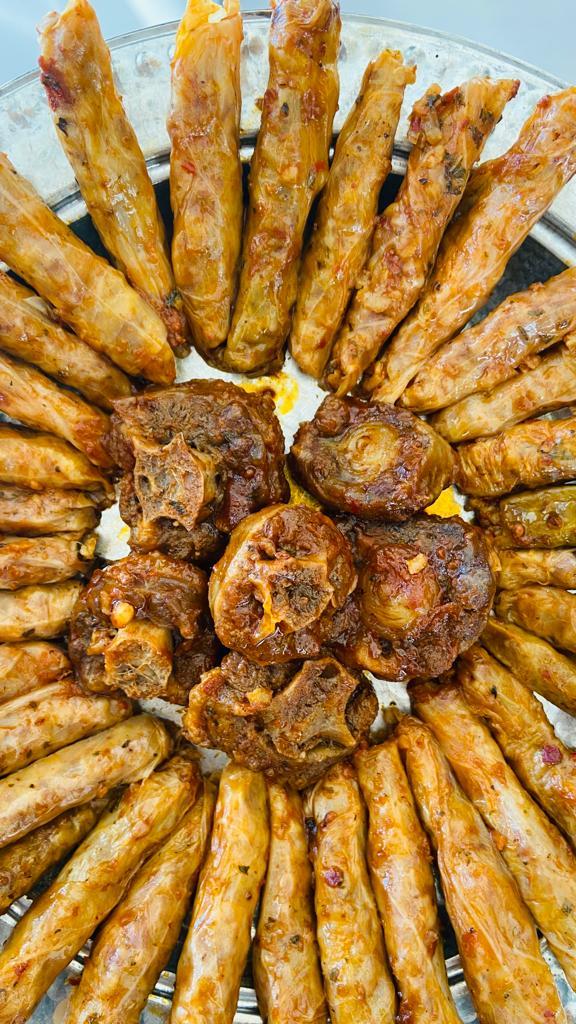
Malatya pöçüklü lahana sarması / Malatya nahna küftesi is a traditional dish specific to the province of Malatya, officially registered with a geographical indication. It is prepared by wrapping a filling made of minced meat with fat, coarse bulgur, dried onion, tomato paste, salt, black pepper, basil, red pepper flakes, and parsley inside blanched white cabbage leaves. The stuffed leaves are layered in a pot with sautéed onion and tomato paste mixture, then cooked with added diced tail meat from a calf. Once cooking is complete, the dish is served by inverting the pot onto a serving tray, with the bone-in calf tail meat arranged on top and sprinkled with black pepper while still hot.
Malatya pöçüklü lahana sarması / Malatya nahna küftesi is a dish prepared by wrapping a filling inside blanched cabbage leaves, cooking it with a mixture of onion and tomato paste sautéed in butter, and topping it with cooked bone-in calf tail meat. The serving method is distinctive: the pot in which the stuffed leaves were cooked is inverted onto a serving tray. The bone-in calf tail meat is then placed on top of the inverted sarmas, sprinkled with black pepper, and served hot.
The dish has acquired a unique place within Malatya’s culinary culture due to its use of calf tail meat (the posterior portion of the calf) and cabbage leaves. The product is tied to a specific geographical area and has historical roots dating back to antiquity.
The following ingredients are used in the preparation of Malatya pöçüklü lahana sarması / Malatya nahna küftesi:
The white cabbage leaves are separated one by one from the top and washed. They are blanched in boiling water for 1–2 minutes, then transferred to a bowl of cold water, gently squeezed to remove excess water, and cut into strips 8–10 cm in length. The leaves are placed on a colander to drain. The thick veins of the cabbage leaves are separated and arranged at the bottom of the pot in which the dish will be cooked.
500 g of dried onion is sliced into rings and sautéed in 100 g of butter for 5 minutes. Then, 40 g of tomato paste is added, mixed well, and the mixture is removed from heat.
In a bowl, combine 500 g minced meat with fat, 250 g dried onion, 400 g coarse bulgur, salt, black pepper, basil, red pepper flakes, finely chopped parsley, 40 g tomato paste, and 200 ml water. Knead the mixture for approximately 30 minutes until it reaches a firm but not overly soft consistency.
The cabbage veins are arranged at the bottom of the pot. Each cabbage leaf is laid flat. Walnut-sized portions of the filling are taken, rolled into finger-shaped cylinders between the palms, and placed on the leaf. The leaf is folded twice so that both ends remain open, then wrapped around the filling. The stuffed leaves are gently compressed in the palm to leave finger impressions on the surface and arranged in the pot. After each layer is completed, the sautéed onion and tomato paste mixture is sprinkled on top. Once all layers are assembled, an additional layer of the sautéed mixture is added to the top. The pot is covered with a lid to create pressure and prevent the sarmas from unraveling during cooking.
The calf tail meat consists of segments connected along the spine. The meat is cut into disc-shaped pieces at the joints, washed, and placed in a pot. After boiling for 5 minutes, 100 g of butter, 40 g of tomato paste, salt, and 2 litres of hot water are added, and the meat is simmered for 2 hours. The cooking liquid is strained and poured over the sarmas in the pot. The bone-in calf tail meat is then arranged on top of the sarmas. The total cooking time is 1.5 hours, starting with high heat and then reducing to low heat. After cooking, the dish is left to rest for 10 minutes. The bone-in meat is removed, the pot is inverted onto a serving tray, and the sarmas are transferred onto the tray. The bone-in calf tail meat is placed back on top, sprinkled with black pepper, and served hot.
Malatya pöçüklü lahana sarması / Malatya nahna küftesi must be produced within the boundaries of Malatya Province. This dish holds a deep-rooted position in Malatya’s culinary culture and is subject to geographical indication registration. The product’s reputation and distinctive qualities are directly linked to its geographical origin. Therefore, all stages of production must occur exclusively within the defined geographical boundaries.
The production processes of Malatya pöçüklü lahana sarması / Malatya nahna küftesi are monitored by a three-member oversight body coordinated by the Malatya Metropolitan Municipality, comprising representatives from the Malatya Provincial Directorate of Culture and Tourism, the Malatya Provincial Coordination Office of the Agricultural and Rural Development Support Institution, and one expert appointed by the Malatya Metropolitan Municipality. Monitoring inspections are conducted at least once annually and may also be carried out at any time if deemed necessary or upon complaint. During inspections, the quantity and quality of ingredients used, compliance with production methods, and the correct use of the geographical indication emblem “Malatya pöçüklü lahana sarması / Malatya nahna küftesi” are reviewed. The oversight body may utilize experts from public or private institutions or procure services from them as needed. The registering institution holds the authority to pursue legal procedures for the protection of these rights.
Turk Patent and Trademark Office. "Malatya Pöçüklü Lahana Sarması / Malatya Nahna Küftesi." Accessed July 13, 2025. https://ci.turkpatent.gov.tr/Files/GeographicalSigns/fdbde648-a0cc-448a-9908-23d225ab1a70.pdf.
Turkish Patent and Trademark Office. "Malatya Pöçüklü Lahana Sarması / Malatya Nahna Küftesi." Accessed July 13, 2025. https://ci.turkpatent.gov.tr/cografi-isaretler/detay/5925.

Registration Number | 1181 | ||||||||
|---|---|---|---|---|---|---|---|---|---|
Registration Date | 27.07.2022 | ||||||||
Application Number | C2022/000006 | ||||||||
Application Date | 07.01.2022 | ||||||||
Name of the Geographical Indication | Malatya Pöçüklü Lahana Sarması / Malatya Nahna Küftesi | ||||||||
Product / Product Group(s) | Food / Foods and Soups | ||||||||
Type of Geographical Indication | Mahreç Sign | ||||||||
Applicant/Registrant(s) | Malatya Metropolitan Municipality | ||||||||
Address of the Registrant | İnönü Mah. İnönü Cad. No 18 Yeşilyurt MALATYA | ||||||||
Geographical Boundary | Malatya Province | ||||||||
No Discussion Added Yet
Start discussion for "Malatya Pöçüklü Lahana Sarması / Malatya Nahna Küftesi" article
Characteristics
Ingredients (for 10 servings)
Recipe / Production Method
Preparation of Cabbage Leaves
Preparation of Onion Mixture
Preparation of Filling
Stuffing Process
Preparation of Calf Tail Meat
Production Area and Geographical Link
Monitoring